Networks Symposium Papers

June 6-7, 2019
 
Papers for "Networks: The Creation and Circulation of Knowledge from Franklin to Facebook" can be found below.  You will be required to enter a password provided by conference organizers to access them. Please contact the APS at [email protected] if you are attending the conference but have not yet received the password.


Papers are not to be cited or circulated without the written permission of the author


9:30-10:45am Panel 1: Social Networks

“Science, Skepticism, and Societies: the Politics of Knowledge Creation in the Early Republic”
George Oberle, George Mason University

“Who You Know: How Social and Educational Networks Fostered Professional Identity Among American Doctors, 1780-1815”
Sarah Naramore, The University of the South

“Benjamin Smith Barton's Natural History Network: Local Knowledge and Atlantic Community”
Peter Messer, Mississippi State University

“Planting the Seeds of Empire: Botanical Gardens and Correspondence Networks in Antebellum America”
Alicia DeMaio, Harvard University

Comment: Andrew Shankman, Rutgers University, Camden


11:15-12:15pm Panel 2: Reconstructing Networks

“Spatial Expansion and State Power in the Nineteenth-Century United States”
Cameron Blevins, Northeastern University

“Intertribal Networks in the Colonized American West, 1870-1895”
Justin Gage, University of Arkansas

“Mapping the Networks of African North Americans Hidden in U.S. Government Records: Cases from Pension Files and the Census”
Adam Arenson, Manhattan College

Comment: Maeve Kane, SUNY Albany


2:15-3:15pm Panel 4: Reproducing Networks

“Plagiarism as Dialogue: The Loyalist Historians as Transatlantic Mediators”
Eileen Cheng, Sarah Lawrence College

“Before the Truth Puts its Boots on: Mis-Information Networks in 19th Century America”
Robert MacDougall, University of Western Ontario

“Worlds of Wonder: Tracing Reproductions of Microscopy Illustrations in the Nineteenth Century”
Lea Beiermann, Maastricht University

Comment: Richard John, Columbia University


3:30-4:45pm Panel 5: Networks and Nodes

“From Brussels to Europe: Building a Big Data Set in the Nineteenth Century”
Kevin Donnelly, Alvernia University

“Visualizing 19th and 20th Century Women in Science”
Serenity Sutherland, SUNY Oswego

“The Cybernetic Effect: Soviet Mind Research in the 1960s and 70s”
Ekaterina Babintseva, University of Pennsylvania

“Organizations and Knowledge Networks”
Janet Vertesi, Princeton University

Comment: Robert M. Hauser, Executive Officer, American Philosophical Society
APS version.pdf (858470 B)

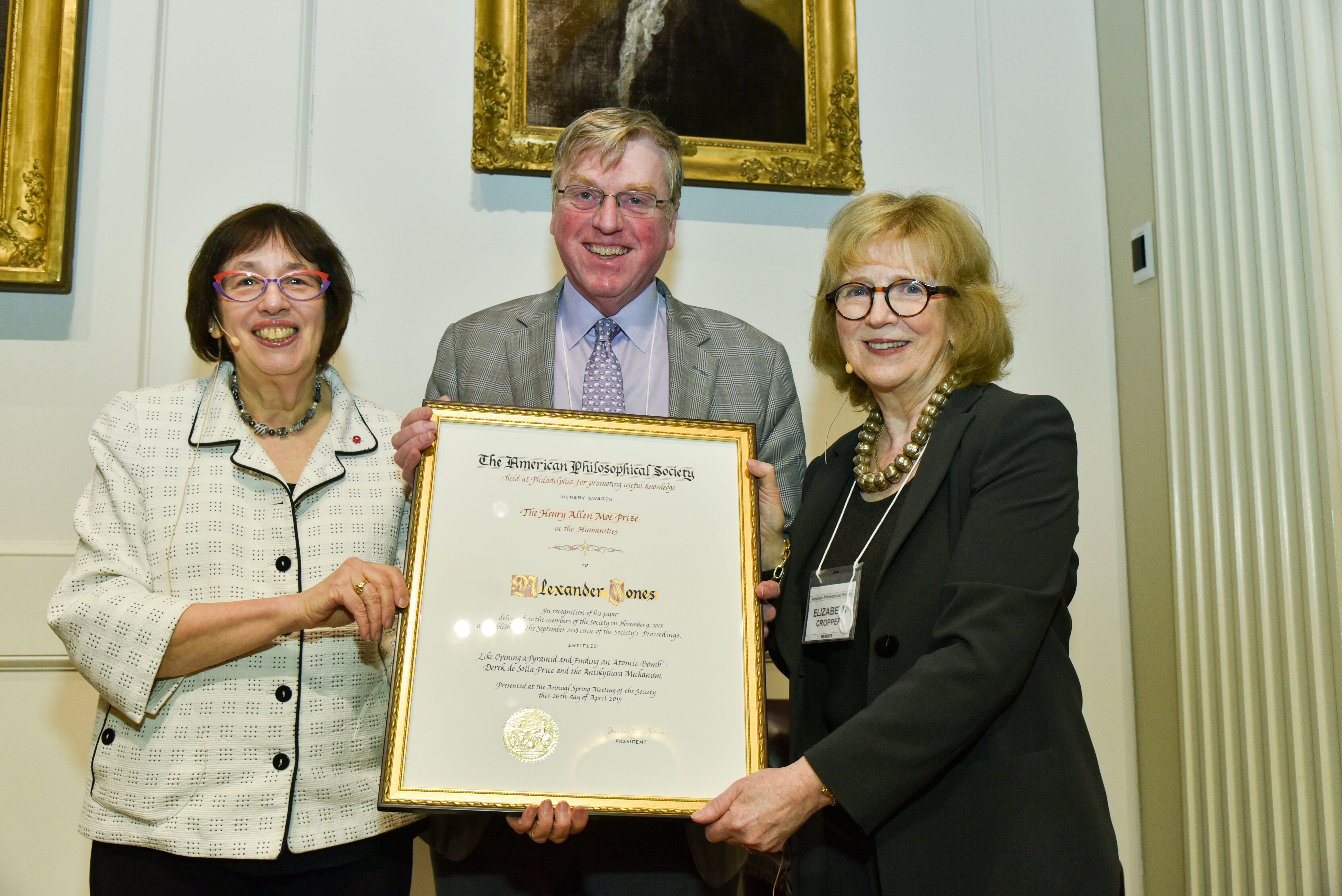
2019 Henry Allen Moe Prize

The recipient selected for the 2019 Henry Allen Moe Prize in the Humanities is Alexander Jones, Professor of History of the Exact Sciences in Antiquity and Leon Levy Director of the Institute for the Study of the Ancient World, New York University, in recognition of his paper “‘Like Opening a Pyramid and Finding an Atomic Bomb’: Derek de Solla Price and the Antikythera Mechanism” read at the American Philosophical Society’s 2017 November Meeting and published in its Proceedings Volume 162, Number 3, September 2018. The award was presented April 26, 2019 at the Society's Spring 2019 Meeting.
    
Alexander Jones recounts advances in the understanding of an obscure archaeological artifact as a series of discoveries and near-misses that began with a grant to Derek de Solla Price from the American Philosophical Society in 1958. As Jones puts it, his essay is, in a sense, a review of an American Philosophical Society research grant and its outcomes. In part a historical detective story about the most important fine machinery to survive from Antiquity, in part a history of scientific inquiry and the role of new technologies, Jones’s essay renders comprehensible the complexity of piecing together this ancient artifact. 
 
Small pieces of corroded metal were salvaged from a Hellenistic shipwreck off the island of Antikythera in 1900–1901. Identified as parts of a Mechanism, they attracted little attention until Price traveled to Athens. Close examination suggested that the Mechanism was not an Archimedean planetarium, as thought, but a mechanical representation of the ancient Babylonian arithmetical approach to mathematical astronomy.

Price’s popular publication in Scientific American in 1959 diverted him from contributing to the 1965 Transactions dedicated to the Antikythera shipwreck, but his crucial conclusions appeared in the Transactions in 1974. Jones shows how such new techniques as microfocus X-ray computed tomography and reflectance transformation imaging have made it possible to improve Price’s reconstruction. The Mechanism was not a “calendar computer” or an atomic bomb in a pyramid, but a sophisticated instrument that displayed the synodic cycles of the planets. Price lacked adequate radiography, and failed to recognize that the dials consisted of spirals, not concentric circles. But his successors would untangle the meaning of the Mechanism that Price had done so much to explain based on his original APS grant. 

The prize was established in 1982 by a gift from the widow of Henry Allen Moe, to honor the longtime head of the Guggenheim Foundation and president of the American Philosophical Society from 1959 to 1970. It pays particular tribute to his firm commitment to the humanities and those who pursue them.  The prize is awarded annually to the author of a paper in the humanities or jurisprudence read at a meeting of the Society.  

Members of the selection committee were Elizabeth Cropper (chair), Dean, Center for Advanced Study in the Visual Arts, National Gallery of Art; Michael McCormick, Goelet Professor of Medieval History, Harvard University; Brent Shaw, Andrew Fleming West Professor of Classics, Princeton University.

Alexander Jones receives the Moe Prize

2018 Franklin Medal

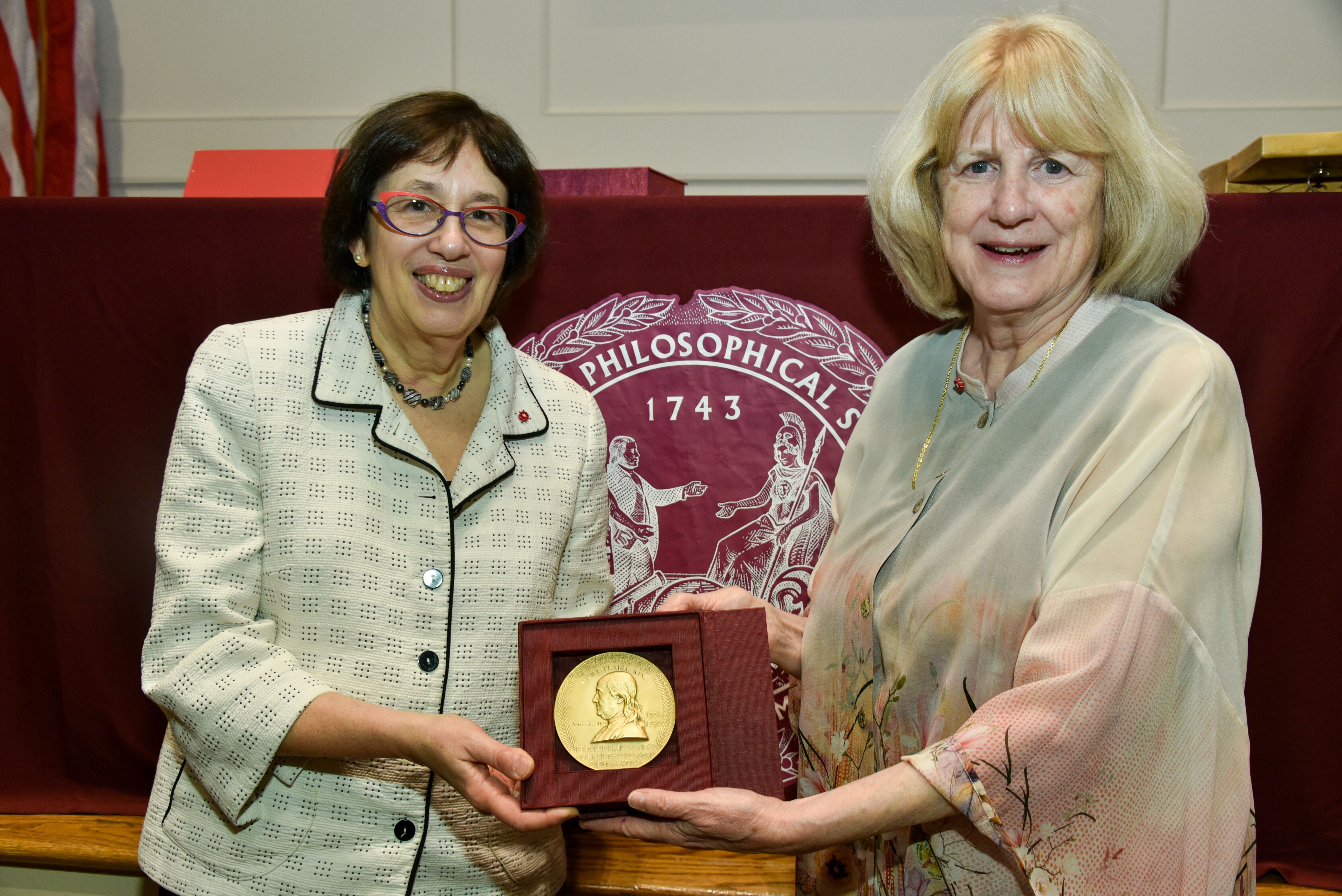
The recipient of the Society’s 2018 Benjamin Franklin Medal for Distinguished Achievement in Science is Mary-Claire King, American Cancer Society Professor in the Department of Medicine and the Department of Genome Sciences at the University of Washington in Seattle.  The medal was presented on April 26, 2019 at the Society's Spring 2019 meeting. Her diverse works have included the demonstration that humans and chimpanzees are 99% genetically identical.  She also is recognized for the use of genomic sequencing to identify victims of human rights abuse in identifying children stolen from their families and illegally adopted under the military dictatorship in Argentina.  She is best known for her pioneering work in identifying a single gene, BRCA1, as a cause of inherited breast and ovarian cancer.  Her meticulous and landmark studies empowered women to be tested for deleterious genes that predispose them to breast and/or ovarian cancer and thus providing options for prophylactic surgeries or earlier and more frequent screening.  

Her exemplary research has been recognized with numerous awards, including the Brinker award from the Komen Foundation in 1999, Lasker Award in 2014, and National Medal of Science in 2015.  She was elected a member of the American Philosophical Society in 2012.  

In 1906 Congress authorized the medal to commemorate the 200th anniversary of Franklin’s birth.  President Roosevelt directed that the 1st one go to the Republic of France.  50 copies were given to the American Philosophical Society for its use.  The Society has chosen to be to be parsimonious in their distribution.  For three decades only one was given and that was to Marie Curie in 1921.  Since 1937 they have been awarded more liberally but still quite selectively, for major contributions in the sciences, humanities or public service.  It was decided to present the medal as part of the celebration of the American Philosophical Society’s 275th anniversary 

The members of the selection committee are APS president Linda Greenhouse (chair), Council members representing Classes 1 and 2 Warren M. Washington, Stephen J. Benkovic, Lawrence H. Einhorn, Philip D. Gingerich, Nina G. Jablonski, and executive officer Robert M. Hauser.

Mary-Claire King and Linda Greenhouse hold Franklin Medal

2017 John Frederick Lewis Award

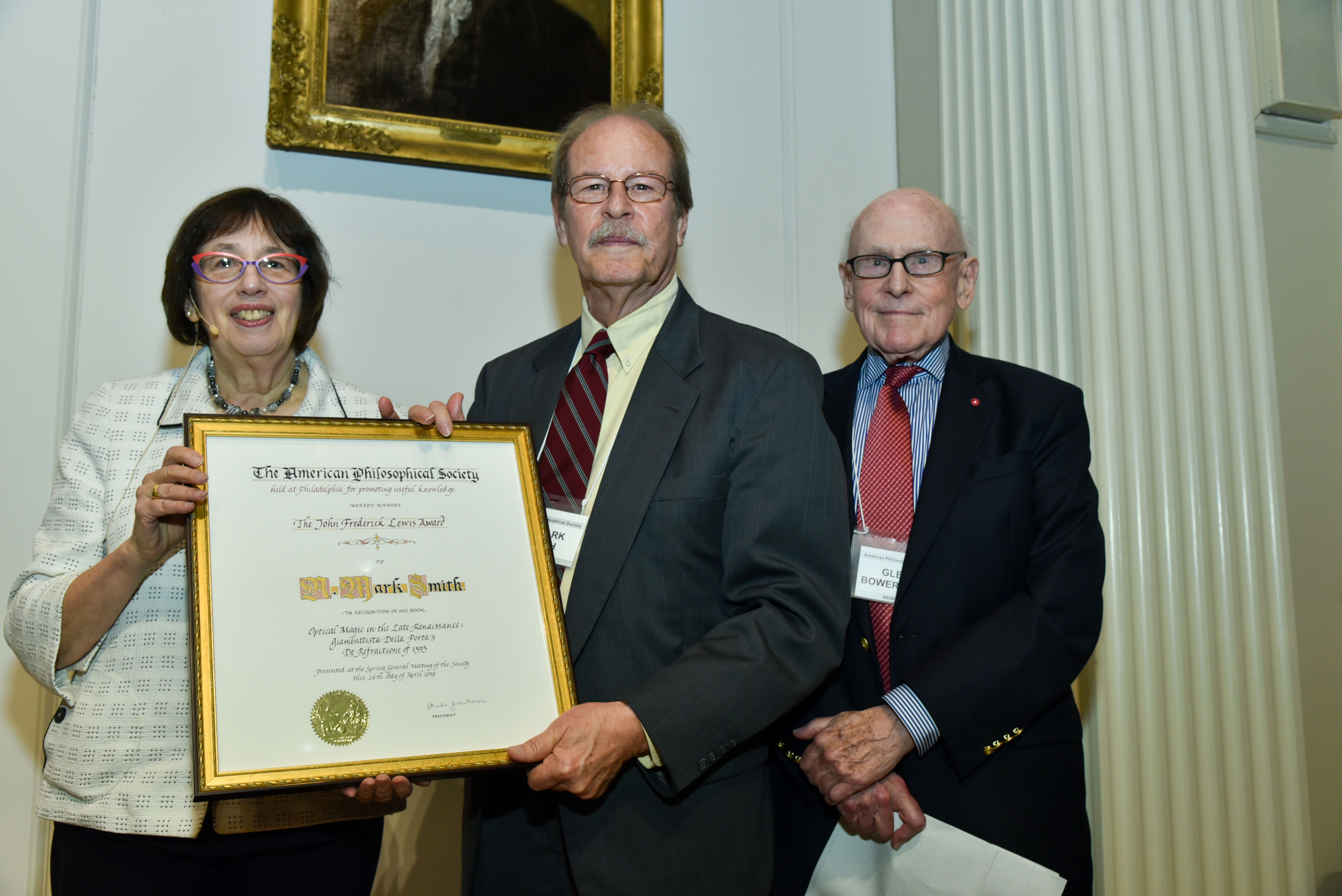
The recipient for the 2017 John Frederick Lewis Award is A. Mark Smith in recognition of his book Optical Magic in the Late Renaissance: Giambattista Della Porta’s 'De Refractione' of 1593. The award was presented April 26, 2019 at the Society Spring 2019 meeting.

Mark Smith presents a “critical English translation” of Giambattista Della Porta’s De Refractione (1593). Offering a general introduction that deals with both the treatise’s historical  context and its technical aspects, Dr. Smith gives readers an account of Della Porta’s life and works, a discussion of the genesis of De Refractione, a close examination of his account of visual illusions and their environmental or pathological causes, and a study of the historical significance of Della Porta’s account of light and sight within the broader context of natural philosophy as it evolved in the late sixteenth and early seventeenth centuries. Following the Introduction is a “modernized” transcription of the original Latin text and the English translation of the transcription. The transcription provided by Dr. Smith is important because the printed original is incredibly disordered and maladroit. Not only does it abound in textual errors, some of them significant, but the accompanying diagrams are often so poorly executed as to be misleading. 

Mark Smith is Curators’ Distinguished Professor at the University of Missouri. He teaches a variety of courses in medieval history as well as the history of science from antiquity to the late Enlightenment. His interests lie in the field of intellectual history from the pre-Socratics to the Enlightenment, his scholarly focus being on the evolution of pre-Newtonian theories of visual perception. His earlier publications with the American Philosophical Society include Ptolemy’s Theory of Visual Perception: An English Translation of the Optics with Introduction and Commentary (1996), Ptolemy and the Foundations of Ancient Mathematical Optics: A Source Based Study Guide (1999), and a seven-volume collection of books on Alhacen’s Optics (2001-2010). Dr. Smith received the Lewis Award in 2001 for Alhacen’s Theory of Visual Perception (Volume 1) and in 2010 Alhacen on Refraction (Volume 7).

In 1935 the Society established the John Frederick Lewis Award with funds donated by his widow.  The award recognizes the best book or monograph published by the Society in a given year.  Members of the selection committee were Glen W. Bowersock (chair), Professor Emeritus of Ancient History, Institute for Advanced Study; Julia Haig Gaisser, Professor Emeritus of Latin, Eugenia Chase Guild Professor Emeritus in the Humanities, Bryn Mawr College; and Noel M. Swerdlow, Professor Emeritus of Astronomy and Astrophysics and of History, University of Chicago.

A. Mark Smith receives Lewis Award

2018 Magellanic Premium Medal


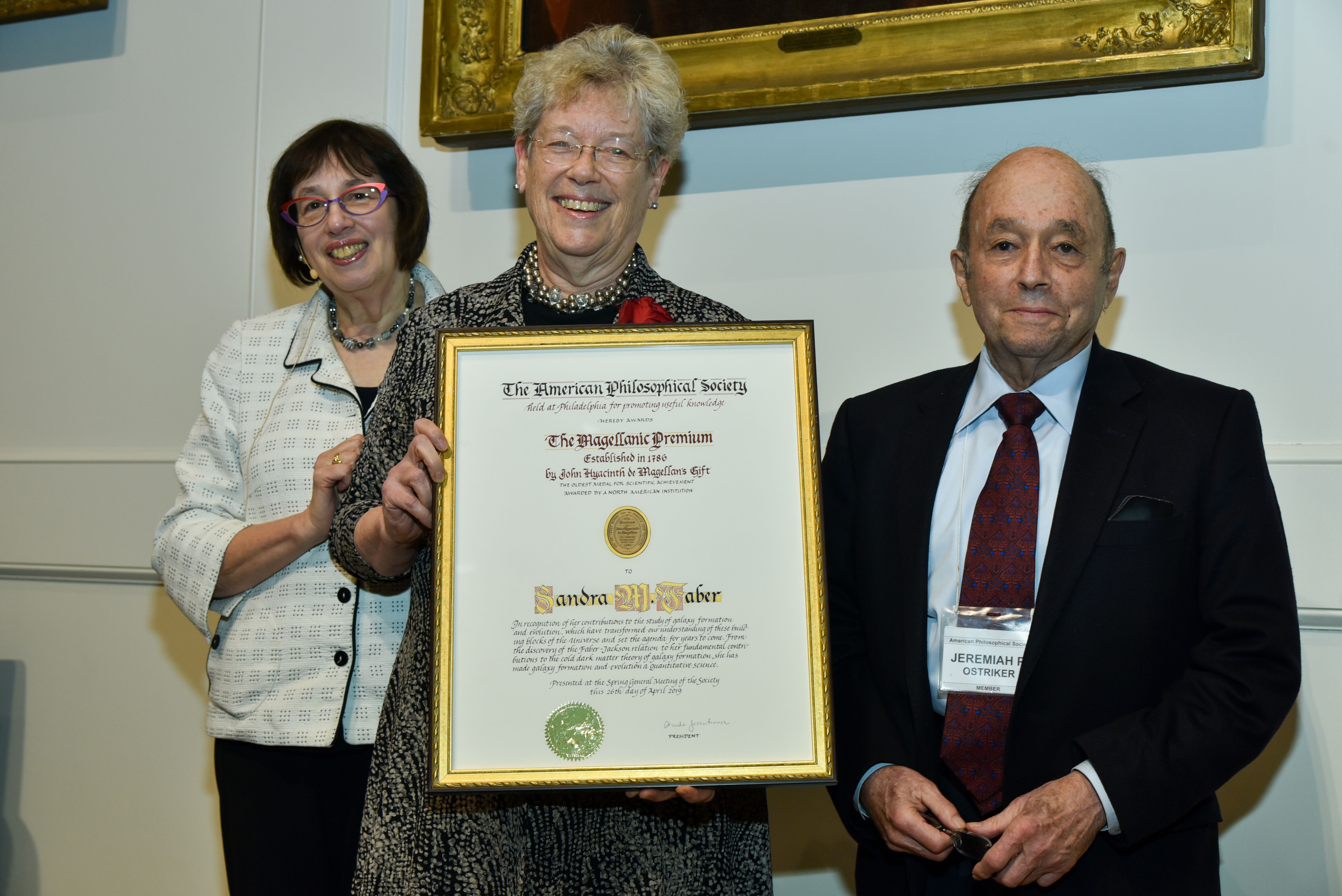
The 2018 Magellanic Premium medal was awarded to Sandra Faber “for her contributions to the study of galaxy formation and evolution, which have transformed our understanding of these building blocks of the Universe and set the agenda for years to come.  From the discovery of the Faber-Jackson relation to her fundamental contributions to the cold dark matter theory of galaxy formation, she has made galaxy formation and evolution a quantitative science.”  The medal was presented on April 26, 2019, at the Society's Spring 2019 meeting.  The inscription engraved on the medal is “Sandra Faber, for transforming the understanding of galaxy formation and evolution.”

Sandra Faber has been one of the leading optical astronomers since the 1970s whose contributions changed the study of galaxies from a qualitative to a quantitative science. Her observations and analysis showed the quantitative relations among mass, size, velocity dispersion, stellar populations and resident black holes in the massive elliptical galaxies that are the bedrock of extragalactic astronomy.  Among the earliest observers to recognize the prevalence and importance of dark matter, she also was among the earliest to note how feedback from supernova winds would alter the evolution of galaxies. Her numerous prescient contributions form the basis on which modern understanding of galaxy evolution now stands.  

Faber is professor emerita at the University of California, Santa Cruz, and astronomer emerita at University of California Observatories.  She has been recognized by many prizes including the National Medal of Science in 2013.  She was elected a member of the American Philosophical Society in 2001.

The award was established from a gift of 200 guineas by John Hyacinth de Magellan, of London, in 1786, “for a gold medal to be awarded from time to time under prescribed terms, to the author of the best discovery or most useful invention relating to navigation, astronomy, or natural philosophy (mere natural history only excepted).”  The medal, named the Magellanic Premium, was first awarded in 1790.   It is the oldest medal recognizing scientific achievements given by a North American institution.

The selection committee members were Gordon Baym (chair), Professor Emeritus, Research Professor, University of Illinois at Urbana-Champaign; Marvin Cohen, University Professor of Physics, University of California, Berkeley, Senior Faculty Scientist, Lawrence Berkeley Laboratory; Jeremiah Ostriker, Professor of Astronomy, Columbia University, Professor Emeritus of Astrophysical Sciences, Princeton University; and Michael Turner, Director, Kavli Institute for Cosmological Physics, Bruce V. and Diana M. Rauner Distinguished Service Professor, University of Chicago.
 

Sandra Faber receives Magellanic Premium

Press Release: Mapping a Nation

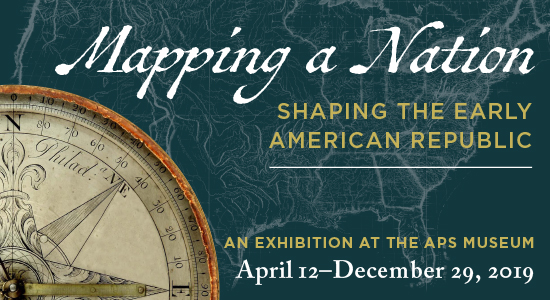
compass on blue map background

Contact: Jessica Frankenfield
Phone: 215-701-4427 
Email: [email protected] 

Mapping a Nation: Shaping the Early American Republic Opens at the American Philosophical Society Museum on April 12

“Indeed, what is the history of a country without maps?”
–Sebastian Bauman (1782)

Philadelphia [April 10, 2019]—Why would a government publish a map claiming land they do not control? Why would the citizens of a young nation—still recovering from a war for independence—care about making maps? Opening April 12, 2019, the new exhibition from the American Philosophical Society Museum, Mapping a Nation: Shaping the Early American Republic, traces the creation and uses of maps from the mid-18th century through 1816 to investigate maps’ political and social meanings. 

The exhibition draws on the APS Museum and Library’s extensive holdings and will feature significant Early American maps, the tools that were used to create them, and historical artifacts that represent the figures who negotiated the landscape of the early United States. 

“Early American maps were practical tools that defined physical and political borders,” said APS Museum Director Merrill Mason, “but many of the maps we have on display were also works of art and feats of printing technology.”  

The exhibition traces the history of mapmaking in early America through three phases titled “Empires in Motion,” “Civic Geography,” and “From Sea to Sea.”

Empires in Motion
During the colonial era, European powers competed for North American territory, often making maps that overstated their claims. They also consulted Native American informants and sent out surveyors, mapmakers, and naturalists to learn as much as they could about the continent’s people, geography, plants, and animals. Highlights from this section include:

  • John Mitchell’s 1757 Map of the British and French dominions in North America—created for the English government, it claimed lands that were actually in French or Native American hands. After the American colonists declared independence, British officials used the map to negotiate new boundaries.
  • Surveying tools that David Rittenhouse used to extend the Mason-Dixon line
  • Maps and catalogues from William Bartram’s travels to document American plants and animals

Civic Geography
After the American Revolution, mapmakers shaped national identity by defining the borders of the newly united states. Maps on display from this era include:

  • A previously un-exhibited collection of hand-drawn maps used to create the first atlas of the United States
  • George Washington’s 1792 copy of the plan for the city of Washington, D.C.

From Sea to Sea
As the United States entered the 19th century, westward expansion became one of the federal government’s priorities. Maps from this period show the nation’s growing infrastructure and expeditions across the continent. Postal routes and road systems soon stretched into the frontier, encouraging settlement by white Americans, many of whom envisioned the expansion of slavery, and obscuring the presence of Native Americans. Visitors will be able to see: 

  • The only known document signed by the first four presidents of the United States—the 1793 subscription list for the botanist André Michaux’s proposed western expedition
  • Journals and maps from the Lewis and Clark expedition
  • 1796 and 1804 maps of American postal routes

The exhibition will be open Thursday–Sunday through December 29, 2019 in Philosophical Hall, 104 South Fifth Street, Philadelphia. Admission is free, but donations are encouraged. Groups can schedule tours by contacting [email protected].

About the APS Museum
Founded in 2001, the APS Museum is located adjacent to Independence Hall in Philadelphia’s historic district. It develops thematic exhibitions from the Society’s collections of over 13 million manuscripts, rare books, artworks, scientific instruments, Native American materials, and other historical objects. Programs expand upon the themes and objects in the exhibitions and relate them to relevant issues today.  
 

2018 Lashley Award

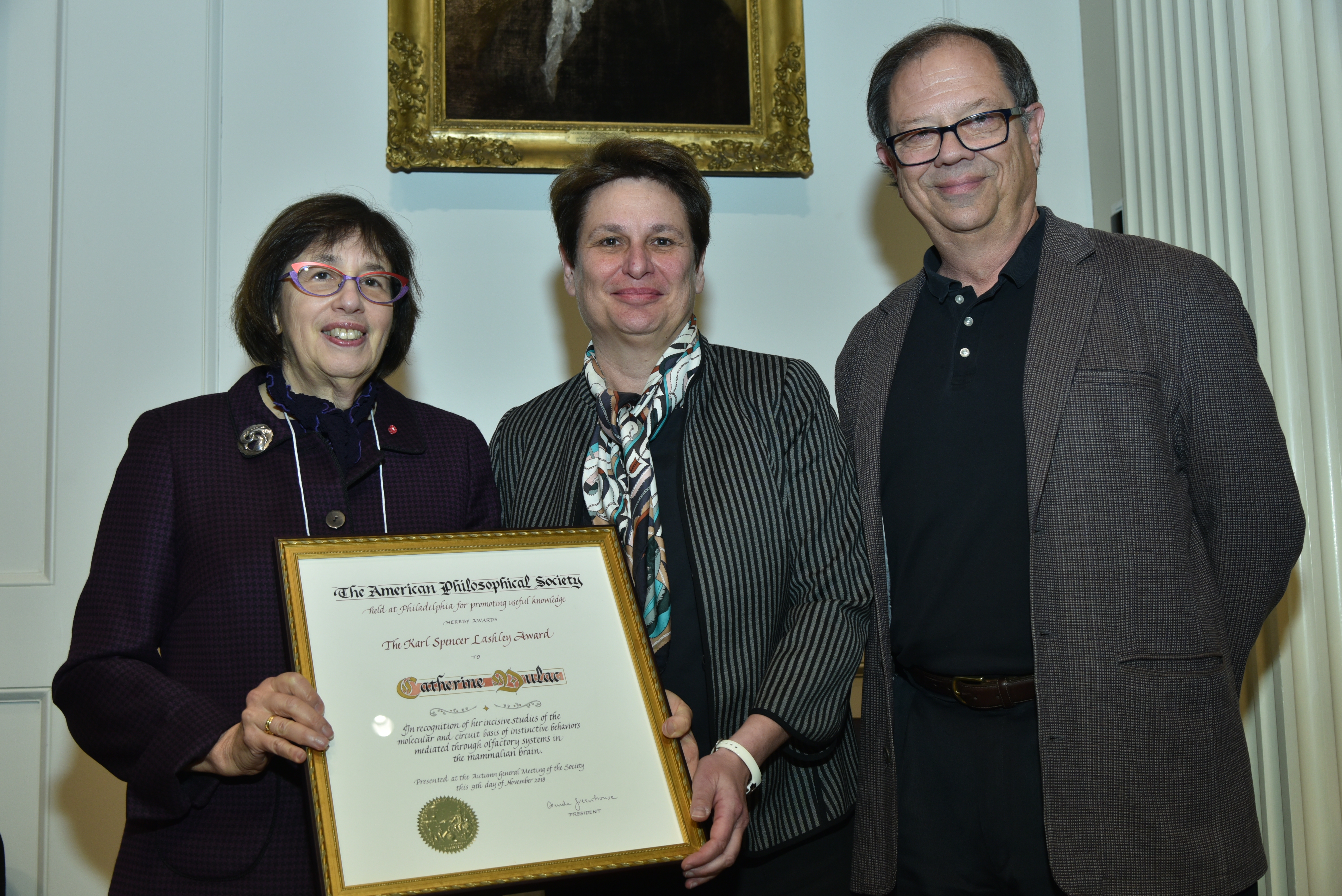
Catherine Dulac is the recipient of the 2018 Karl Spencer Lashley Award in recognition of her incisive studies of the molecular and circuit basis of instinctive behaviors mediated through olfactory systems in the mammalian brain. The Prize was awarded to her at the 2018 November meeting of the American Philosophical Society.

Presentation of Lashley Award
APS President Linda Greenhouse (left) and prize committee chair William T. Newsome (right) present the award to Catherine Dulac (center)

Catherine Dulac has elucidated the mechanisms by which the mammalian brain detects pheromones, and processes pheromone-related information to produce social behaviors. Pheromones are molecules that constitute an important mode of communication between members of the same species. Dulac devised single cell cDNA cloning methods for characterizing novel families of pheromone receptors in the vomerulonasal organ (VNO). These discoveries led directly to her groundbreaking work on the anatomical pathways and physiological mechanisms that mediate pheromone effects in the central brain. Dulac showed how VNO circuitry generates sex-specific behaviors in response to pheromones, even though circuits for both male- and female-specific behaviors exist in both sexes. Dulac’s body of work is a brilliant example of how molecular, physiological and behavioral techniques, deployed in concert, can lead to a deep, mechanistically powerful understanding of behavior.

Dr. Dulac is Higgins Professor of Molecular and Cellular Biology and Lee and Ezpeleta Professor of Arts and Sciences at Harvard University and an Investigator for the Howard Hughes Medical Institute. She earned her Ph.D. in developmental biology from the University of Paris.

The Karl Spencer Lashley Award was established in 1957 by a gift from Dr. Lashley, a member of the Society and a distinguished neuroscientist and neuropsychologist. His entire scientific life was spent in the study of behavior and its neural basis. Dr. Lashley’s famous experiments on the brain mechanisms of learning, memory and intelligence helped inaugurate the modern era of integrative neuroscience, and the Lashley Award recognizes innovative work that continues exploration in the field.

The members of the selection committee are William T. Newsome III (Chair), Harman Family Provostial Professor, Vincent V. C. Woo Director of the Stanford Neurosciences Institute, Professor of Neurobiology and, by courtesy, of Psychology, Stanford University; John E. Dowling, Gordon and Llura Gund Research Professor of Neurosciences Emeritus, Harvard University; Ann M. Graybiel, Institute Professor, Department of Brain and Cognitive Sciences, Investigator, McGovern Institute for Brain Research, Massachusetts Institute of Technology; John G. Hildebrand, Regents Professor of Neuroscience, University of Arizona; Eric Knudsen, Sewell Professor of Neurobiology Emeritus, Stanford University School of Medicine; Edvard Moser, Professor of Neuroscience, Director, Kavli Institute for Systems Neuroscience, Norwegian University of Science and Technology; and Larry R. Squire, Distinguished Professor of Psychiatry, Neurosciences, and Psychology, University of California, San Diego, Research Career Scientist, Veterans Affairs Medical Center, San Diego.
 

2018 Jefferson Medal

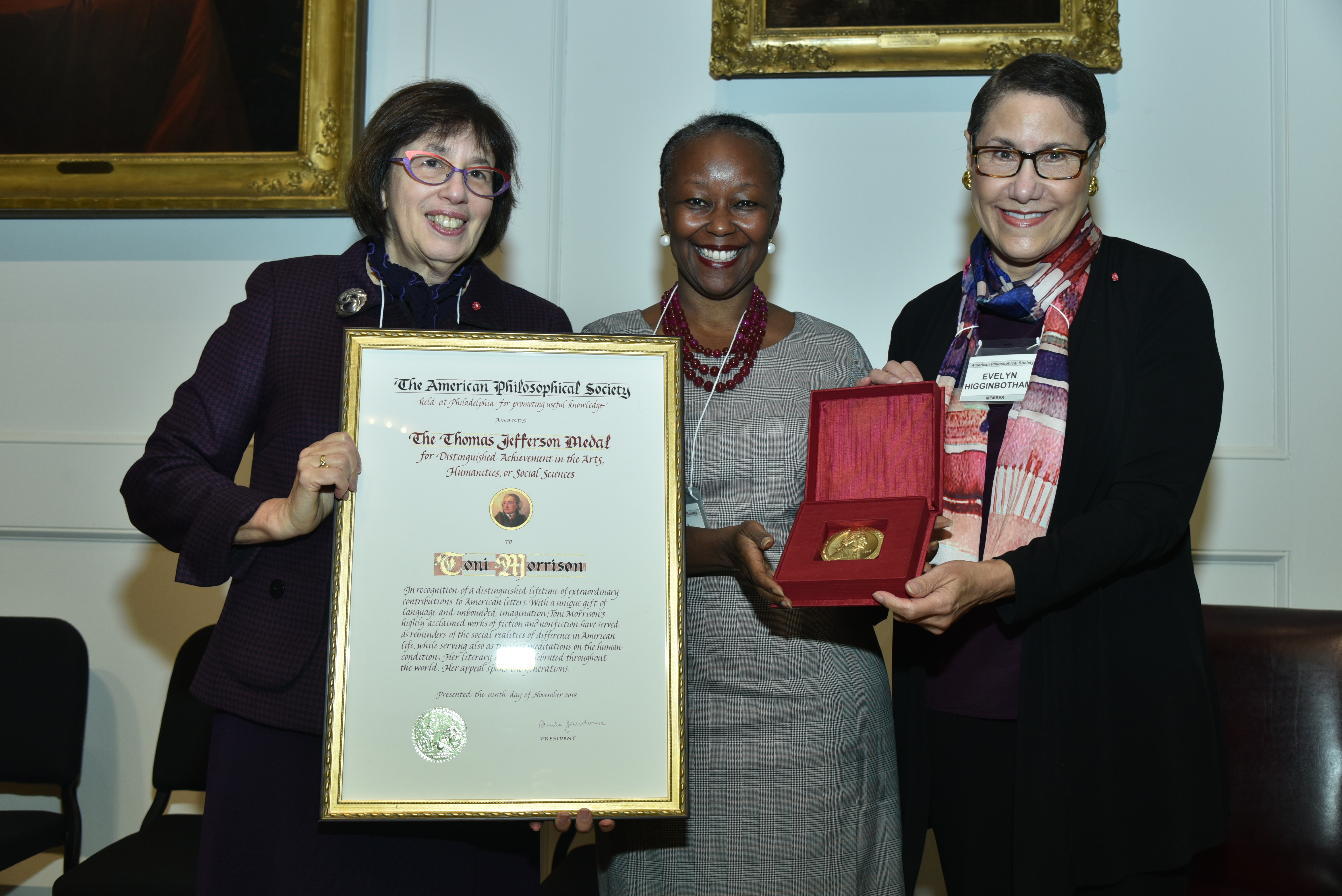
Toni Morrison was awarded the Thomas Jefferson Medal for Distinguished Achievement in the Arts, Social Sciences, or Humanities in 2018. The citation inscribed on the prize certificate reads “in recognition of a distinguished lifetime of extraordinary contributions to American letters. With a unique gift of language and unbounded imagination, Toni Morrison’s highly acclaimed works of fiction and non-fiction have served as reminders of the social realities of difference in American life, while serving also as timeless meditations on the human condition. Her literary genius is celebrated throughout the world. Her appeal spans the generations.”

Because Toni Morrison was unable to attend the medal presentation at the Society's November 2018 meeting, her friend Professor Farah Jasmine Griffin accepted the award on her behalf. Dr. Griffin is William B. Ransford Professor of English & Comparative Literature and African American Studies at Columbia University.

Woman receives prize
APS president Linda Greenhouse (left) and prize committee member Evelyn Brooks Higginbotham (right) present the medal to Farah Griffin (center), who accepted the award on behalf of Toni Morrison.

Toni Morrison’s accolades include the 1993 Nobel Prize in Literature and a Presidential Medal of Freedom. Her work is widely recognized for both its literary and cultural significance. In addition to her twelve novels, she has written plays, non-fiction pieces, and children’s literature. Yet above and beyond her impressive awards and honors, the narratives she has set down stand as testaments to the liberating power of reading and of storytelling. Through her writing, she has given voice and light to aspects of the American story that have long been excluded from the nation’s narrative.

In 1993, the United States Congress praised the American Philosophical Society as "the oldest learned society in the United States and one of the principal scholarly and scientific bodies in the world." Congress honored the Society and its third President, Thomas Jefferson, for "devotion to learning" by authorizing the minting of the Thomas Jefferson Medal. Thomas Jefferson served as President of the American Philosophical Society at the same time that he was Vice President and then President of the United States. The medal is the Society's highest award for the arts, humanities, and social sciences.

The members of the selection committee were the Society’s President Linda Greenhouse (Chair), Executive Officer Robert M. Hauser, and Council members representing Classes 3 and 4 Richard M. Shiffrin, Howard Gardner, Evelyn Brooks Higginbotham, Jeremy A. Sabloff, Christopher Jones, and Roger S. Bagnall.