Fall 2018 Cataloguing Intern

The American Philosophical Society is seeking applicants for a paid Cataloguing Department internship.

Founded in 1743, The American Philosophical Society’s library, located near Independence Hall in Philadelphia, is a leading international center for research in the History of American science and technology and its European roots, as well as early American history and culture. The Library houses over 13 million manuscript leaves, 275,000 volumes and bound periodicals, thousands of prints and maps, and large audio, video, and digital holdings. Outstanding historical collections and subject areas include the papers of Benjamin Franklin (14,000 letters and documents); Jefferson’s holograph of the Declaration of Independence; western scientific expeditions and travel including the original journals of Lewis and Clark; polar exploration; history of physics and 20th-century medical research.

Cataloguing Department: Staff consists of the Head of Cataloguing and Assistant Head of Cataloguing, who report to the Curator of Printed Materials. Together they are responsible for the acquisition, cataloguing, and organization of all library printed materials.>

Internship: The successful candidate will report to the Assistant Head of Cataloguing and gain practical experience in a professional library setting through experience in creating catalogue records for rare books and pamphlets, maps, broadsides and graphics. The intern will be expected to write a blog about the internship, and to give an informal talk to library staff.

Stipend: $2,580 ($15 per hour for 172 hours) during fall semester (September through December).

Experience: Applicants currently should be enrolled in or graduated from a graduate-level library science program; and preference will be given to candidates who have strong organizational skills and a keen interest in learning cataloguing practices.

Deadline: Applications will be accepted through June 8.

The American Philosophical Society is an EOE. Successful applicants will be asked to show proof that they legally can work in the United States.

To apply upload CV or resume, a cover letter explaining qualifications for and interest in the position and three references (not letters of reference, please) to http://apply.interfolio.com/50173

Please direct any questions to Marian Christ, Assistant Librarian and Head Cataloguer, via email: [email protected].

Press Release: In Franklin's Footsteps

FOR IMMEDIATE RELEASE                                                     

Contact: Jessica Frankenfield
Phone: 215-701-4427
Email: [email protected]

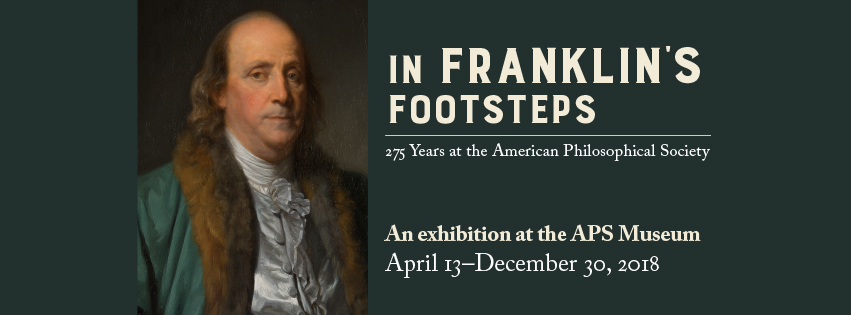
Museum Exhibition In Franklin’s Footsteps: 275 Years at the American Philosophical Society Opens April 13, 2018

Philadelphia [April 13, 2018]—They calculated the size of the solar system, explored distant lands, shed light on the origins of life, unearthed ancient fossils, invented computer technologies, cured diseases, and walked on the moon. What did these accomplished people have in common? They were Members of the American Philosophical Society. Opening April 13, 2018, the new exhibition at the APS Museum, In Franklin’s Footsteps: 275 Years at the American Philosophical Society, tells the story of the nation’s oldest learned society and how its Members have changed the world.

When Benjamin Franklin founded the American Philosophical Society in 1743, he recognized the need for an organization that would bring together the brightest thinkers of the day to share their scientific experiments, from the esoteric to the deeply practical. He named the Society for the then-common term for the study of science—“natural philosophy.”

In Franklin’s Footsteps shows how APS Members have continued Franklin’s Enlightenment mission since 1743. The exhibition reveals their work through three themes inspired by Franklin’s original charge for Members to pursue “all philosophical Experiments that let Light into the Nature of Things, tend to increase the Power of Man over Matter, and multiply the Conveniencies or Pleasures of Life.”

Highlights in the exhibition include Benjamin Franklin’s library chair, an original journal from the Lewis and Clark Expedition, Charles Darwin’s handwritten title page of On the Origin of Species, and Neil Armstrong’s annotated and signed copy of the moon landing transcript. The exhibition draws out stories of collaboration and debate on divisive topics, many of which have occurred at the Society’s biannual Meetings of Members and in APS publications. A section on nuclear energy covers APS Members’ contributions to atomic research, including materials from Enrico Fermi, E. U. Condon, and Henry DeWolf Smyth. These scientific breakthroughs prompted APS Members to hold a symposium on the ethics of nuclear weapons at a 1945 Meeting, which featured remarks from J. Robert Oppenheimer and resulted in a letter to President Truman advocating for freedom of academic research on atomic energy.

The exhibition also includes items from one of the APS Library’s most frequently requested material—the eugenics collection. Members like Charles Davenport and Alexander Graham Bell advocated for the eradication of “unfit human traits,” while critics of the movement like anthropologist Franz Boas dedicated their work to celebrating and better understanding the diversity of human culture. APS Members today continue to discuss challenging topics with recent Meeting symposiums on climate change, the nature of democracy, and the future of higher education.

Special labels written by current APS Members show the enduring significance of objects selected for the exhibition. Climate scientist Warren M. Washington highlighted the importance of explorer Elisha Kent Kane’s meteorological data collected in Greenland from 1853 to 1855. This type of historical record allows scientists like Washington to track long-term climate trends. Anthropologist and paleobiologist Nina Jablonski’s label accompanies the handwritten title page to Charles Darwin’s On the Origin of Species. Jablonski noted that Darwin only mentioned humans once in the book, but he provided the theoretical framework for understanding human evolution.

The exhibition opening also will unveil the product of a Super Bowl bet with the Boston-based American Academy of Arts and Sciences (i.e. Patriots fans.) The Eagles beat the Patriots and the APS received from AAAS a loaned set of Benjamin Franklin’s manuscript writings on his electricity experiments.

APS Museum Director Merrill Mason said, “I hope visitors will be surprised with the variety of historical objects and topics represented in this exhibition—everything from Franklin to the moon—and that they will come away with some memorable stories about our Members.” 

Since the exhibition can only hold a small fraction of the Society’s 13 million treasures, visitors will be able to explore the collections more deeply via a touch-screen kiosk. This interactive display will allow visitors to learn more about objects from the APS Museum and Library in the areas of Early American History, History of Science, Natural History, and Native American History, plus fun finds in the Surprise Me! and Staff Favorites categories.

Over the course of the exhibition, a sculpture of the extinct giant ground sloth Megalonyx jeffersonii will be installed piece by piece in the Thomas Jefferson Garden (across the street from Philosophical Hall). In 1797, Jefferson presented a paper on this then-unidentified fossil to his fellow Members of the Society, detailing his theory that the creature may still be alive and, judging by the size of its claws, must be from a ferocious animal like a lion or tiger. Jefferson was correct that this creature was massive, but it turned out to be an herbivorous gentle giant.

The opening reception will be held on Friday, April 13 at 5:30 p.m. in the Society’s Philosophical Hall. APS President Linda Greenhouse will deliver opening remarks and guests will be able to tour the exhibition. The opening date was selected to coincide with Thomas Jefferson’s 275th birthday.

Special events will complement the themes of the exhibition, including a series of lectures entitled “Useful Knowledge 101” that will cover unexpected yet practical topics on everything from the ecology of Philadelphia to the history of beer. There will be family-friendly programs throughout the summer on the second Saturday of each month, and the Annual Garden Party in October.

The exhibition will be open Thursday–Sunday through December 30, 2018 in Philosophical Hall, 104 South Fifth Street, Philadelphia. Admission is free, but donations are encouraged. Groups can schedule tours by contacting [email protected].

About the APS Museum

Founded in 2001, the APS Museum is located adjacent to Independence Hall in Philadelphia’s historic district. It develops thematic exhibitions from the Society’s collections of over 13 million manuscripts, rare books, artworks, scientific instruments, Native American materials, and other historical objects. Programs expand upon the themes and objects in the exhibitions and relate them to relevant issues today. 

exhibition logo

Contact Us

Executive Offices and Museum Gallery
104 South Fifth Street 
Philadelphia, PA 19106-3387
215-440-3400 | Fax 215-440-3450

Library
105 South Fifth Street
Philadelphia, Pa 19106-3386
215-440-3400 | Fax 215-440-3423

For questions about APS Library collections and research visits, please use the APS Library Reference Requests form. All visitors to the Reading Room must make an appointment through [email protected]. To request copies or to learn more about publication permissions from the APS Library, please visit the Reference Requests page

Use this form to contact the American Philosophical Society electronically. 

Contact Us

CAPTCHA
This question is for testing whether or not you are a human visitor and to prevent automated spam submissions.

Assistant Conservator for Archival Materials

Departmental Program Summary:

The Conservation Department at the American Philosophical Society is responsible for the preventive care as well as conservation treatment for items found in its diverse special collections library. This growing collection currently includes over 13 million manuscript leaves, 275,000 volumes and bound periodicals, thousands of prints and maps, and large audio, video, and digital holdings. The department is currently composed of two full-time conservators, an annual grant-funded intern, and occasional volunteers.

Position Description:

This entry level position aids in the preservation/ preventive conservation of the collections. This care includes treatment and documentation of individual items for a variety of materials such as manuscripts on paper, maps, ephemera, photographic materials, graphic works on paper, and manuscripts on parchment.

Responsibilities:

  • Performs conservation treatment on primarily non-bound materials owned by the Library.
  • Provides written and photographic documentation in accordance with the AIC Code of Ethics (including examination, condition and treatment reports, and photographic documentation).  
  • Participates and assists in a wide range of preservation/ preventive conservation activities including disaster preparedness and recovery, pest management, minor mold remediation, examination and preparation of materials for loan, and environmental monitoring.
  • Reviews and moves unprocessed boxed collections weighing up to 40 lbs.
  • Assists in the general maintenance and organization of the conservation laboratory.  
  • Assists in the preparation and display of materials for exhibition.
  • Keeps abreast of current developments in the conservation field.
  • Performs other duties as assigned. 

Qualifications:

  • Master’s degree from an accredited graduate training program in conservation, with Master’s in hand prior to start date.
  • Demonstrated working knowledge of conservation theory and practice. 
  • Ability to wear a respirator and other personal protective equipment.
  • Demonstrated computer skills including use of Microsoft Office Suite and Adobe Bridge/Photoshop.
  • Demonstrated mastery of written and oral communication.
  • Demonstrated success in a wide range of conservation treatment procedures and techniques.

The ideal candidate will have these additional qualities:

  • Is highly organized.
  • An interest in outreach and education through lab tours and use of social media.

The Society offers a competitive benefits package including health insurance, life insurance, long term disability, 403b with the employer match, and paid days off.

 The American Philosophical Society is an EOE. Successful applicants will be asked to show proof that they can legally work in the U.S. Applications will be accepted through February 28, 2018.

To apply upload CV or resume, a cover letter explaining qualifications for and interest in the position and three references (not letters of reference, please) to http://apply.interfolio.com/48348.

About the Library:  Founded in 1743, The American Philosophical Society’s library, located near Independence Hall in Philadelphia, is a leading international center for research in the history of American science and technology and its European roots, as well as early American history and culture. The Library houses over 13 million manuscript leaves, 275,000 volumes and bound periodicals, thousands of prints and maps, and large audio, video, and digital holdings. Outstanding historical collections and subject areas include the papers of Benjamin Franklin (14,000 letters and documents); Jefferson’s holograph of the Declaration of Independence; the American Revolution; the papers of Thomas Paine; 18th and 19th-century natural history; western scientific expeditions and travel including the original journals of Lewis and Clark; polar exploration; the papers of Charles Willson Peale, his family and descendants; American Indian languages; anthropology including the papers of Franz Boas; the papers of Charles Darwin and his forerunners, colleagues, critics, and successors; history of genetics, eugenics, and evolution; history of biochemistry, physiology, and biophysics; 20th-century medical research; and history of physics. The Library does not hold materials on philosophy in the modern sense.  

Gift Levels and Benefits

Contributions of every amount are appreciated to support the American Philosophical Society. Please contact the Development office at [email protected] or 215-440-3434 to discuss gift levels and benefits.


Leadership Giving Levels 

Independence Circle: $2,500+

Founder's Circle: $5,000+

1743 Circle: $10,000+

Nullo Discrimine Circle: $25,000+

Contribute Now

The American Philosophical Society is a private, non-profit, tax-exempt, 501(c)(3) organization under the provisions of the Internal Revenue Code of the United States Department of the Treasury. The Society is registered as a charitable organization with the Commonwealth of Pennsylvania’s Bureau of Charitable Organizations and is authorized to solicit charitable contributions under the conditions and limitations set forth under the Solicitation of Funds for Charitable Purposes Act. The official registration and financial information for the American Philosophical Society may be obtained from the Pennsylvania Department of State by calling toll free, within Pennsylvania, 1-800-732-0999. Registration does not imply endorsement.

The tax ID number for the American Philosophical Society is 23-1353269.

Contribute Now

Brown Bag Lunches

Check back regularly for schedule updates. Brown Bag lunches are held in the Library Hall Board Room (105 South Fifth Street) from 12-1pm unless otherwise noted. Food is not provided, so bring your sack lunch and join us!

Note: Beginning on March 24, Brown Bag will be held virtually via Zoom. To attend, please contact Adrianna Link at [email protected]. Please visit our "Virtual Offerings Page" for the most up-to-date schedule. 

Spring 2020 Calendar

January 7 – Jeffrey Appelhans (APS John C. Slater Bibliography Postdoctoral Fellow), "Catholic Persuasion, from Republicanism to Romanticism to Riots"

January 14 – Melanie Rinehart (APS Archivist), "Processing Garwin: A Project Update"

January 21 – Bethany Farrell (APS Digital Franklin Fellow), "The Art of Making Data for Every Scholar’s Pocket: Opening Benjamin Franklin’s Account Books"

January 28 – Cynthia Heider (APS Digital Projects Specialist), "Meaning-Making: Data, Discourse, and Advocacy within the American Settlement House Movement"

February 4 – Lila O'Leary Chambers (2019-2020 McNeil Center Consortium Fellow/New York University), "Liquid Claiming: Alcohol and Authority in Kalinago-English Interaction in the Leeward Islands, 1623-1700"

February 11– Jennifer Tucker (Associate Professor of History and Science in Society, Wesleyan University) [in collaboration with the Science History Institute], "Collecting the Future: Photography, Waste, & the Industrial Revolution"

February 18 – Angela Tapia (Spring 2020 The Andrew W. Mellon Foundation Native American Scholars Initiative (NASI) Predoctoral Fellow), "Mujeres de Polleras: Weaving A Way of Being in the Altiplano Region"

February 25 – David Dunning (2019-2020 Leon and Joanne V.C. Knopoff Fellow/Princeton University), "Writing the Rules of Reason: Notations in Mathematical Logic, 1847-1937"

March 3 – Tracey deJong (APS Archivist) [part of Women's History Month]

March 10 – James Truitt (Swarthmore College), "Graceanna Lewis: Naturalist and Radical"  [part of Women's History Month]

March 17 [CANCELLED] –  Short-Term Fellows Presentation: Baligh Ben Taleb (2019-2020 The Andrew W. Mellon Foundation Fellow/University of Nebraska, Lincoln), “Reckoning with the Legacy of American Settler Colonialism: Treaty Claims and Western Shoshoni Quest for Justice,” and, Vedran Duančić (2019-2020 François André Michaux Fund Fellow/Institute for the History and Philosophy of Science, Croatian Academy of Arts and Sciences), “Scientific Diaspora as a Resource in the Struggle Over Agrobiology in Socialist Yugoslavia”

March 24 – Molly Nebiolo (2019-2020 Digital Humanities Fellow/Northeastern University), "Visualizing Early Colonial Philadelphia"

March 31 – Lisa Ruth Rand (2019-2022 Haas Fellow, Science History Institute), " Neocolonial Space: Orbital Allocation in the Age of the New International Economic Order, 1971-1979"

April 7 – Paul Myles, "The Rise of Thomas Paine and The Officers of Excise"

April 14 – Anisha Gupta (APS Assistant Conservator of Archival Materials), "To Counterfeit is Death: Benjamin Franklin's Anti-Counterfeiting Papermaking Techniques for Colonial Currency"

April 21 – Susan Laquer (APS Archivist), "Evidence of Genius: Barbara McClintock's Scientific Ephemera"

April 28 – Lise Puoyo (University of Pennsylvania), "Speaking to Kin: Abenaki Wampum Belts at Chartres"

May 5 – Baligh Ben Taleb (2019-2020 The Andrew W. Mellon Foundation Fellow/University of Nebraska), “Reckoning with the Legacy of American Settler Colonialism: Treaty Claims and Western Shoshoni Quest for
Justice”

May 12 – Vedran Duančić (2019-2020 François André Michaux Fund Fellow/Institute for the History and Philosophy of Science, Croatian Academy of Arts and Sciences), “Scientific Diaspora as a Resource in the Struggle Over Agrobiology in Socialist Yugoslavia”

May 19 – Sean Fraga (Princeton University), "They Came on Waves of Ink”

May 26 – Joanna Hurd (Winterthur/University of Delaware Program in Art Conservation (WUDPAC)), "Have You Hurd? Introducing Paper Conservation Intern Joanna Hurd"


The Franklin Seminar

“Benjamin Franklin liked to eat. He liked to drink. He liked to entertain and be entertained. Franklin also loved knowledge and was a great promoter of its advancement.”

―Forward to Benjamin Franklin on The Art of Eating


Join us for an exciting collaboration of the American Philosophical Society and Library Company of Philadelphia—a jointly-developed seminar built around our rare documents and taught by our own experts that will give a small group the Benjamin Franklin learning experience of a lifetime! Course sessions will immerse participants in different periods in Franklin's life through selected course readings and the archival holdings of each institution. 

The seminar will alternate locations between the American Philosophical Society Library (105 South Fifth Street) and the Library Company of Philadelphia (1314 Locust Street). Seminar sessions will be from 6:00 p.m. to 8:00 p.m., beginning with hands-on review of primary materials, followed by conversation over dinner. Tuition for the course is $2,000. For information and/or registration, please email Abigail Shelton at [email protected]. Payment must be received before your spot in the course can be confirmed. 

Schedule

Date

Location

Topic

Wednesday, January 17

American Philosophical Society

Franklin’s Birthday and Seminar Introduction

Thursday, February 1

American Philosophical Society

Franklin and the Revolution

Thursday, March 1

Library Company of Philadelphia

Franklin as Printer

Thursday, March 29

American Philosophical Society

Franklin’s Autobiography

Thursday, May 3

Library Company of Philadelphia

Franklin’s Legacy


Course Leaders

James N. Green is Librarian of the Library Company of Philadelphia, where he has worked since 1983. He holds degrees from Oberlin College (A.B.), Yale University (M. Phil.), and Columbia University (M.L.S). His three essays on printing and book publishing in America from 1680 to 1840 appear in the first two volumes of the collaborative History of the Book in America, published by the American Antiquarian Society (2000-2010) under the general editorship of David D. Hall. He is also co-author, with Peter Stallybrass, of Benjamin Franklin, Writer and Printer (Oak Knoll Press and the British Library, 2006). Jim serves on the board of Rare Book School at the University of Virginia and teaches courses there in the summer.

Patrick Spero is the Librarian of the American Philosophical Society in Philadelphia. As a scholar of early American history, Dr. Spero specializes in the era of the American Revolution. He has published over a dozen essays and reviews on the topic. He is the author of Fighting for Independence in the American West, 1765-1776 (W.W. Norton) as well as Frontier Country: The Politics of War in Early Pennsylvania, and the edited anthology The American Revolution Reborn: New Perspectives for the Twenty-First Century (both published by the University of Pennsylvania Press). Prior to his appointment at the American Philosophical Society, Patrick taught at Williams College where he served as Assistant Professor of History and Leadership Studies and received recognition for his integration of new technology in the classroom. Patrick has also held the position of Historian at the David Library of the Revolution and served on their Board of Trustees. He received his Ph.D. from the University of Pennsylvania in 2009.