



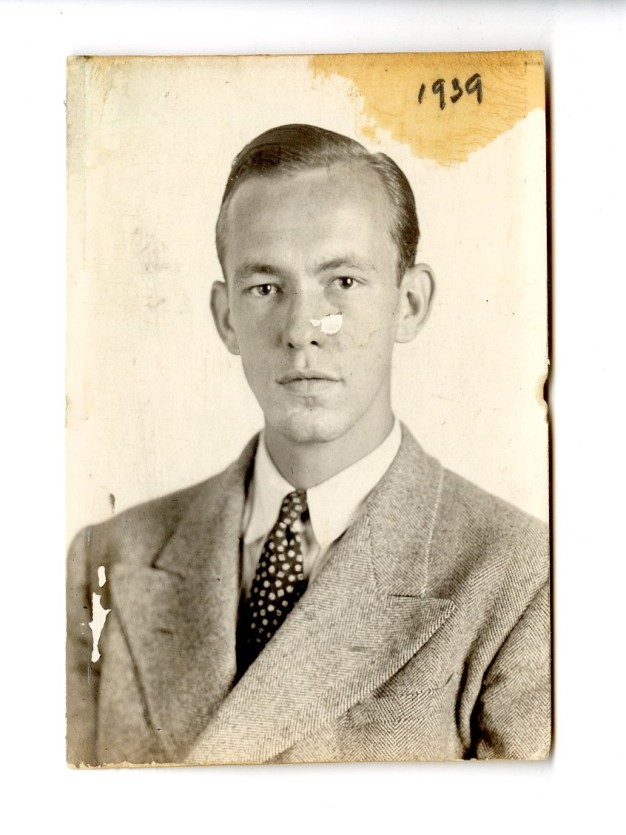
Header image: Charles Cotterman in his mid-twenties, copy in Photographs, Box 35, Charles W. Cotterman Papers, APS.
Charles W. Cotterman (1914–1989) made many lists. While those located across his papers reveal much about his particular academic fascinations, the following list aims to catalog twelve dimensions of who Cotterman was as a person and highlight connections between his scientific and recreational undertakings.
Side 1: Ohioan:
Cotterman spent approximately the first 26 years of his life based in Ohio, where he was educated through his doctorate (1).
Side 2: Collector:
Cotterman had a penchant for assembling collections. Even before he began college, Cotterman had made a habit of gathering and preserving botanicals from familiar Ohio landscapes. His efforts in this regard were lauded in a (seemingly local) newspaper article, as was his zoological adeptness. Outside of the natural historical realm, Cotterman created a stamp collection around age 17. He kept up these sorts of collecting tendencies later in life (2).
Side 3: Geneticist:
Cotterman studied the mathematical, statistical, and clinical dimensions of genetics around the middle of the 20th century. His start in the arena of genetics coincided with a time during which eugenics (in its varied configurations) represented a prominent strain of genetic ideology and practice. In his postgraduate work at Ohio State, Cotterman developed mathematical frameworks for assessing human genetic data through statistical lenses. After graduating, Cotterman was among the first hired employees at a new Hereditary Clinic associated with the University of Michigan (3).
Side 4: Snyder Trainee:
Laurence H. Snyder was Cotterman’s most significant Ohio State mentor. Snyder believed Cotterman possessed such promise as a genetics investigator that he once wrote to Cotterman’s father to set forth a case for why, in his judgment, Cotterman stood out as someone especially well-suited to take on a genetics-oriented career (4).
Side 5: Shipwreck Survivor:
As a Ph.D. student, Cotterman endured a 1939 torpedoing while traveling on the S.S. Athenia, which sank as it was transporting him and a fellow Ohio Stater, psychologist-turned-geneticist/statistician Bronson Price, home from an academic conference they had attended in Scotland. Now recognized as an early World War II-associated incident, this ordeal features prominently in one of Cotterman’s scrapbooks, which contains relevant ephemera and many collected contemporary newspaper articles (5).
Side 6: ASHG Co-Founder:
Cotterman was among the originators of a novel academic organization, the American Society of Human Genetics (ASHG), instituted in part to help solidify the professional standing of the biomedical examination of human genetic questions. At the end of the 1940s, Cotterman became the first to edit the society’s scholarly publication, The American Journal of Human Genetics (6).
Side 7: Blood Researcher:
One direction that Cotterman’s interest in genetics took him was an exploration of blood groups and immunogenetics. For a period in the 1950s, Cotterman worked in Dallas at the Wadley Research Institute and Blood Center (7).
Side 8: Tennis Player:
Since at least his Ohio State days, Cotterman valued tennis as a pastime. Numerous references to the sport can be found throughout his papers; of particular note is his methodical, though fragmentary, meditation on “The Take Two Rule” (8).
Side 9: Poet:
Cotterman enjoyed collecting short poems by others and authoring some of his own; both kinds sometimes appear in the collection on little scraps of paper or pasted onto scrapbook pages. At least one of Cotterman's poems, “The Microscopist’s Song,” seems to have been published, likely in a flyer or newspaper put out by his Ohio high school (9).
Side 10: Legume Enthusiast:
Though he practiced mainly as a geneticist, Cotterman had always been botanically-minded. He was particularly fascinated with Leguminosae (legumes), especially the trees and their associated seeds and woods. When Cotterman was working in blood genetics, he was able to mobilize lectins derived from such seeds in certain blood-typing experiments. Cotterman continued to especially admire these plants even after he had ceased this kind of scientific work (10).
Side 11: Woodworker:
Cotterman took an interest not only in wood originating from trees of the legume type, but also in woodworking activities. His papers contain an assortment of woodworking magazines, lists of wood types, correspondence regarding wood orders, and sketches of furniture pieces he hoped to make (11).
Side 12: “Unpublisher”:
Though Cotterman had published academic papers earlier in his career, by the time he settled at the University of Wisconsin–Madison in 1960, he had almost completely adopted the outlook of someone who generally disliked disseminating written work in public fora. During the final three decades of his life, Cotterman produced writings on a range of topics reflective of his personal and scholarly eccentricities. Many appear in the collection in partial/draft form, and he was unfailingly reluctant to publish these or other works. A self-described “unpublisher,” Cotterman eventually came to regard his anti-publication proclivities as comical, concocting a humorous abbreviation system consisting of an “unpublication” number (e.g., U-1, U-2, etc.) for keeping track of the pieces he had authored for himself and a close circle of coworkers/friends (12).
The title of this post is a reference to one of Cotterman’s more unusual “unpublications,” “U-35,” alternatively titled “A Dodecaleguminous Dodecahedron.” In this small explanatory pamphlet, Cotterman described and illustrated the geometric principles behind and effort involved in constructing a regular polyhedron consisting of twelve sides, each fashioned out of a particular type of his treasured legume wood. This dodecahedron, dubbed “dodecaleguminous” by Cotterman in reference to its twelve component woods, uniquely merged his interests in this particular grouping of plants, collecting, woodcraft, mathematical analysis, and authoring/numbering short “unpublications” with his distinctive strain of idiosyncrasy (13).
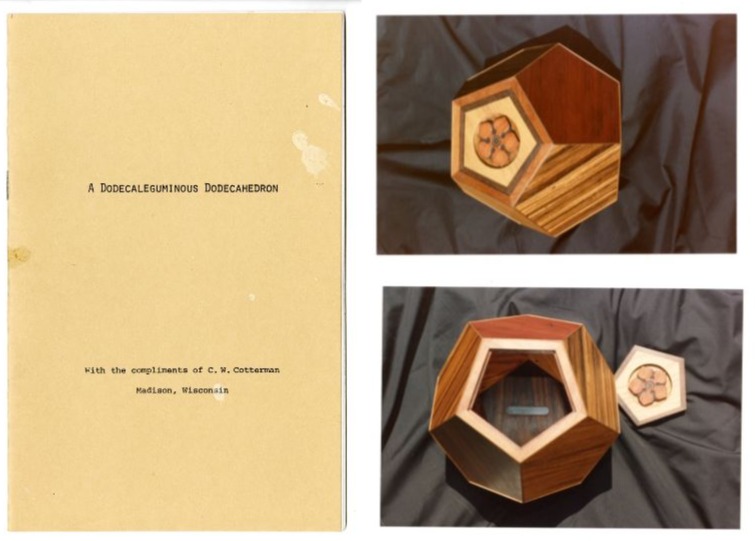
While the docdecahedron pictured above and that referenced in “U-35” appear to be small, hollow boxes, there is evidence that Cotterman also constructed a larger version meant to function as a table (14). That more than one iteration of this project may have existed seems possible given that Cotterman found the dodecahedral shape particularly appropriate for his grander purposes. As Cotterman once wrote in a fragmentary/draft piece of writing: “As a ‘wood collector’ I would like [to] show off as many woods as possible in the form of furniture…The many faces of a dodecahedron provides one rather attractive way in which to work several woods into a single structure…” (15). Thus, in many ways, the labor and care undergirding the invention of the “dodecaleguminous dodecahedron” can be seen as emblematic not only of many of the “twelve sides” of Cotterman enumerated above (he seems to have understood it this way), but also of his lifelong endeavors to reveal unknown or underappreciated information about the natural world in which he existed (16).
The complete finding aid for the Charles W. Cotterman Papers can be accessed here.
References
1. Charles W. Cotterman Curriculum Vitae, Folder: Allen Award Nomination, Box 32, Charles W. Cotterman Papers, APS.
2. Anonymous, “Collection of Grass Obtained,” undated newspaper article, Folder: Newspaper Clippings, Box 33, Charles W. Cotterman Papers, APS; Anonymous, “Discovery of New Specimen of Life Made by Youth Who Elects Biology Life Work,” undated newspaper article, Folder: Newspaper Clippings, Box 33, Charles W. Cotterman Papers, APS; Charles W. Cotterman, “Stamp Collection, 1931,” Box 34, Charles W. Cotterman Papers, APS.
3. Nathaniel Comfort, “‘Polyhybrid Heterogenous Bastards’: Promoting Medical Genetics in America in the 1930s and 1940s,” Journal of the History of Medicine and Allied Sciences Vol. 61, no. 4 (2006): 415-455; Daniel Kevles, In the Name of Eugenics: Genetics and the Uses of Human Heredity (New York: Alfred A. Knopf, Inc., 1985); Charles W. Cotterman, “Some Extensions of the Gene Frequency Analysis of Human Pedigrees,” 1937, Box 21, Charles W. Cotterman Papers, APS; Charles W. Cotterman, “A Calculus for Statistico-Genetics,” 1940, Box 19, Charles W. Cotterman Papers, APS; Anonymous, “The Michigan Human Hereditary Clinic,” The Journal of Heredity 32, no. 10 (1941): 364.
4. Laurence H. Snyder to Charles A. Cotterman, April 7, 1936, Box 4, Charles W. Cotterman Papers, APS.
5. See the various newspaper clippings in “Scrapbook #2,” Box 36, Charles W. Cotterman Papers, APS.
6. Kurt Hirschhorn, “A Short History of the American Society of Human Genetics,” Perspectives in Human Genetics 83, (2008): 307-310; Nathaniel Comfort, The Science of Human Perfection: How Genes Became the Heart of American Medicine (New Haven: Yale University Press, 2012), 130-162.
7. For an example of published work stemming from this period, see Charles W. Cotterman, “Erythrocyte Antigen Mosaicism,” Journal of Cellular and Comparative Physiology 52, Supplement 1 (1958): 69-95, Copy in Box 19, Charles W. Cotterman Papers, APS.
8. Charles W. Cotterman, “Confession,” February 14, 1976, Box 32, Charles W. Cotterman Papers, APS; Unidentified Writing Fragment in Folder: Notes, Lists, and Fragments, Box 33, Charles W. Cotterman Papers, APS; Charles W. Cotterman, “‘Take Two Rule’ of Tennis Etiquette," August 20, 1977, Box 18, Charles W. Cotterman Papers, APS.
9. See Charles Cotterman, “The Microscopist’s Song” and other materials in Folder: Ephemera, Box 32, Charles W. Cotterman Papers, APS; “Scrapbook #1,” Box 33, Charles W. Cotterman Papers, APS.
10. John M. Opitz, “Obituary: Charles W. Cotterman,” American Journal of Medical Genetics 34, no. 2 (1989): 149-154; James F. Crow and Carter Denniston, “In Memory of Charles W. Cotterman, 1914-1989,” American Journal of Human Genetics 44 (1989): 903-904; see also items in Folder: Woodworking, Box 34, Charles W. Cotterman Papers, APS.
11. See items in Folder: Woodworking, Box 34, Charles W. Cotterman Papers, APS.
12. Charles W. Cotterman Curriculum Vitae, Folder: Allen Award Nomination, Box 32, Charles W. Cotterman Papers, APS; John M. Opitz, “Editorial Comment: Cotterman and Combinatorial Genetics,” American Journal of Medical Genetics 16 (1983): 389-392; Charles W. Cotterman to Paul Ballonoff, May 9, 1980, Box 1, Charles W. Cotterman Papers, APS; Charles W. Cotterman, “Relationship and Probability in Mendelian Populations” (U-1) - Version 1, Box 20, Charles W. Cotterman Papers, APS.
13. Charles W. Cotterman, “A Dodecaleguminous Dodecahedron,” Copy in Charts, Diagrams, and Photographs, Box 42, Charles W. Cotterman Papers, APS; “A ‘Legume Flower’ Coffee-Table,” in Folder: Woodworking, Box 34, Charles W. Cotterman Papers, APS.
14. Various items in Folder: Woodworking, Box 34, Charles W. Cotterman Papers, APS; Charles W. Cotterman, Untitled Writing Fragment in Folder: Dodecahedron - Woodworking, Box 14, Charles W. Cotterman Papers, APS.
15. Charles W. Cotterman, Untitled Writing Fragment in Folder: Dodecahedron - Woodworking, Box 14, Charles W. Cotterman Papers, APS.
16. “A ‘Legume Flower’ Coffee-Table,” in Folder: Woodworking, Box 34, Charles W. Cotterman Papers, APS.