



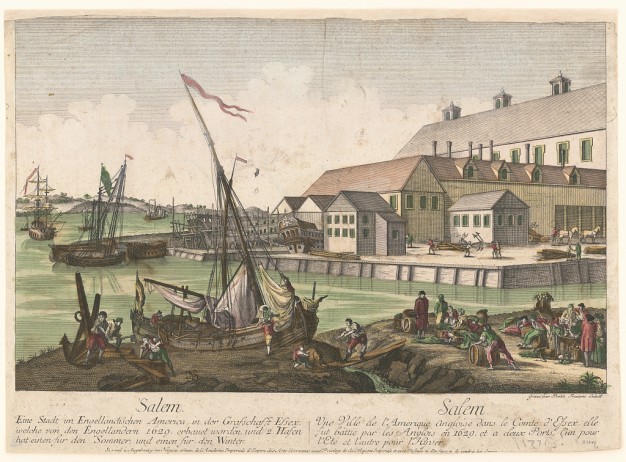
Image: Balthasar Friedrich Leizelt, "Vuë de Salem. Salem - eine stadt in Engelländischen America, in der Grafschafft Essex..." c. 1770s, engraving, Library of Congress Prints and Photographs Online Catalog.
Nathaniel Bowditch’s story begins with stolen books. In 1780, a ship bearing the library of Irish chemist and geologist Richard Kirwan came face to face with an enemy at sea. The American privateer, owned by John and Andrew Cabot of Boston, intercepted the ship in the Irish Channel. The first of the privateer’s nine captures, the English merchant vessel carried hundreds of scientific texts that were nearly impossible for most American colonists to access. The Cabots decided to auction off their loot in Beverly, Massachusetts. Along with several associates, Joseph Willard—the soon-to-be president of Harvard—purchased the extensive collection of books. Willard kept the library in his home until he moved to Cambridge, when the collection was transferred to Salem, to the home of John Prince, and eventually became the core of the Salem Philosophical Library (1781-1801).
Nathaniel Bowditch (APS 1809) was only seven years old when the privateer had stolen its loot, eight when the Salem Philosophical Library was finally founded. Bowditch had little memory of the Revolutionary War, but he was arguably made by it. Today, the name Nathaniel Bowditch is hardly remembered except by some maritime enthusiasts and historians of American science. But in the 19th century, Bowditch reached celebrity status, with his name becoming synonymous with expert maritime knowledge. His reputation eventually earned him election into the American Philosophical Society in 1809. The self-taught boy from Salem produced mathematical papers, joined philosophical societies around the globe, and completely revised and refined the essential maritime navigation handbook for American ships. In the late 19th century, famed astronomer Simon Newcomb (APS 1878) claimed that “there was hardly a man living who was a more complete master of the celestial mechanics of his time than was Bowditch. When we consider that he acquired this mastery by his unaided efforts, from pure love of the subject, while engaged in mercantile business or seafaring pursuits, we can hardly refuse him, in genius, a place alongside of [Pierre-Simon] Laplace and [Peter Andreas] Hansen.”
Nathaniel Bowditch was born on March 26, 1773 in the port town of Salem, Massachusetts. As a young student, he quickly surprised his tutors with his mathematical skill. On one occasion, “he was soundly flogged for solving a difficult question so quickly, that his teacher believed him to have been assisted by some unauthorized coadjutor.” In 1791, when Bowditch was 18, John Prince (APS 1805) and other incorporators of the Salem Philosophical Library determined “that Nathaniel Bowditch have the privilege of the Philosophical and Mathematical books of the library, to use them in the town of Salem only, for the year ensuing.” In these stolen books Bowditch found a new home. In his will, he noted that the “valuable scientific library of the celebrated Dr. Richard Kirwan” was “captured” by men who shared “enlightened views.” And “thus in early life,” he wrote, “I found near me a better collection of Philosophical and Scientific books than could be found in any other part of the United States nearer than Philadelphia.”
Diving into scientific treatises allowed the young man to escape into an exciting new world, a pleasant removal from the more uneven and tumultuous personal life he grew up with. At the beginning of the war, Bowditch’s father, Habakkuk, had gone out to sea, where he was captured by the British and held as a prisoner in Nova Scotia. In the 1780s, he lost his property, his wife and his mother passed away, and he developed a particularly ravenous appetite for rum. Bowditch’s family had long been in the shipping business, but Habakkuk’s drink and misfortune gradually eroded the stability that this tradition had provided. When Nathaniel became a bookkeeping apprentice to a ship chandler at the age of 12, he received no compensation beyond room and board. But this simple care Nathaniel received meant one less mouth to feed for the family. Bowditch would always remember these days with dread. Knowing he would have to rely on his own independence, the young man turned his attention to what the city of Salem had to offer.
Commerce was the heart of Salem, and its population size swelled or diminished depending on the health of its trade. During the war, Salem became a center of privateering, where private ships were granted a “letter of marque” to attack and seize enemy commercial vessels—how the Kirwan library eventually came to Salem. With the end of the war, the ships built and outfitted from the investments in privateering then turned their attention to trade. By the 1790s, a boom in trade lifted Salem’s sails, and the disruptions in shipping during the Revolution were soon forgotten.
One of the early books Bowditch studied in the Kirwan library was Isaac Newton’s Principia. He was attempting a nearly impossible task: learning Latin and Newton’s mathematics simultaneously. Bowditch was patient and impressive. At 13, he had created his own notebook on navigation, and at 14 he had started a manuscript called “The Practical Surveyor.” While small, thin, and intensely studious, Bowditch balanced his scientific curiosity with daring adventure. He traveled far out into the world numerous times as a ship’s clerk and captain’s writer. He spent time in Spain, Portugal, Manila, Sumatra, and various islands in the Indian Ocean. While making his wage, he continued his scientific studies to the soundtrack of the ocean pounding the sides of the ship. And he kept a journal to document his musings, from expressions of patriotism and excitement to more solemn criticisms: “God grant that that detestable traffic which she pursued may soon cease & that the tawny Sons of Africa may be permitted quietly to enjoy the blessings of liberty in their native country.” On his fifth and final voyage out to sea, Bowditch traveled as a master and part owner of the ship. After eight years of transient life, he returned to Salem in 1803 to become the president of a marine insurance company.

Intense travel did not inhibit Bowditch’s productivity. On his trip to Manila, Bowditch had discovered numerous errors in John Hamilton Moore’s The Practical Navigator. He decided to recalculate the numbers Moore used for his rules and tables—a deeply arduous and complex task—and found roughly 8,000 errors in Moore’s numbers. A Newburyport maritime publisher employed Bowditch, among others, to revise Moore’s work, which Bowditch did a second time in 1800. By 1802, Bowditch’s changes were so extensive that the publisher put the work in Bowditch’s name, titled The New American Practical Navigator. While Moore’s text was intended to be practical, Bowditch’s version was better organized, with more instruction in the mathematics and the explanation of symbols and abbreviations to guide readers. It presented a way to calculate compound interest using logarithms, marine insurance advice, and numerous other lessons in trade and commerce. It was geared to an American readership, especially a maritime population, that was now more forcefully entering global markets at the dawn of the 19th century.

Bowditch’s ingenuity was rewarded by membership to the American Academy of Arts and Sciences in 1799. Harvard offered Bowditch the chair of mathematics and physics in 1806, but he turned it down. And, the American Philosophical Society elected him a member in 1809. The New American Practical Navigator had made Bowditch a well-known name, but it was not the primary source of his growing scientific reputation. Through the early 19th century, Bowditch published numerous articles on mathematics, corresponded with leading European scientists, and translated and annotated Pierre-Simon Laplace’s multi-volume Mécanique Céleste (1799-1825). In 1818, the Royal Society of London elected Bowditch as a member, a distinct honor for an American.
All the while, Bowditch maintained his work as an insurance actuary. The shipping world of Salem had made Bowditch, and he continued to give back to the port city. He served as the president of the Essex Fire and Marine Insurance Company of Salem until, after many years, he decided to make a bigger move. In 1823, Bowditch left the Salem company and became an actuary for the Massachusetts Hospital Life Insurance Company in Boston, where he could attain greater prestige and a higher salary. But he never forgot Salem. In his will, Bowditch left $1,000 to the Salem Athenaeum, remembering the stolen books that had kindled his fire. The young boy, who had come from a long line of seamen, who had traveled the world on ships as both a clerk and a master, was now a titan of American finance and trade.
19th-century Americans imagined American empire extending far throughout both the Pacific and Atlantic Oceans. The language of maritime boosterism filled the periodicals of Early America, claiming that the far reach of American sails would “whiten” every sea. As historian Brian Rouleau writes, “it was a mantra meant to express the nation’s ambitious pursuit of commercial supremacy overseas, of U.S. dominance in the global carrying trade, and of transoceanic commerce as a conduit for American-led enlightenment.” Bowditch was the numbers guy behind this dream of expansion. His name had even become a useful shorthand for knowledge at sea. In Herman Melville’s Moby Dick (1851), Ishmael declares that “beware of enlisting in your vigilant fisheries any lad with lean brow and hollow eye; given to unseasonable meditative ness; and who offers to ship with the Phædon instead of Bowditch in his head.”
American ships carried “Bowditch” aboard to help guide their way, and Bowditch the actuary lined his own pockets through the growing fortunes Americans made at sea. The impact of this scientific revolutionary carries on today in a very tangible form, as every commissioned U.S. naval vessel still sails with a copy of “Bowditch” aboard.
References:
References:
Berry, Robert Elton. Yankee Stargazer: The Life of Nathaniel Bowditch. New York: Whittlesey House, 1941.
Bowditch, Nathaniel. The New American Practical Navigator. Newburyport, MA: Cushing & Appleton, 1802.
Dolin, Eric Jay. Rebels at Sea: Privateering in the American Revolution. New York: Liveright Publishing Corporation, 2022.
Kalkstein, Molly E. “The World According to Bowditch,” Naval History 17 (2003). https://www.usni.org/magazines/naval-history-magazine/2003/april/world-according-bowditch. Accessed March 19, 2026.
“Life and Character of Hon. Nathaniel Bowditch.” The Christian Review 3 (1838): 321.
Melville, Herman. Moby-Dick; or, The Whale. New York: Harper & Brothers, 1851.
Morris, Richard J. “Social Change, Republican Rhetoric, and the American Revolution: The Case of Salem, Massachusetts.” Journal of Social History 31 (1997): 419-433.
––––––. “General Gage Comes to Salem: Interests, Ideologies, Identities, and Family Alliances Collide on the Eve of the American Revolution.” Early American Studies 20 (2022): 263-304.
Newcomb, Simon. “Abstract Science in America, 1776-1876.” The North American Review 122 (1876): 42-65.
Pickering, John. Eulogy on Nathaniel Bowditch, LL.D., President of the American Academy of Arts and Sciences; Including an Analysis of his Scientific Publications. Boston: Charles C. Little and James Brown, 1838.
Rouleau, Brian. With Sails Whitening Every Sea: Mariners and the Making of an American Maritime Empires. Ithaca: Cornell University Press, 2014.
Thornton, Tamara Plakins. “The ‘Intelligent Mariner’: Nathaniel Bowditch, the Science of Navigation, and the Art of Upward Mobility in the Maritime World.” The New England Quarterly 79 (2006): 609-635.
––––––. Nathaniel Bowditch and the Power of Numbers: How a Nineteenth-Century Man of Business, Science, and the Sea Changed American Life. Chapel Hill: The University of North Carolina Press, 2016.