

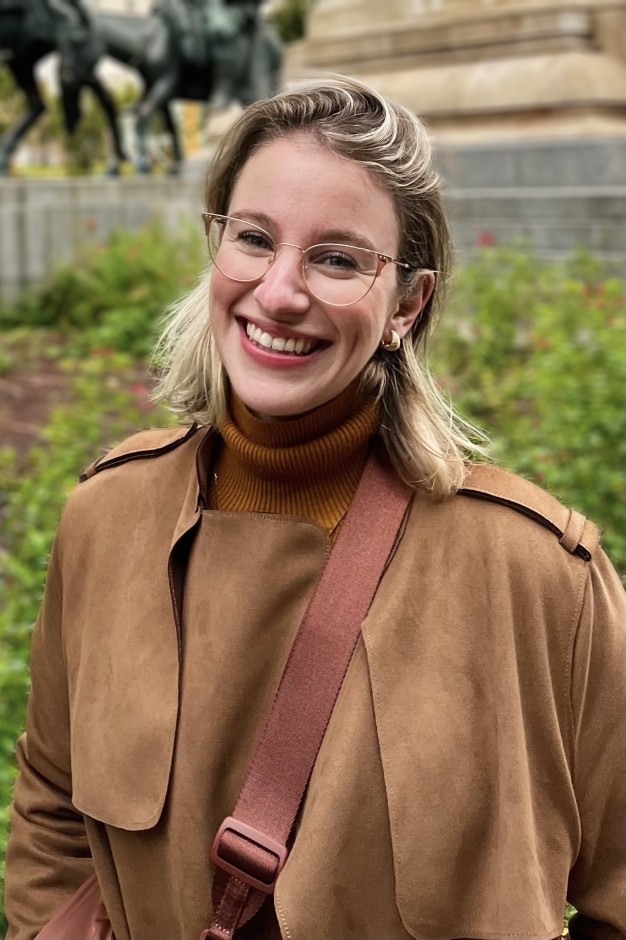
Featured Fellow: Taylor Elizabeth Dysart (2024-2025 John C. Slater Predoctoral Fellow in the History of Science, Technology & Medicine)


The Library & Museum at the American Philosophical Society supports a diverse community of scholars working on a wide-range of projects in fields including early American history, history of science and technology, and Native American and Indigenous Studies, among others. Additional information about our fellowship programming and other funding opportunities can be found here.
Briefly describe your research project.
I am a science studies scholar, and historian of medicine, science, and modern Latin America. My research investigates the transformation of sacred plants into subjects of psychedelic science and medicine in the northwestern Amazon, spanning the 19th century to today. I follow these transformations—which were often unexpected and partial but always complex—through the relationships between human and life scientists, folk and Indigenous knowledge practitioners, community stakeholders, and the plants themselves, with a particular emphasis on ayahuasca.
What collections did you use while working at the APS?
While at the American Philosophical Society, I spent most of my time with the Anthony F.C. Wallace Papers.
What’s the most interesting or most exciting thing you found in the collections?
While psychedelic medicine and science are becoming more mainstream in our present moment, many of the researchers that I follow in my dissertation could be considered as “fringe” scientists. In other words, several of them did not have much public support, institutional stability, funding sources, or established professional networks, and this was especially true for the women who were involved in this research in the 1960s and the 1970s. One such researcher, Marlene Dobkin de Rios, was a transcultural psychotherapist and medical anthropologist who published prolifically on folk uses of ayahuasca in northeastern Peru, amongst other related topics like cross-cultural drug rituals and divination. Despite this vast expertise, Dobkin de Rios and her peers had reflected on how their research about psychedelic plants (as they would describe them) did not always fit neatly within existing academic disciplines. Given that history, I was surprised to learn how much she relied on well-established cultural anthropologists, like Anthony F.C. Wallace, as intellectual and social mentors as she moved through her career. She had a similar relationship with Richard Evans Schultes, an ethnobotanist, who fashioned himself as a modern Victorian gentleman scientist and distanced himself as much as possible from the “psychedelic sixties.”
Do you have any tips or suggestions for future fellows or researchers?
Philadelphia is an exceptional place to conduct archival research and build scholarly community. I would attend as many Brown Bags and Works-in-Progress sessions as possible, even if they appear vastly different from your own work.
Any suggestions for must-see places or things to do in Philadelphia?
As a former resident of South Philly, I am unapologetically partial to its offerings. I would suggest that you get cheesesteaks (with whiz obviously) from Angelo’s but make sure you call around 6pm so that you don’t have to wait in-line and risk them selling out for the evening. If you are missing your pets and/or need a break from your work, you can volunteer to walk the rescue dogs from Doggie Style Pets on Market. The Rodin Museum is serene, and the Rosenbach has unexpected and fun events. You should also embrace the Eagles.
Taylor Elizabeth Dysart is a science studies scholar, and historian of medicine, science, and modern Latin America. She received her Ph.D. in History and Sociology of Science from the University of Pennsylvania, along with a graduate certificate in Latin American and Latinx Studies, in 2025. She is currently an Assistant Professor of History at the School of History and Sociology at the Georgia Institute of Technology.