

“I Never Read Locke”: A Letter at the American Philosophical Society and Paine’s Dialogue with Locke



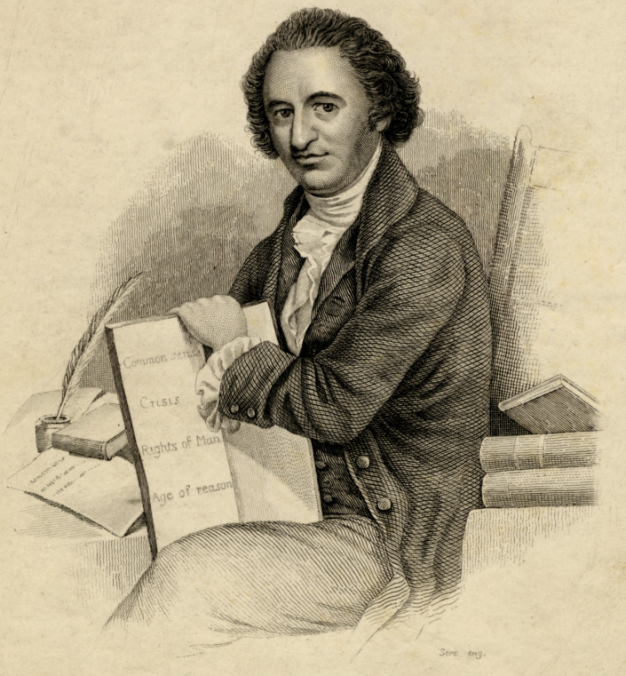
John Serz, "Thomas Paine," engraving, Colonel Richard Gimbel Collection of Thomas Paine Papers, American Philosophical Society Digital Library.
The place of John Locke in Thomas Paine’s political thought has long been a matter of debate. Locke was omnipresent in the 18th-century European Republic of Letters; his name was inescapable even for those who had not read him. In his classic essay on John Locke, Peter Laslett notes that, as early as 1798, Bishop Thomas Elrington, in his own edition of Two Treatises of Government, introduced and annotated remarks directed against citizen Thomas Paine in order to establish the distinction “between the system of Locke and the theories of modern democrats.”
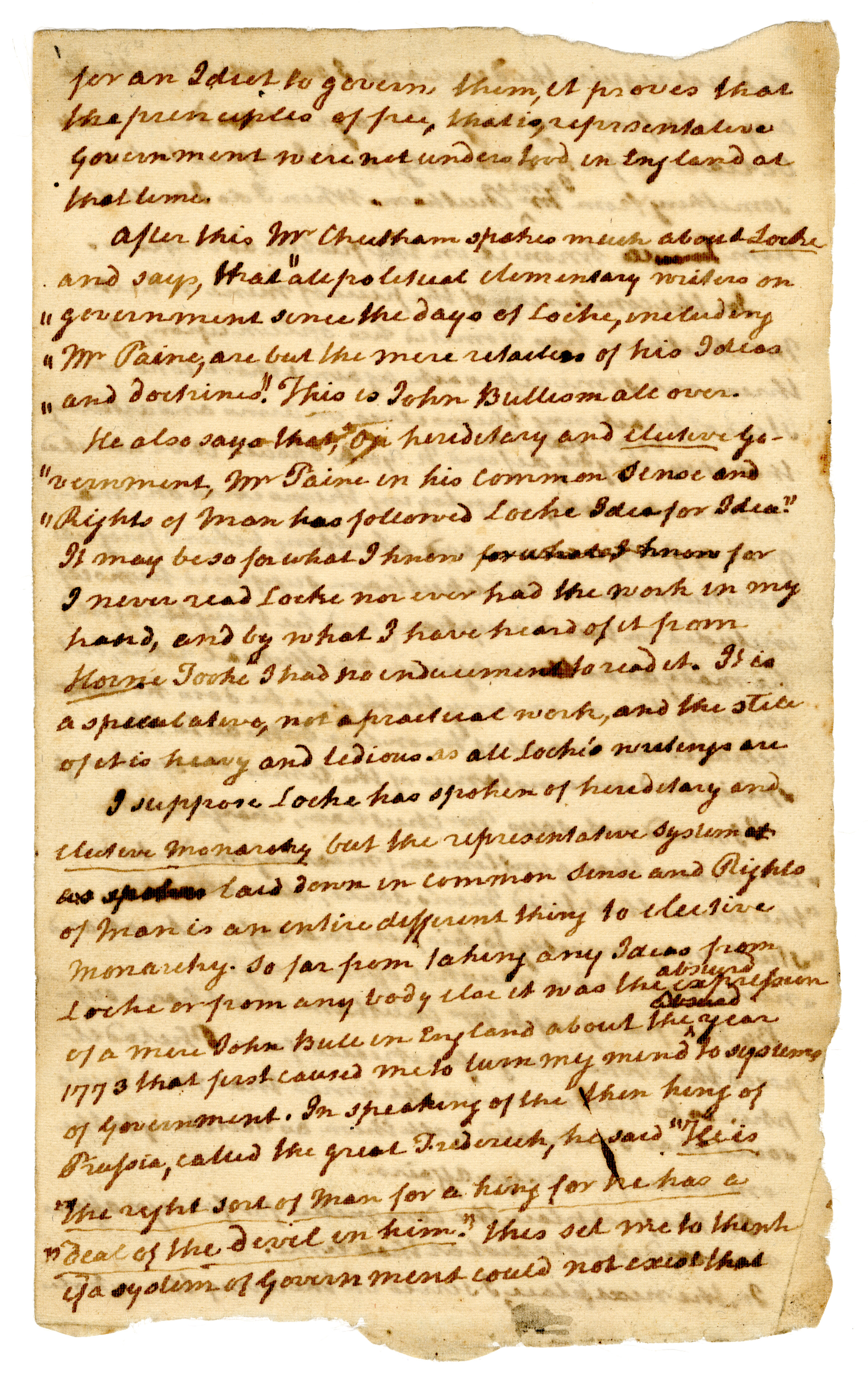
Many pages have already been written reflecting both on the ideas that unite the two authors, such as empiricism, the defense of toleration, and the right of resistance, and on what distinguishes them, including Paine’s more explicitly democratic political stance, defense of universal suffrage during the French Revolution, his religious position, and his social commitments, notably his rejection of slavery. Nevertheless, one letter, a reply to James Cheetham dated August 21, 1807, written at the end of Paine’s life and preserved in the Richard Gimbel Collection of the American Philosophical Society, offers an especially revealing clue: the letter can be read as a deliberate act of intellectual self-positioning, in which he defines his political project in conscious opposition to what he understood as the Lockean tradition.
Colonel Richard Gimbel Collection of Thomas Paine Papers, American Philosophical Society Digital Library.
Paine had published an article in the Public Advertiser defending the harbor of New York. Cheetham criticized Paine for this article. Cheetham was English by origin and initially a friend and admirer of Paine. Their relationship deteriorated when Paine discovered that one of his contributions to the Jeffersonian newspaper The American Citizen had been altered without his authorization. Cheetham later became known for publishing The Life of Thomas Paine in 1809, a biography written with explicitly defamatory purposes. In this biography, Paine is portrayed as a man who wrote Common Sense as a form of revenge for what he had suffered in England.
Paine’s letter is a fragment and begins abruptly with Paine responding to Cheetham: “it proves that the principles of free, that is, representative government were not understood in England at that time.” Later in the letter, Paine refers to a passage by Cheetham, who reportedly stated: “all political elementary writers on government since the days of Locke, including Mr. Paine, are but the mere retailers of his ideas and doctrines.” Indeed, one of the fundamental elements of Common Sense was an effort to give Americans a history of their own, distinct from England: “as the colony increases, the public concerns will increase likewise,” he asserts at the very beginning of the pamphlet, aiming to provide the American world with its own historical narrative and to critique the biases derived from English “national pride.” This leads us to speculate whether, in distancing himself from Locke, Paine was not merely rejecting Locke, but also turning away from English political thought as a whole.
Paine then proceeds with a startling confession: “He [Mr. Cheetham] also says that, ‘on hereditary and elective government, Mr. Paine in his Common Sense and Rights of Man has followed Locke Idea for Idea’. It may be so for what I know for I never read Locke nor ever had the work in my hand, and by what I have heard of it from Horne Tooke I had no inducement to read it.” Paine asserts that Locke’s text is “speculative,” not “practical,” and that its style is “heavy and tedious as all Locke’s writings are.” This is particularly significant, given that a pamphleteering style and clear, simple writing are hallmarks of Paine’s entire oeuvre.
We cannot determine whether Paine had read Locke or whether the remark was rhetorical. What the letter does make clear, however, is his intention to position himself at some distance from the author. Accordingly, Paine writes, “I suppose Locke has spoken of hereditary and elective Monarchy but the representative system laid down in Common Sense and Rights of Man is an entirely different thing to elective Monarchy.”
The passage is not entirely fair to Locke. More than mere discussions of elective monarchy, Locke’s two treatises address broader issues, including the legitimacy of governments, the relationship between subjects and rulers, and the problem of property, all of which are also present in Paine’s work. Locke demonstrates that all civil power must derive either from the tacit consent of the people, reinforced by their constant obedience, or from their explicit consent. Naturally, these ideas closely resemble the principles of Common Sense.
Having acknowledged this fairness toward Locke, it is necessary to recognize, conversely, that Paine had some justification in marking a distinction. With regard to hereditary and elective governments, one of Paine’s main arguments, in both Common Sense and Rights of Man, is the impossibility of any effective checks and balances involving the monarchy, the aristocracy, and the people. This is because the monarchical, aristocratic (the House of Lords), and popular (the House of Commons) powers are of fundamentally different natures: the first two derive from succession and heredity, and therefore, in Paine’s view, have no legitimate claim to exist, while the latter derives from election and representation and is thus legitimate. Not surprisingly, for Paine, instead of a “balance of power,” what exists in England is a house divided against itself.
In Paine, therefore, there is no possibility of a mixed government. For Locke, the “slowness and aversion in the people to quit their old constitutions, has, in the many revolutions which have been seen in this kingdom, in this and former ages, still kept us to, or, after some interval of fruitless attempts, still brought us back again to our old legislative of king, lords and commons.”
It is possible to imagine, although we can never be certain, that this may have been what most disturbed Paine when he heard about Locke’s work from Horne Tooke – a well-known critic of Locke’s theory of ideas. This suggests that Paine would have encountered Lockean ideas through one of their most famous contemporary critics.
This difference is also one of the main aspects, as noted by Bishop Elrington, mentioned at the beginning of this text, regarding what separates Paine from Locke. In attempting to defend Locke against Paine, Elrington inadvertently sharpened the distinction between them. According to the bishop, who was a defender of the English constitution, Paine’s egalitarian vision of representative government was something completely different from what Locke had proposed. While Locke’s primary concern was to protect men from the “abuses which all men admit to have exist in our present government remedied,” Paine’s model would extend the franchise universally, including to women and those without property. For Paine, equality was the solution — not the problem — suggested by nature.
It cannot be said that Paine’s early position was simply the same as Locke’s. The 1807 letter to Cheetham helps to illuminate this distinction. While some points of similarity between his work and Locke’s can be observed, Paine himself explicitly distances his thought from the 17th-century tradition, rejecting both Locke’s style and what he saw as the speculative character of his political theory. Paine emphasizes that his political project arose from a different context and addressed different problems. In this respect, his adversaries—most notably Bishop Thomas Elrington—were more accurate than some later commentators in marking the distinction. Paine’s rejection of mixed government and his commitment to an egalitarian conception of representation place him well beyond the Lockean framework tied to the preservation of the English constitution. The letter thus functions not merely as a biographical curiosity, but as a crucial document for understanding how Paine himself conceived of the originality and purpose of his political thought.
References:
Bruce Parsons, William. “Thomas Paine: Conscience of Liberalism; A Comparison of the Political Philosophy of Paine and Locke.” PhD dissertation, University of Toronto, 2008.
Cheetham, James. The Life of Thomas Paine. London: Reprinted for A. Maxwell, 1817.
The Complete Writings of Thomas Paine. Edited by Philip S. Foner. New York: Citadel Press, 1945.
Elrington, Wilfred. Thoughts on the Principles of Civil Government, and their Foundation in the Law of Nature. Dublin: Printed for the author by George Grierson, 1793.
Harris, James A. “The Interpretation of Locke’s Two Treatises in Britain, 1778–1956.” In Historiographies of Philosophy 1800–1950. London: Routledge, 2023.
Horne Tooke, John. Epea Pteroenta, or The Diversions of Purley. Edited by Richard Taylor. London: Thomas Tegg, 1940.
Kinsel, Jason “The Misunderstood Philosophy of Thomas Paine.” Master’s thesis, University of Akron, 2015.
Kramnick, Isaac. "Tom Paine: Radical Democrat." Democracy 1 (1981).
Locke, John. Two Treatises of Government. Edited by Peter Laslett. Cambridge: Cambridge University Press, 1960.
Paine, Thomas. Common Sense. In The Complete Writings of Thomas Paine. Edited by Philip S. Foner. New York: Citadel Press, 1945.
Paine, Thomas. “Dissertation on First Principles of Government.” In The Complete Writings of Thomas Paine. Edited by Philip S. Foner. New York: Citadel Press, 1945.
Paine, Thomas to James Cheetham. August 21, 1807. Colonel Richard Gimbel Collection of Thomas Paine Papers. American Philosophical Society Digital Library.
Vale, Gilbert. “The Life of Thomas Paine.” New York: Published by the Author, 1853. Accessed via Thomas Paine Historical Association.
Zuckert, Michael. “Two Paths from Revolution—Jefferson, Paine, and the Radicalization of Enlightenment Thought.” In Paine and Jefferson in the Age of Revolutions. Edited by Simon P. Newman and Peter S. Onuf. Charlottesville: University of Virginia Press, 2013.