




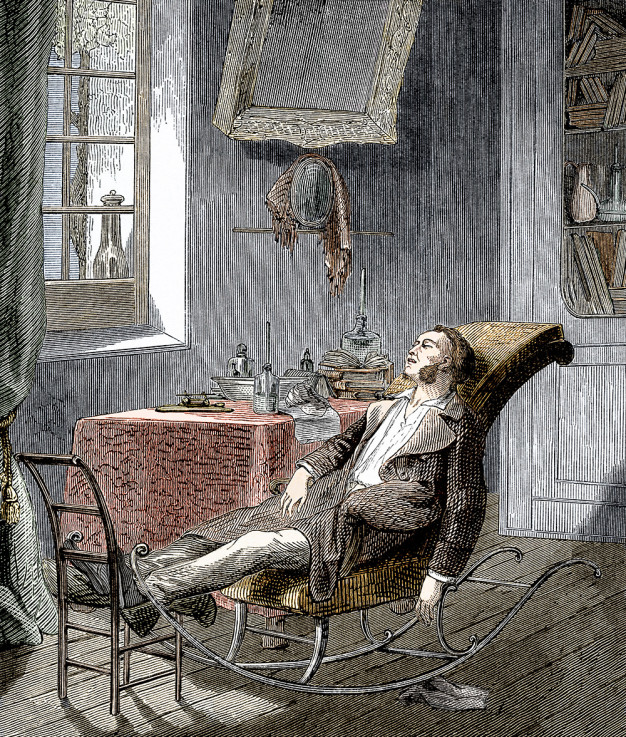
“Jackson under the effects of ether,” depicting his 1841 self-experiment.
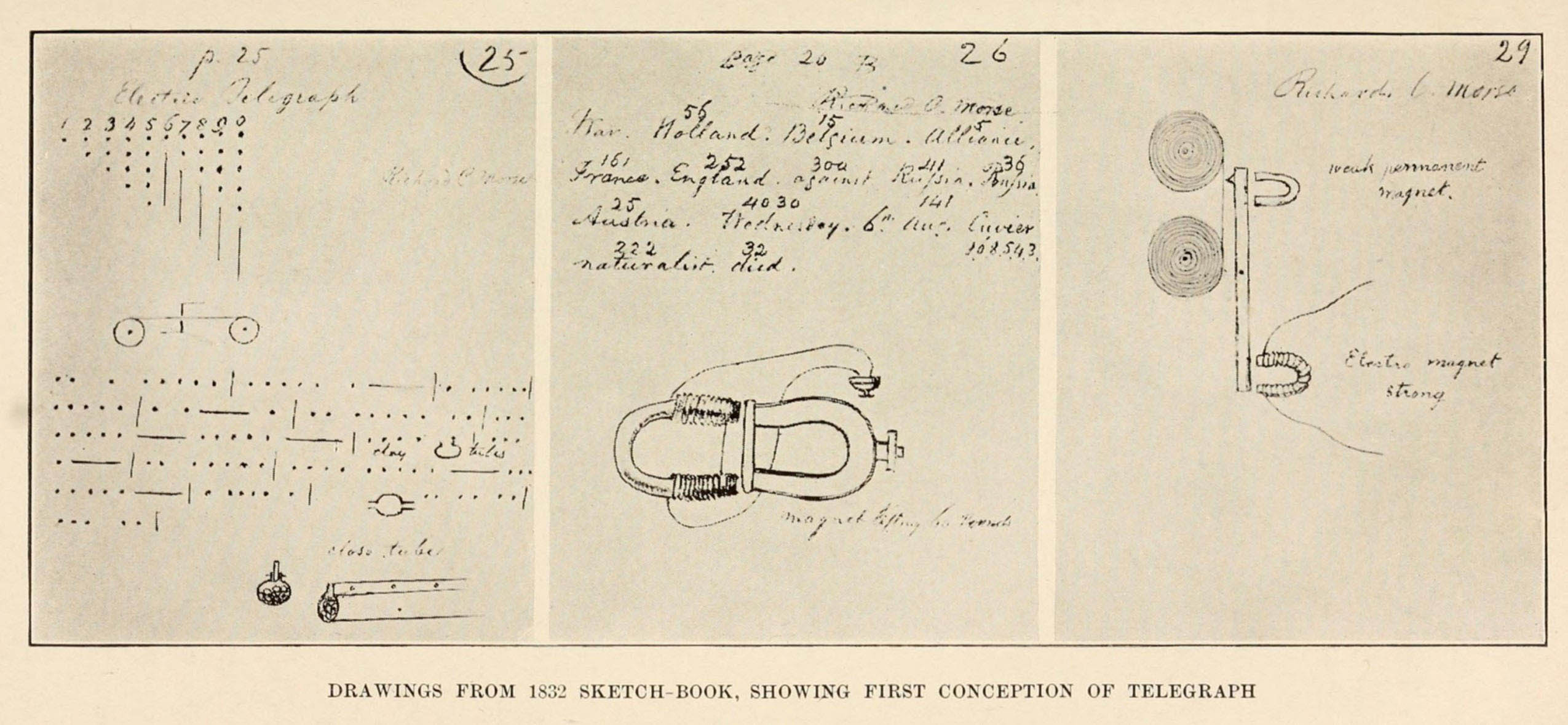
Somewhere on the mid-Atlantic, in the fall of 1832, a portrait painter aboard the packet ship Sully posed a question to a young Boston physician. “Electro-magnetism! How does that differ from other magnetism?” The physician—homeward bound after three years spent studying medicine, geology, and chemistry in Paris—sketched batteries and magnets on a scrap of paper by way of explanation. For the remainder of the crossing, the portrait painter, a man by the name of Samuel F.B. Morse, trailed him around the ship with a notebook in hand.
This was how it happened according to Charles Thomas Jackson, the aforementioned physician, who vividly recreated the scene in a deposition given under oath some 18 years after the voyage of the Sully. As of 1850, telegraph lines were popping up all over the country—some licensed, some not—and Morse was suing his unlicensed competitors for patent infringement. Jackson was there to testify against his old travel companion: He swore that there was nothing to infringe, because the telegraph had been his idea to begin with.
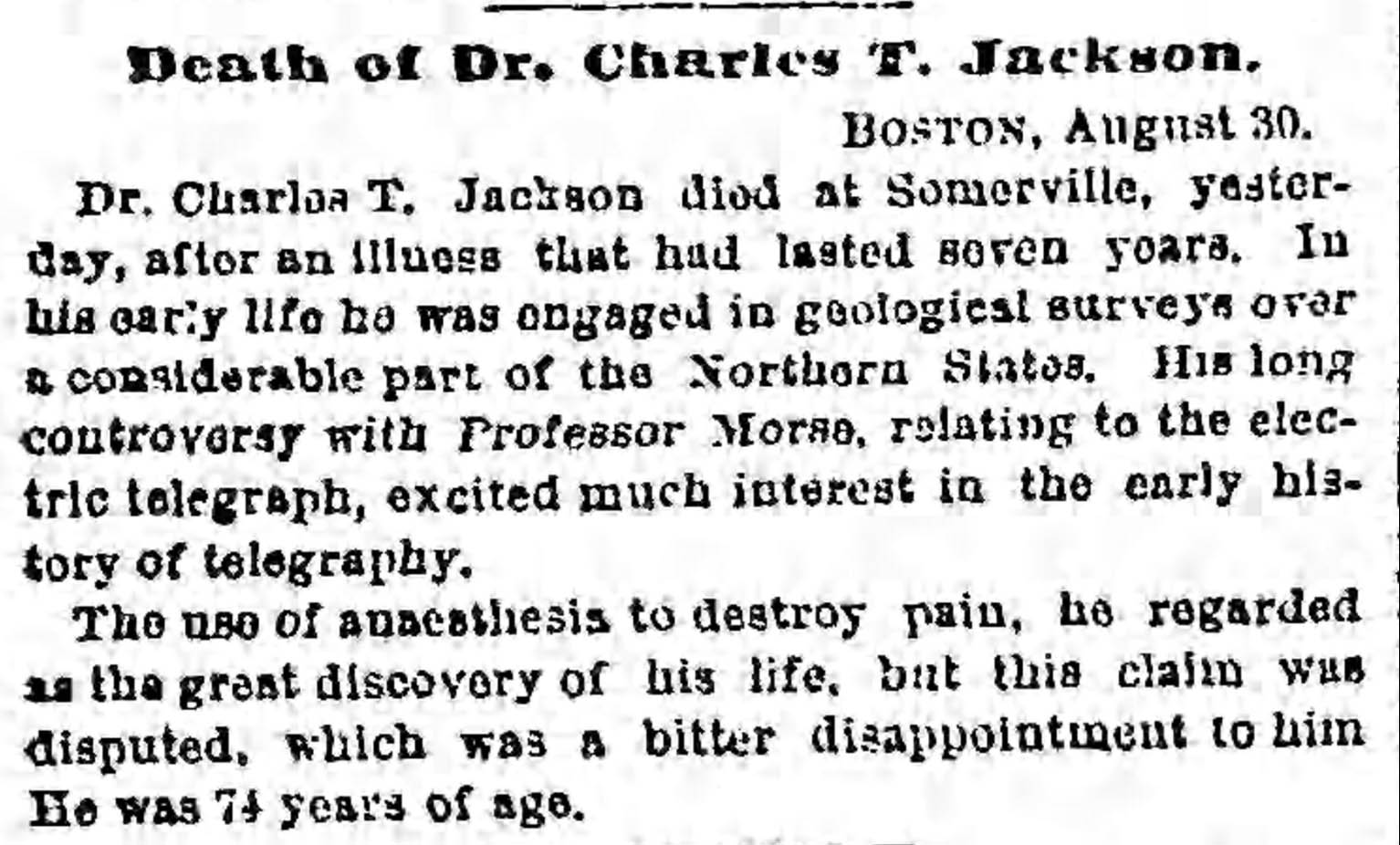
Jackson likely believed he’d reconstructed the conversation exactly as it happened nearly two decades later; he may even have done so, with the fastidious recall of a rigorous mind. He was a doctor, a chemist, and a geologist, sometimes all in the same year, and he had made substantial contributions to practical fields as disparate as surgery and mining. He did so in an era that measured the value of science by how directly it bettered ordinary life. Jackson embodied the idealism of the age as well as anyone, but that idealism came at a price. The other pillars of nineteenth century American science were unbridled capitalism—mediated by the patent system—and the cult of personality, both of which had passed Jackson by completely. Indeed, the telegraph wasn’t his only dispute. Jackson had advised the dentist William T. G. Morton on the use of ether before Morton’s 1846 public demonstration using it as surgical anesthesia. Morton then patented the formula and claimed sole credit. At the time of his death, Jackson was residing in the McLean Asylum. A 1944 Hollywood film on the invention of anesthesia, The Great Moment (Paramount, dir. Preston Sturges), even cast him as the villainous counterpart to the heroic Morton.
Jackson’s brother-in-law Ralph Waldo Emerson diagnosed his predicament, writing to Senator Charles Sumner in March of 1863 that Jackson simply had “not known how to conciliate some important persons.” This may seem like an unexpected assessment coming from the author of “Self-Reliance,” but conciliating important persons was exactly how Emerson made his living on the lecture circuit—a skill Jackson never seemed to care to learn. He had brought back a deep conviction from his training at the French Academy of Sciences during his fateful trip to Paris. Jackson believed that a discovery fundamentally belonged to the community of science at large. He bemoaned “the impropriety of scientific men taking out patents for their discovery,” and in 1851 called for the creation of a body to arbitrate such claims, a dozen years before Congress chartered the National Academy of Sciences. Yet Jackson also spent his life bitterly convinced he’d been cheated of credit for his discoveries, a contradiction he never resolved. Jackson’s friend Dr. C. A. Bartol wrote that he was “as simple as a child and voracious like the sun,” but prone to becoming “bellicose” in a disagreement. Bartol understood Jackson plainly as “a man whose self-respect did not allow him to waive his own claim.”
A more complete and personal view of Jackson is now coming into focus. The Charles Thomas Jackson Papers came to the American Philosophical Society courtesy of Jackson’s great-great-grandson, Charles Jackson Bird, comprising over two hundred bound volumes of correspondence, notebooks, legal depositions, hospital documents, and family papers. Discovered in two Civil War–era army trunks that had sat unopened for decades, it is one of the largest caches of mid-nineteenth century American scientific manuscripts. The collection was digitized this year and made available via the APS Digital Library, supplementing the dominant narratives of American innovation that turned Morse and Morton into household names. Bird’s own essay in Proceedings of the American Philosophical Society draws on previously unread family correspondence and testimony to reframe a life story long reduced to a historical caricature. You can also read an early biographical sketch of Jackson by Joseph Hale Abbot, offering a contemporary account corroborating Jackson’s integral role in the discovery of ether.
Among the papers in the Bird collection is a letter Jackson wrote to his sisters in January of 1837, mentioning offhand that the telegraph he and Morse had dreamt up together was “but a project in air.” Penned long before the patent dispute, the letter lends credibility to Jackson’s later recollection of the voyage. It’s also an apropos turn of phrase for a man who championed the essence of scientific discovery as a collaborative and convivial process. Yet by leaving his ideas in the air, Jackson became an early casualty of a pragmatic new American order: one that rewarded the individual who could bring a vision down to earth and turn a profit first.
References
- Charles Thomas Jackson, deposition testimony, 1850; quoted in Richard J. Wolfe and Richard W. Patterson, Charles Thomas Jackson: The Head Behind the Hands (Norman Publishing, 2007), 227–232.
- “Drawings from the sketchbook of Samuel F. B. Morse, illustrating his first conception of the telegraph,” Everett Collection/Alamy Stock Photo, reproduced in Joseph Connor, “Morse's Partner Argued He Invented Famous Code—to No A-Vail,” HistoryNet (originally published in American History, June 2020).
- Charles Thomas Jackson Papers, American Philosophical Society, Philadelphia; W. Franklin Wood to Alexander Forbes, December 12, 1938, Charles Thomas Jackson Papers, Series I Correspondence, American Philosophical Society.
- The Great Moment, directed by Preston Sturges (Paramount Pictures, 1944), based on René Fülöp-Miller, Triumph Over Pain (The Literary Guild of America, 1938).
- “Jackson’s Ether Experiment,” illustration by Sheila Terry, Science Photo Library, ref. K004/4322.
- Ralph Waldo Emerson to Charles Sumner, March 1, 1863, Concord; Jackson Family Papers, Unprocessed Materials.
- Charles Thomas Jackson, deposition testimony, 1850; quoted in Wolfe and Patterson, Charles Thomas Jackson, 235.
- Dr. C. A. Bartol, quoted in J. B. Woodworth, “Charles Thomas Jackson,” The American Geologist 20 (August 1897): 85–86.
- “Dr. Charles Thomas Jackson”, Brooklyn Daily Eagle, August 30, 1880
- “Charles Thomas Jackson Papers: A Unique Look into the World of 19th-Century Science and Culture,” American Philosophical Society blog, August 2023; Charles Thomas Jackson Papers finding aid, American Philosophical Society.
- Charles Jackson Bird, “Reassessing the Legacy of Charles Thomas Jackson (1805–1880), Proceedings of the American Philosophical Society (2026).
- Charles Thomas Jackson to Lidian Emerson and Lucy Brown, January 13, 1837, Series I Correspondence, Charles Thomas Jackson Papers, American Philosophical Society.