



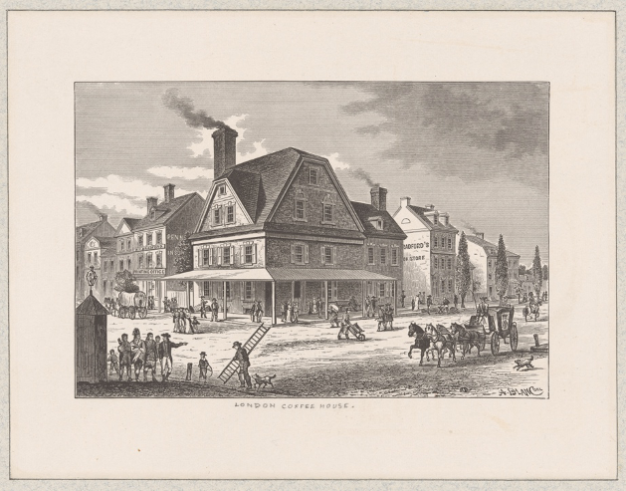
Header Image: London Coffeehouse on Market Street (https://digitalcollections.nypl.org/items/d30aa830-c608-012f-2243-58d385a7bc34?canvasIndex=0)
High Street (later Market Street) was the central artery of colonial Philadelphia. In 1682, William Penn and Thomas Holme, learning from the bubonic plague that ravaged London from 1665 to 1666 and the Great Fire of London in 1666, planned the street to be one hundred feet wide. It sat along the longitudinal center of Philadelphia’s gridiron. The geometric streets provided openness, intuitive structure, and visibility—what scholar Dell Upton calls the “republican spatial imagination.” Walking west from the Delaware River in the middle of the 18th century, a traveler would come across many shops, taverns, a city jail, the Town Hall and Courthouse, Christ Church, and the London Coffeehouse. Private residences also looked out over the bustling street, including Benjamin Franklin’s between Third and Fourth Streets and financier Robert Morris’s between Fifth and Sixth Streets.
As the traveler passed carefully through the noise and dirt, dodging flying buckets of water used to cool down the streets, she would eventually reach a dry goods store on the north side of Market Street. The store belonged to a widow, healer, and businesswoman named Elizabeth Coates Paschall. Paschall was born in 1702 to a well-to-do Quaker merchant family. She was raised in the store on Market and Second Streets that would eventually become hers. The store sold staple goods, such as fabrics, flour, hardware, and groceries, but, like other general shops, it also sold medicines. Her parents taught Elizabeth and her siblings best business practices and methods of healing. And as her father grew ill, the young Elizabeth helped him keep his account books. A Quaker, Elizabeth was made an executor, along with her brother, of her father’s 1719 will. She held legal responsibility normally not given to non-Quaker women under English common law.
Elizabeth’s Quaker upbringing afforded remarkable ambition. In contrast to the Church of England, Quakers rejected formal worship, had no liturgy, and believed that reading the Bible should be done under the care and guidance of the Holy Spirit. And unlike the many Evangelical Christians of the 18th century, the Quakers’ spiritual practice allowed for reinterpretation with each generation, which created a greater assimilation of scientific ideas into their religious belief system and education. Quakers bestowed this educational empiricism and independence upon both boys and girls. Their beliefs in female literacy and religious equality (women could serve as Quaker ministers) allowed women to step out into the public sphere in more visible ways than non-Quaker women. In Philadelphia, women entrepreneurs “took advantage,” historian Susan Brandt writes, “of an emerging culture of medical consumerism accompanied by increased demand for printed health care information, therapeutic advice, and pharmaceuticals.”
Elizabeth became one of the most prominent women healers in Philadelphia. Two years after her father’s death, at the age of 19, she married Joseph Paschall, the grandson of Thomas Paschall Sr., an apothecary, pewterer, and alchemist who joined William Penn’s 1682 fleet that sailed to Pennsylvania from Bristol, England. Thomas Paschall Jr., Joseph’s father, ran a mill west of Philadelphia and served in the Pennsylvania Assembly. Joseph similarly grew up in a Quaker family, and when Joseph and Elizabeth married, the two moved into the Coates house on Market Street that Elizabeth had inherited from her father. Elizabeth learned alchemical and medical practices from Joseph and his brothers, augmenting what she had already learned from her parents, especially her mother Beulah. In the 1730s, Joseph served in positions on the Philadelphia City Council and helped establish, along with Benjamin Franklin, the Union Fire Company. From her elite standing, Elizabeth amassed a network of medical informants, from leading Philadelphia intellectuals to unnamed Indigenous healers, blending and compiling this knowledge in her recipe book. As a testament to her connections, Franklin, in his old age, recalled Elizabeth as “my dear old friend.” Tragically, Joseph died suddenly in 1742, but Elizabeth maintained the dry goods store on Market Street, took care of their three children, and pursued her second career as a well-respected healer. She never remarried, choosing to retain the right to conduct legal, business, and real estate transactions as a single woman.
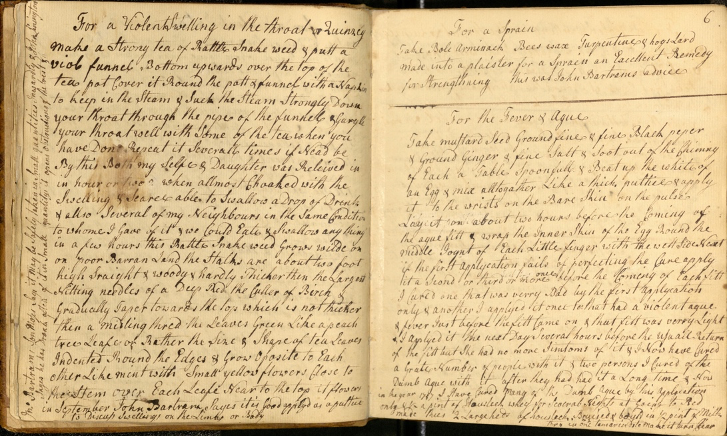
From the 1740s until her death in 1768, Elizabeth recorded nearly two hundred medical recipes in her notebook. Elizabeth Paschall’s recipe book has given scholars a remarkable window into the medical landscape of colonial Philadelphia. Medical knowledge passed freely: in the streets, in homes, and in shops. The recipe book recreates both the social life of the city and the channels through which medical knowledge traveled. Elizbeth recorded knowledge from Black healers, Indigenous healers, physicians, tavern keepers, women in both shops and the home, family members, and more. Her recipe book reveals extensive experimentation, blending ancient humoral theories with novel chemical medicine, as well as incorporating foreign traditions such as a Pennsylvania German folk medicine called Braucherei, or the wisdom of an elderly Black healer from Merion who had come to Philadelphia to treat a man who feared the surgeon’s reputation for hasty amputation. When writing down her own treatments, she ecstatically noted her successful experiments: “Cured when the Doctors failed!” And she was never shy to state that a particular cure was “[her] own invention.”
Two short entries from her recipe book reveal both how she recorded medical knowledge and the extent of her networks:
For a Sprain
Take Bole arminach, Bees wax, Turpentine & hogs lard made into a plaister for a sprain an Excellent Remedy for Strengthening. This was John Bartrams advice.For Piping a Bed
I was informed By Thomas Penrose’s wife who is an acquaintance of mine & a person of undoubted credit that a spoonful of whole mustard seed taken Every Night was a Certain Cure for those that cannot hold their water in the Night from Piping the Bed & that She cured a young man that mostly Piped the Bed Every Night By only giving him a table spoonful of whole mustard seed in warm milk Every Night for a Considerable time.
She supplemented the lay knowledge of Philadelphia networks with reading from resources at the Library Company of Philadelphia, including Robert James’s Medicinal Dictionary. She transcribed and reinterpreted many of James’s cures and anatomical explanations, and copied a long passage on famed physician Herman Boerhaave, focusing on his early life experiences that led him to a life of medicine. In Boerhaave’s story, she found inspiring similarities to her own experiments with self-treatments.
Elizabeth happily maintained her dry goods store on Market Street, bridging, as Brandt notes, “the spheres of private domesticity, communal neighborliness, healing, and commerce.” But in 1746 she purchased fifteen acres of land in Frankford, desiring a rural retreat from her urban responsibilities. She commissioned a small stone house, eventually called Cedar Grove, that was completed in 1750. In the 1750s, she cultivated a medicinal and herb garden on the grounds of Cedar Grove. Yet she did not retreat from public life. In 1765, she signed a nonimportation agreement, along with four hundred other merchants, protesting the Stamp Act. Sadly, her flourishing medical career came to a sudden end in 1768. She died at the age of sixty-six of unknown causes. The final entries in her recipe book were both culinary and medicinal, but they shared a characteristic sentiment that Elizabeth proudly carried with her until the end: “my way.”
On Market Street, Elizabeth had shown to her neighbors, and to historians and curious readers today, the revolutionary possibility of women in science and medicine in 18th-century American life. Quaker Philadelphia had tendered such possibility. And it would set the stage for the ambitious liberal project of the next decade. On Market and Seventh Streets, Thomas Jefferson drafted the Declaration of Independence in 1776. After the Revolution, Philadelphia, as the nation’s capital in the 1790s, provided the home to the country’s executive branch. Financier Robert Morris offered his home on Market Street to George Washington, who resided there until 1797. In the meantime, Washington and Jefferson had tasked a team of surveyors to chart out the new federal capital along the banks of the Potomac. John Adams lived in the Market Street house after George Washington, until the capital finally moved to Washington in 1800.
Quaker women in Philadelphia sustained a vibrant and diverse medical marketplace in the city. Around the time of the Revolution, Catharine Haines, a Quaker girl from Germantown, and fifty-nine years Elizabeth’s junior, kept a similar recipe book of medical knowledge. Catharine’s recipe book is now held at the APS’s Library & Museum and currently on display in the Society’s exhibition, Philadelphia, The Revolutionary City. It contains a couple cures from English physician John Fothergill, but it is mostly a product of family and neighbors, including knowledge from her cousin Caspar Wistar, and William Chancellor, who sold medicines imported from London at his apothecary on Market Street. These medical networks travelled along Market Street, yet they also connected city to hinterland, urban core to the wider region. For example, Margaret Hill Morris, born in 1737, had grown up in Philadelphia as a Quaker and married a Quaker dry goods merchant. When her husband died in 1766, Margaret moved to Burlington, New Jersey where she opened her own medical practice and apothecary. Growing up, she would have known Elizabeth, and likely Elizabeth Whartnaby, who also ran a medical shop on Market Street. Indeed, Margaret was Elizabeth Paschall’s cousin. North of Philadelphia and just across the Delaware River, Margaret was able to turn her medical knowledge into economic success: “I have more custom [business] than I expected!” As Brandt notes, Elizabeth Paschall’s healing networks “extended beyond the city of Philadelphia to the greater Delaware Valley and across the Atlantic.” Science was knowledge in transit, the persistent movement of ideas and methods through established and, at times, unexpected places and people.
References:
Amano, Yuri. “Narrating a Life in a Medical Recipe Book: Elizabeth Paschall of Philadelphia.” The Journal of American and Canadian Studies 37 (2019): 3-30.
Brandt, Susan H. Women Healers: Gender, Authority, and Medicine in Early Philadelphia. Philadelphia: University of Pennsylvania Press, 2022.
Haines, Catharine. Recipe Book. Digitized by the American Philosophical Society Library and Museum. https://therevolutionarycity.org/islandora/haines-catharine-medicinal-and-household-recipe-notebook-1776
Nash, Gary B. First City: Philadelphia and the Forging of Historical Memory. Philadelphia: University of Pennsylvania Press, 2002.
Paschall, Elizabeth Coates. Recipe Book. Digitized by The College of Physicians of Philadelphia Historical Medical Library. https://archive.org/details/10a-352-ECpaschall.
Secord, James A. “Knowledge in Transit.” Isis 95 (2004): 654-672.
Upton, Dell. Another City: Urban Life and Urban Spaces in the New American Republic. New Haven: Yale University Press, 2008.
Wunsch, Aaron. “Cedar Grove.” Historical American Buildings Survey, Washington, D.C., Library of Congress. August 1995. https://tile.loc.gov/storage-services/master/pnp/habshaer/pa/pa1100/pa1145/data/pa1145data.pdf