

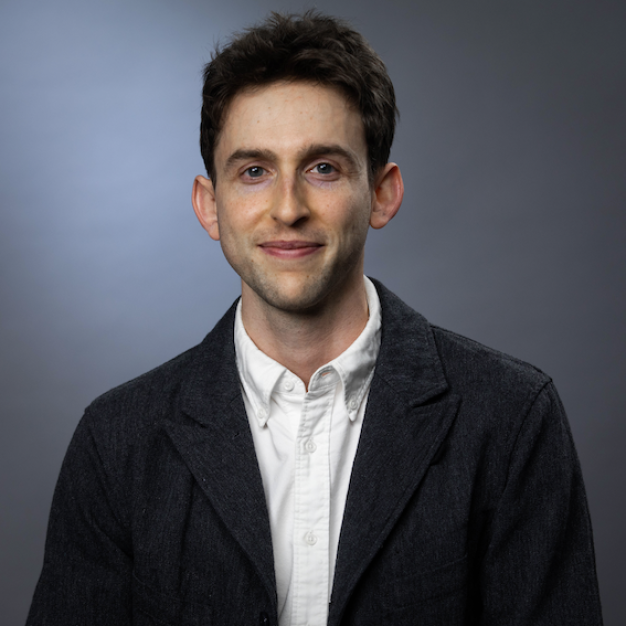
Featured Fellow: Aaron Gluck-Thaler (2023-2024 Mellon Foundation Short-Term Research Fellow)


The Library & Museum at the American Philosophical Society supports a diverse community of scholars working on a wide-range of projects in fields including early American history, history of science and technology, and Native American and Indigenous Studies, among others. Additional information about our fellowship programming and other funding opportunities can be found here.
Briefly describe your research project.
My project examines the role that scientists have played in the emergence of new forms of surveillance. I consider how scientific research has changed government surveillance programs and how problems of surveillance have shaped the character of scientific knowledge. The project focuses on how scientists from diverse fields in the 20th century tried to settle problems of identity, like who someone is or what something is, by amassing data and recognizing patterns within those data. I show how the techniques this work spurred informed machine learning, artificial intelligence, and computer vision research and were eventually embraced by intelligence agencies.
What collections did you use while working at the APS?
While at the APS I benefited from its extensive history of science collections. I worked with manuscript collections spanning anthropology, psychology, physics, and mathematics (including the papers of Franz Boas, Edward Sapir, Warren McCulloch, Wolfgang Köhler, Richard Garwin, and John Tukey). In studying these collections together, I was better able to see the shared concepts, values, and methodologies that have historically cut across scientific disciplines often thought of as siloed.
What’s the most interesting or most exciting thing you found in the collections?
In my work with the APS’ Franz Boas collections, I was struck by how rapidly cultural anthropology congealed into an academic discipline in the United States. The Boas collections provide a granular view into how this happened, from strategic alignments with more well-established fields to the development of scientific methodologies to legitimize cultural anthropology.
Do you have any tips or suggestions for future fellows or researchers?
My advice to future fellows and researchers is to make use of the in-house expertise at the APS. I am grateful for the time APS staff, librarians, and archivists spent pointing me to relevant materials, as well as for having hosted forums to workshop my research with the broader APS community.
Aaron Gluck-Thaler is an Assistant Professor at the University of Toronto’s Munk School of Global Affairs & Public Policy, where he holds the Professorship in Data Sciences. Aaron received his PhD in the History of Science from Harvard University.