



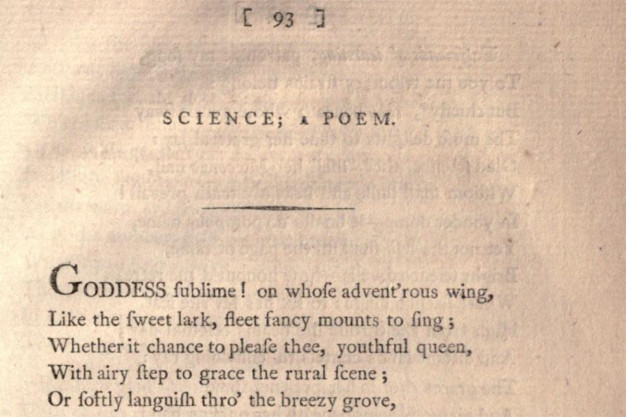
“Science, a Poem” (1762), by Francis Hopkinson, in The Miscellaneous Essays and Occasional Writings of Francis Hopkinson, Esq., 1792, from the University of California Libraries via Archive.org.
The word “harmony” likely meant many things to Francis Hopkinson. For the jurist-lawyer-merchant-composer, life itself seemed like an endless experiment of balance, dividing days among art, poetry, science, business, and politics. Hopkinson was a true Renaissance man, a gentleman amateur in copious fields that had yet to form distinct professional communities in the American colonies. And harmony was his pursuit—in poetic stanzas, musical arrangements, technological invention, and the cultivation of individual citizens. At the time of the Revolution, science held more nebulous and permeable boundaries of expertise. It ebbed and flowed between hobby and obsession, and often linked arms with other industries—including art, music, and religion—in pursuit of higher truths. Like many other curious Philadelphians in the age of revolutions, Hopkinson answered essential questions from many angles. How should we, for example, mold and perpetuate the ideal citizen in a new, enlightened nation? And more fundamentally, is this a scientific, religious, artistic, political, or metaphysical question? Or, perhaps, all of the above?
Francis Hopkinson was born on October 2, 1737, in Philadelphia, Pennsylvania. His father, Thomas Hopkinson, had emigrated from England in 1731, establishing himself as a prominent merchant, lawyer, and judge in Pennsylvania. Thomas became close with Benjamin Franklin in the 1730s and quickly fell in love with natural philosophy. He soon joined Franklin’s Junto and assisted Franklin with several of his electrical experiments. Thomas became a founder of both the Library Company of Philadelphia and the Academy of Philadelphia (now the University of Pennsylvania). He also served as the first president of the first iteration of the American Philosophical Society in 1743, with Franklin as secretary. The young Francis had much to admire in his father, whose passionate cultivation of natural philosophy in Philadelphia in the first half of the 18th century rivaled that of Franklin, James Logan, and John Bartram.
In 1751, Thomas Hopkinson died at the age of 42; Francis’s father and role model tragically left the boy too soon. But Thomas’s cultivated world continued to open doors for Francis, who soon enrolled at the new Academy of Philadelphia. As primarily Benjamin Franklin’s invention, the Academy ensured that Francis received a much more liberal education than he would have at Harvard, Yale, or the College of New Jersey (now Princeton). The school offered courses in surveying, navigation, architecture, mechanics, hydrostatics, pneumatics, astronomy, natural history, and chemistry. It was at the Academy that Hopkinson also developed a love for music and composition as a harpsichordist and poet. In 1754, he wrote a poem called an “Ode on Music”: “Hark! Hark! The sweet vibrating lyre sets my attentive foul on fire,” it began. In 1759, he would write what is today considered America’s first secular song, “My Days Have Been so Wondrous Free.” But in the same year he wrote “Ode on Music,” Hopkinson delivered an address to the trustees “On Education in General,” an exercise that professed devotion to an idea that followed Hopkinson his entire life. Namely, that education formed the bedrock of a healthy and stable polity: “Upon the whole then, it appears, that whether the Design be to preserve a good Constitution civil and religious, and transmit its Spirit, uncorrupted, down thro’ the Ages; or whether the Design be to mend a bad One, and secure it against all Dangers from without, it is only to be done effectually by the slow, but sure Means of a proper Education of Youth.”
The Academy had a profound impact on Hopkinson, and he remained involved with college affairs throughout his adult life. Hopkinson graduated in 1757, and in 1760 the college granted him a promotional master’s degree, a tradition taken from the English universities, which is still practiced today at both Oxford and Cambridge. In 1762, he wrote one of his most ambitious poems to date: “Science, a Poem.” It echoed his address on education, and was similarly directed toward the trustees of the Academy, this time through its dedication. The study of nature, he dramatized, would ultimately turn the American wilderness into a governable and righteous land.
And now advanc’d the student loves t’engage,
More arduous heights—the mathematic page
Invites his riper judgement to explore,
The mazy windings of her subtle lore:
The pleasing toil delights th’ enquiring youth,
And science guides him to th’ entangled truth.
At length behold to his astonish’d eye,
Nature’s vast volume all expanded lye;
From the effect he seeks the hidden caufe,
And deeply searches her mysterious laws.
Earth, air, nor sea, not heav’ns extended fpace
Can bound the reach of man’s aspiring race;
Upward he lifts the astronomic eye,
Surveys those orbs of light that roll on high:
Mid fun’s and blazing stars he dares to rove,
And learn th’ important laws by which they move:
Sits in the centre, wrapt in thought profound,
And views the radiant system rolling round.
And Hopkinson continues:
But now the pupil takes his boldest flight;
See adventrous him, climb the tow’ring height,
Of Ethic learning—more extensive fields,
Views more enlarg’d, the boundless prospect yields.
His searches now pursue a nobler plan,
Now comes that grand enquiry what is man?
How form’d? by whom? Thence shall he learn to know
From his connections what great duties flow.
Hopkinson portrays science as a gateway to greater purpose. It trains the mind to answer questions of meaning and ethics, and ultimately the “duties” one has in life. It opens new possibilities for a vast, unexplored (in Hopkinson’s mind) North American continent. Not just “Religion, Justice, Liberty,” but “science too, in more harmonious strains, Shall sweetly warble to the hills and plains.” This was his song:
The friends of science should my fong reward;
No speedy death my artless strains shall know,
Not without honour will my numbers flow,
If with indulgence, they should not refuse,
To smile propitious on my humble muse.
In the 18th century, political and religious notions of “harmony” bridged music and science in creative and unexpected ways. The ancient philosophical idea of the “music of the spheres” had persisted through the ages. In the 17th century, astronomer Johannes Kepler asserted that such music was inaudible, but that it resonated within the soul. The music of the spheres then resonated with republican theorists in the 18th century, and among a religious revival culture that believed Christianity provided unique access to the solar system’s motions of cosmic harmony. In an “Ode on Music,” Hopkinson directly invoked these very ideas:
“So shall th’ admir’d celestial art,
Raise and transport my ravish’d heart;
Exalt my foul, and give my mind
Ideas of sublimer kind.
Music, then, as a manifestation of audible harmony on Earth had profound effects on the body and soul. And with emerging Enlightenment theories that explained nervous function in the body through fluids or electricity, music allegedly contained radical implications for bodily and mental health. As historian Kirsten E. Wood writes on the Early Republic, “learned thinkers and popular writers alike maintained that both making and listening to music affected the physical body, the feelings, and even the soul. Natural philosophers speculated that music’s power stemmed from the fact that auditory sensations traveled through the nerves of the body more quickly and were felt more intensely than other stimuli. Sounds affected the listener’s mind and body in such predictable ways that some medical practitioners believed they could list sound among their therapeutics.”
Indeed, music became medical. Instruments such as the Aeolian harp and glass harmonica (invented by Benjamin Franklin) were associated with therapeutics given their ethereal sounds, and music held a close association with Mesmerism, or “animal magnetism,” due to their shared theories of sympathetic vibrations. Benjamin Rush firmly believed in music’s “mechanical effects in civilizing the mind,” that “certain notes or airs in musics” could access dormant parts of the brain. Music could heal, tame, and train the body. Music, physiology, and the duties of citizenship became a new harmony of Enlightenment.
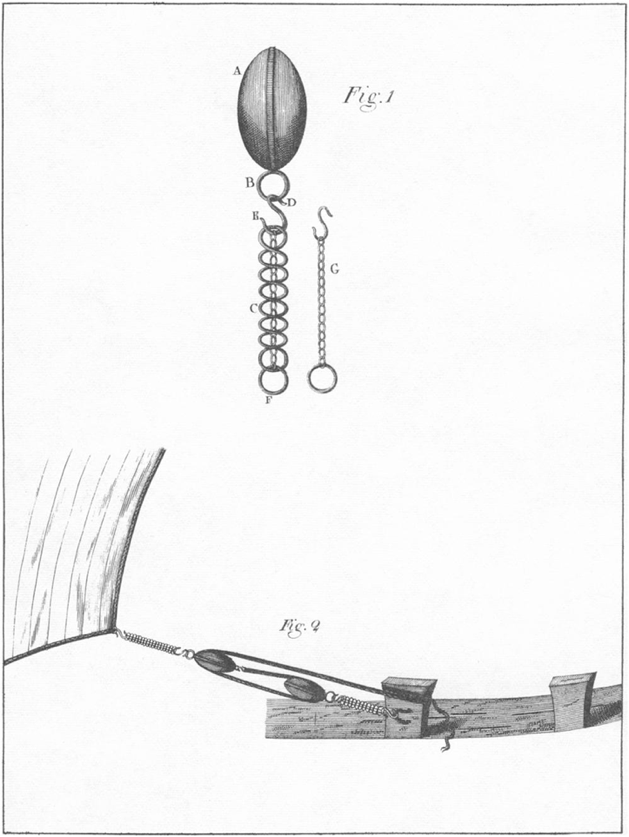
Like father like son, Hopkinson extended his reach far throughout Philadelphia and the wider region. He served as the secretary of the Library Company of Philadelphia from 1759–69, and became a director from 1771–2. He was elected a Member of the American Philosophical Society in 1768 and served as its curator from 1776 to 1782. As an inventor, he improved upon Franklin’s glass harmonica, developed a new method for quilling a harpsichord, and created a “spring-block” for ships, which won the Magellanic Premium from the Society. He studied law and entered private practice in 1761, became collector of customs in Salem, New Jersey, in 1763, collector of customs for New Castle, Delaware County, from 1772 to 1773, and served as a member of the New Jersey Provincial Council from 1774 to 1776. He had also ventured into business in the 1760s, somewhat unsuccessfully. Finally, in 1776, Hopkinson became a delegate to the Second Continental Congress, resigning his Crown appointment, and signed the Declaration of Independence. His professional life was as mercurial as his mind. But Hopkinson, steadfastly, made his mark on history.
Hopkinson had been critical of British policies leading up to the Revolution, writing a satire of King George called A Pretty Story in 1774. For his revolutionary spirit, his home in Bordentown was looted several times by British military and Loyalists. During the war, he served in political and legal capacities and designed now-famous iconography of the United States, including early versions of the Great Seal and the first version of the Stars and Stripes flag. But it was music that remained his deepest passion. In 1778, he wrote a ballad called “Battle of the Kegs,” which told the story of an attack upon the British fleet in Philadelphia, celebrating the spirit and persistence of the rebel army.
His greatest musical work came in 1788, called Seven Songs for the Harpsichord or Forte Piano. He dedicated the work to George Washington, who he had long admired. “It cannot be thought an unwarrantable anticipation,” he professed, “to look up to you as seated in the most dignified situation that a grateful People can offer. The universally avowed Wish of America, and the Nearness of the Period in which that Wish will be accomplished, sufficiently justify such an Anticipation; from which arises a confident Hope, that the fame Wisdom and Virtue which has so successfully conducted the Arms of the United States in Times of Invasion, War, and Tumult, will prove also the successful Patron of Arts and Sciences in Times of national Peace and Prosperity ; and that the Glory of America will rife conspicuous under a Government designated by the Will, and an Administration founded in the Hearts of THE PEOPLE.” With peace, Hopkinson argued, came a new era of art and science. To his fellow citizens, now under the banner of a new nation, he promised that agriculture, manufacturing, and commerce would provide elegance, convenience, and plenty. “But is there not something still wanting to finish the man?,” he asked. A model citizen was an act of harmony, a balance of external arts and internal virtues. “In a serene mind the sciences and the virtues love to dwell,” and this freedom to find blissful serenity was now at hand, with the grasp of the tyrant fractured and relinquished. On May 9, 1791, Hopkinson’s life was cut short, struck down by an apoplectic seizure. With the Constitution ratified only three years earlier, it was anyone’s guess if harmony was even a plausible American reality.
Bibliography
Bertucci, Paola. “A Philosophical Business: Edward Nairne and the Patent Medical Electrical Machine (1782).” History of Technology 23 (2001): 41–58.
Hastings, George Everett. The Life and Works of Francis Hopkinson. Chicago: University of Chicago Press, 1926.
Hopkinson, Francis. “Description of a Spring-Block, designed to assist a vessel in Sailing.” Transactions of the American Philosophical Society 3 (1793): 331–333.
Hopkinson, Francis. “Seven Songs for the Harpsichord or Forte Piano: The Words and Music Composed by Francis Hopkinson.” Philadelphia: T. Dobson, 1788.
Hopkinson, Francis. The Miscellaneous Essay and Occasional Writings of Francis Hopkinson, Esq., Vol. 1. Philadelphia: T. Dobson, 1792.
Hopkinson, Francis. The Miscellaneous Essays and Occasional Writings of Francis Hopkinson, Esq., Vol. 3. Philadelphia: T. Dobson, 1792.
Kassler, Jamie C. “Man—A Musical Instrument: Models of the Brain and Mental Functioning Before the Computer.” History of Science 22 (1984): 59-92.
Kennaway, James. Bad Vibrations: The History of the Idea of Music as a Cause of Disease. Farnham, UK: Ashgate, 2012.
Nash, Gary B. First City: Philadelphia and the Forging of Historical Memory. Philadelphia: University of Pennsylvania Press, 2002.
National Constitution Center, “Francis Hopkinson.” https://constitutioncenter.org/signers/francis-hopkinson. Accessed January 26, 2026.
Pesic, Peter. Music and the Making of Modern Science. Cambridge: The MIT Press, 2014.
Riskin, Jessica. Science in the Age of Sensibility: The Sentimental Empiricists of the French Enlightenment. Chicago: University of Chicago Press, 2002.
Rush, Benjamin. Essays, Literary, Moral and Philosophical, 2nd ed. Philadelphia, 1806.
Wood, Kirsten E. “‘Join with Heart and Soul and Voice’: Music, Harmony, and Politics in the Early American Republic.” The American Historical Review 119 (2014): 1083–116.