



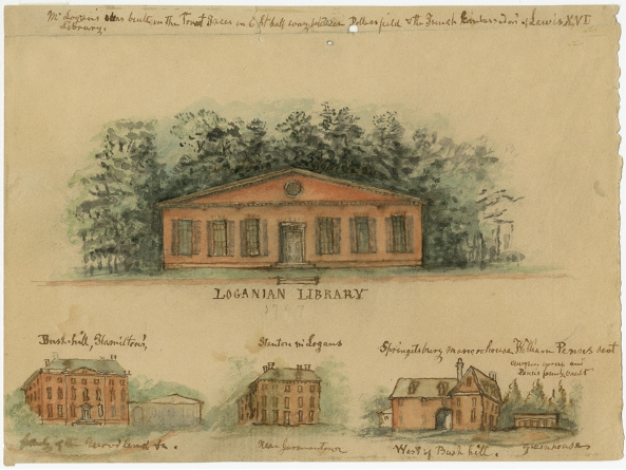
Header image: Loganian Library, Library Company of Philadelphia
“Books are my disease,” James Logan once confessed. The Irish-born Pennsylvania colonist was many things: a judge, an administrator, a fur trader, a botanist, a mathematician, and, early upon his arrival to Pennsylvania, a secretary. But first and foremost, he was a voracious collector, obsessed with books and the intellectual treasures packaged within.
Born in Lurgan, Ireland on October 20, 1674, Logan delighted in a childhood of learning. His father Patrick Logan, a Scotch Quaker schoolmaster, made sure his son studied Latin and Greek, absorbed William Leybourn’s Cursus Mathematicus, and learned rudimentary calculus, botany, and history. The Williamite War in Ireland drove the Logans to Edinburgh, then to London, and finally to Bristol. In 1693, Patrick Logan returned to Lurgan, and the nineteen-year-old James replaced his father as schoolmaster. Soon he began amassing his first library, which he claimed contained over seven hundred items, a stunning achievement for a nineteen-year-old living on a schoolmaster’s salary.
The restless and adventurous Logan soon took another gamble. He sold his library in Dublin and invested in a cargo of linen, hoping to become a cloth merchant. Riches never followed, but Logan’s professional pivot led to a fateful encounter. William Penn, a fellow Quaker, noticed and admired the bright young Logan. In 1699, Penn asked Logan to accompany him back to Pennsylvania as his secretary, and so he did. Upon reaching Philadelphia, Logan’s hunger for books returned. The meticulous, opinionated, capable, stubborn, and, at times, arrogant man—somewhat dissonant with traditional Quaker modesty—would soon make it his mission to bring learning to the British colonies. Science would be his obsession.
Logan’s frustrations with the dearth of scholarship in British America surfaced nearly upon his arrival. He took every chance to find likeminded individuals in Philadelphia, and got to work book collecting, mainly in the mathematical sciences in the early years. His first recorded purchase included astronomical works by Johan Bayer, Ismaël Boulliau, Tycho Brahe, Johannes Hevelius, and more. In 1709, he got his hands on a first edition copy of Isaac Newton’s Principia (1687).
A year later, Logan travelled to London on business for Penn. The metropolis provided delightful respite from what he perceived to be American intellectual squalor. London’s population sat at around 600,000, a teeming capital city sustained by the influx of migrants in search of work, investments, and heavy doses of gin. Founded in 1660, the Royal Society anchored scientific London. As he wandered London’s great campus, Logan observed Newton perform an experiment at St. Paul’s Cathedral; glanced into a hidden world under James Wilson’s microscope; visited Astronomer Royal John Flamsteed; and enjoyed a glass of wine with mathematician Charles Hayes at the bookseller Midwinter’s. He longed to package this world up and transport it to the colonies. And so he poured through books, haggled, and bought, leaving a “Great Chest of Books” in London to be shipped to him in Philadelphia.
By the 1720s, Logan’s library contained thousands of volumes. Several other individuals in the colonies had larger libraries, but as historian Frederick B. Tolles noted, “no collection of books in pre-Revolutionary America, public or private, bears comparison with [Logan’s library] as a scientific library.” He began his own scientific investigations into mathematics, optics, and botany, making a significant experimental contribution to the understanding of hybridization and sexual reproduction in plants. Famed Swedish botanist Carl Linnaeus celebrated Logan’s work on maize pollination. Logan wrote back to Linnaeus with an unusual and courteous display of modesty, and mentioned the name of a budding young American botanist, John Bartram. Logan collected more than books. He had an eye for scientific talent. In the 1730s, he introduced Bartram to key botanical texts, cultivated Thomas Godfrey’s mathematical talents, and mentored a young Benjamin Franklin.
His spirit of collection came with a ravenous appetite for land speculation. From his position in Pennsylvania government, and acting as Penn’s “land agent,” Logan would come to own tens of thousands of acres in Pennsylvania and New Jersey, including large plots on the Pennsylvania frontier that he would lease or sell to settlers, and properties in the heart of Philadelphia. In the 1740s, Logan played a central role in the “Walking Purchase” that forced the Lenape off their homeland in eastern Pennsylvania, land that Logan wanted for himself. With collection also came selfish conceit. He wrote, yet left unpublished, “The Duties of Man As They May Be Deduced from Nature,” a work of secular moral philosophy that fused ethics with mathematics, optics, and harmonics. For Logan, ethics came imprinted by nature and natural laws, deducible by reason, and even extending to our sense of beauty. “Beauty Is Universal,” he declared in his unpublished treatise. He held European faces to be the standard of beauty and believed if other races were given the choice, they would routinely prefer European features over others. For Logan, any preference for non-European features was simply a lapse in proper judgement. It was a case of custom subverting nature, the conditioning of aesthetic fallacy. Logan, like Franklin, owned enslaved people. His scholarly ambition reminds us how stunted “Enlightenment” truly was, a disheartening contradiction that would be inscribed in the Declaration of Independence decades later. Science, a friend of reason—reason, in the eye of the beholder, that is.
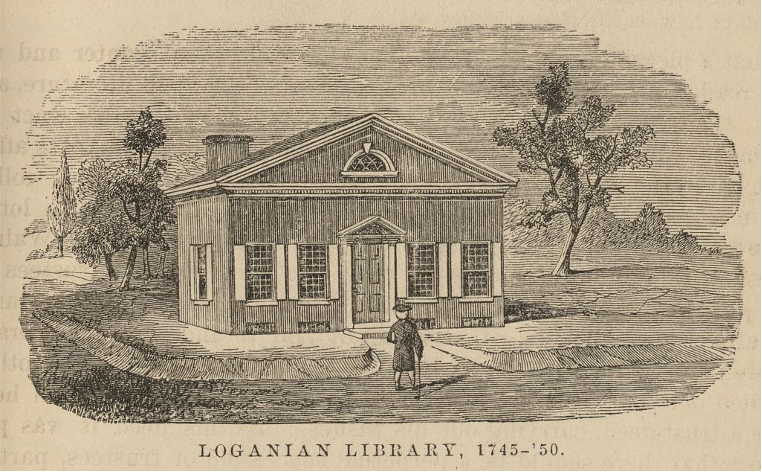
Legacy mattered to the aging collector. He believed he had worked out the laws of spherical aberration with more mathematical precision than both Newton and Huygens. And in 1732, he aided the newly incorporated Library Company of Philadelphia in choosing its first order of books. The Directors of the Library Company, which included Franklin, called Logan “the best judge of Books in these Parts.” In Philadelphia, Logan drew up plans for a building on Sixth Street between Walnut and Chestnut Streets for his own “Loganian Library.” This gesture, he believed, was driven by “patriotic desire” and a wish to extend the “benefits of learning among his fellow citizens.” Logan’s health faltered after multiple strokes and attacks of palsy. But the frail Logan persisted. In 1747, he wrote to Franklin that “Old as I am, near 73, and much fail’d in all respects, I want to lay out about £ 200 Sterling more in Books which I shall do if I am so happy as to see a peace without farther disturbance and I have my Catalogue ready drawn.” And so the collecting continued.
After Logan’s death in 1751, his heirs made sure that Logan’s wish would come true. By 1760, the Loganian Library was open to the public on Saturday afternoons. Logan’s library represented an important transition in American intellectual culture. At a time when most libraries collected theological texts, Logan celebrated and collected the sciences. It was this scientific passion of Logan’s that would have such a profound effect on Franklin, Bartram, and others. As Paul C. Pasles writes, “he was Franklin before Franklin.” His ceaseless desire to package up Enlightenment and transport it to the colonies seeded the passions of the coming generation of “America’s scientific revolutionaries.”
References
- Cohen, I. Bernard. Science and the Founding Fathers: Science in the Political Thought of Thomas Jefferson, Benjamin Franklin, John Adams & James Madison. New York: W.W. Norton & Company, 1995.
- Delbourgo, James. A Most Amazing Scene of Wonders: Electricity and Enlightenment in Early America. Cambridge: Harvard University Press, 2006.
- Dorman, Dana. “Looking Back at the Loganian Library.” The Library Company of Philadelphia, https://librarycompany.org/2024/10/04/looking-back-at-the-loganian-library/. Accessed July 2, 2025.
- Eustace, Nicole. “‘Beauty Is Universal’: Virtue, Aesthetics, Emotion, and Race in James Logan’s Atlantic Moral Sense Philosophy.” In McMahon, Darrin M. ed. History & Human Flourishing. Oxford: Oxford University Press, 2022.
- Fiering, Norman. “James Logan’s ‘The Duties of Man As They May Be Deduced from Nature’: An Analysis of the Unpublished Manuscript.” Transactions of the American Philosophical Society 111 (2022): 1-90.
- Grimm, Dorothy Fea. “A History of the Library Company of Philadelphia, 1731-1835.” PhD dissertation, University of Pennsylvania, 1955.
- Pasles, Paul C. Benjamin Franklin’s Numbers: An Unsung Mathematical Odyssey. Princeton: Princeton University Press, 2007.“The Walking Purchase–August 25, 1737,” Pennsylvania Historical & Museum Commission. https://www.phmc.state.pa.us/portal/communities/documents/1681-1776/walking-purchase.html. Accessed June 23, 2025.
- Tolles, Frederick Barnes. James Logan and the Culture of Provincial America. Boston: Little, Brown and Company, 1957.
–––––, “Philadelphia’s First Scientist: James Logan,” Isis 47 (1956): 20-30. - Logan, James. “Of the Duties of Man as they may be deduced from Nature.” Valenti, Philip, ed. Philadelphia, 2013.
- Wolf 2nd, Edwin. The Library of James Logan of Philadelphia 1674-1751. Philadelphia: The Library Company of Philadelphia, 1974.