




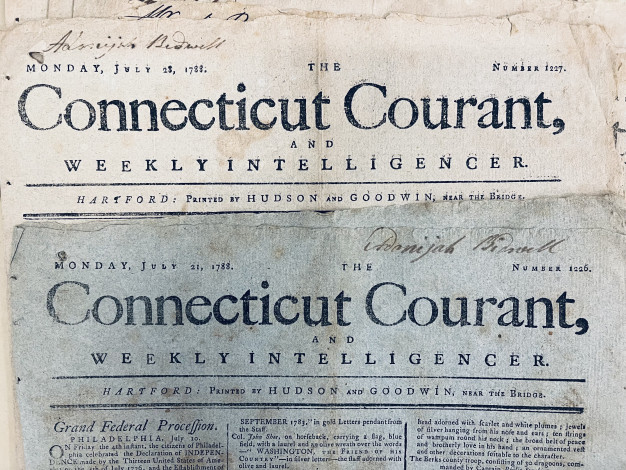
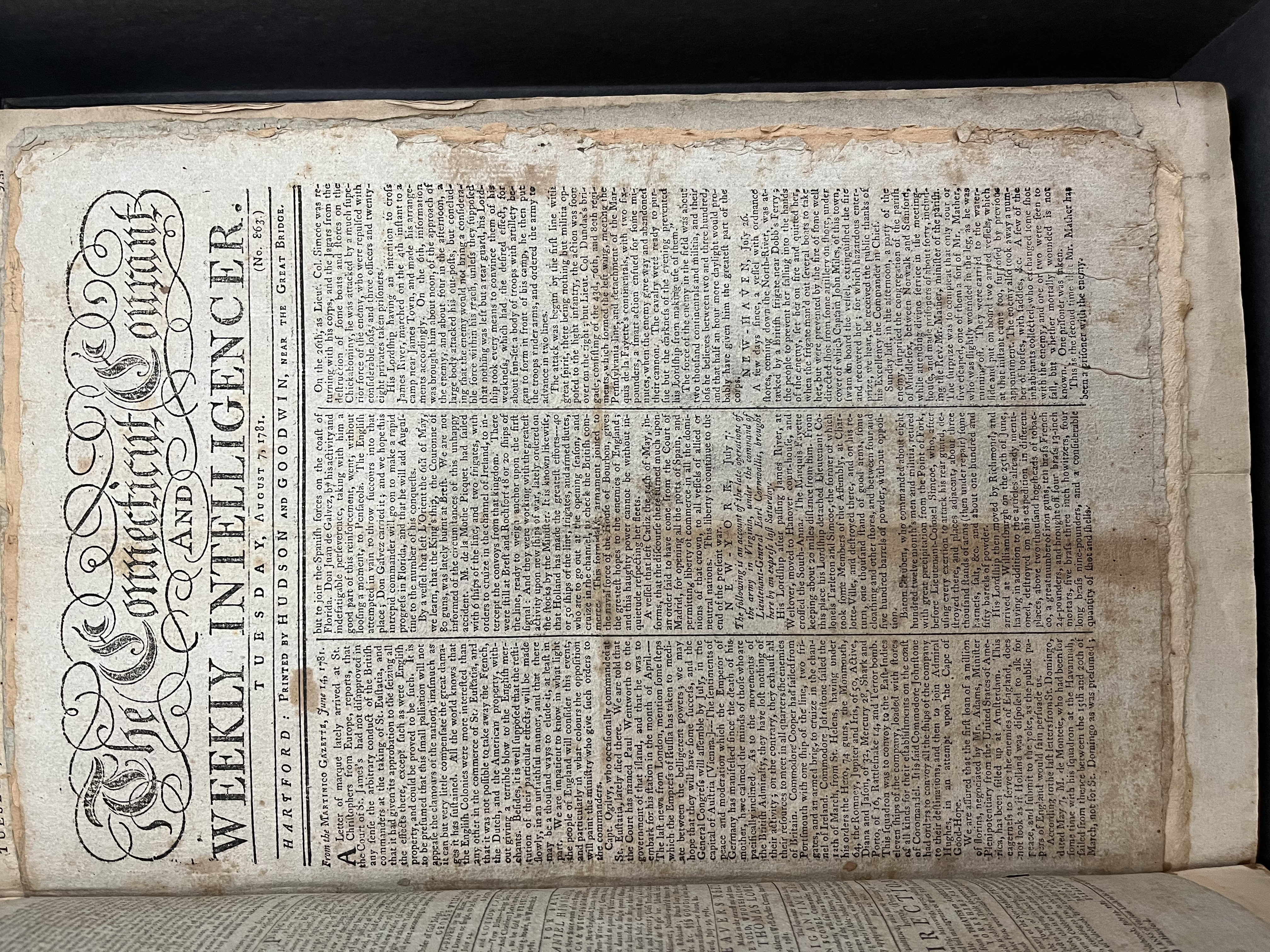
Image: 1788 issues of The Connecticut Courant, signed by former owner Adonijah Bidwell of Hartford, Connecticut [Paine 72A C75]
While doing routine cataloging work for the APS Miscellaneous newspapers collection, a seemingly innocent title appeared: The Connecticut Courant. Typing the title in our library catalog, I discovered there were plenty more issues in the newspaper holdings in the Colonel Richard Gimbel Collection of Thomas Paine Papers, including the first issue printed in 1764.
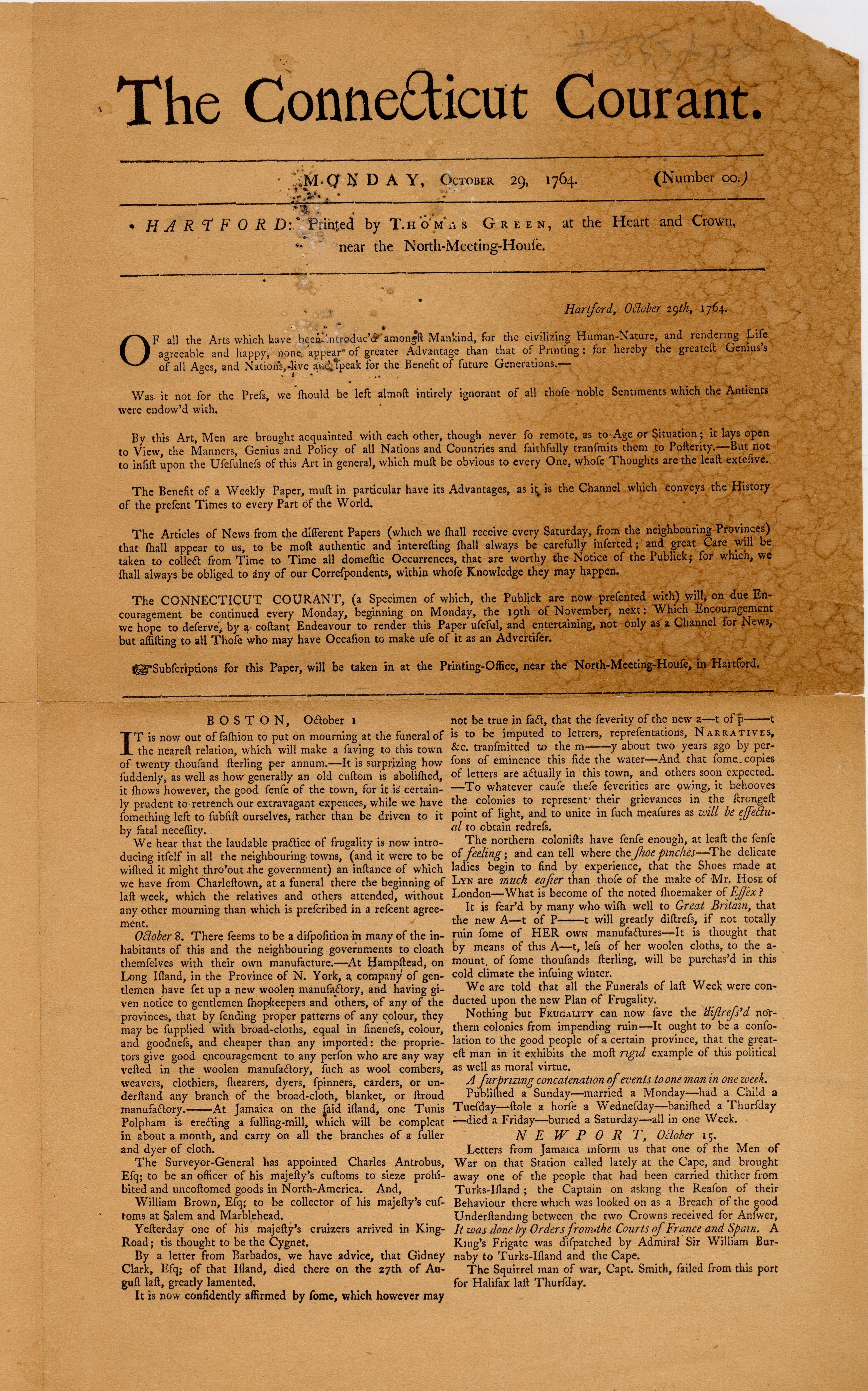
The Connecticut Courant is known today as the Hartford Courant. It is the oldest continuously published newspaper in the country. Thomas Green, who was from a family of printers and publishers in the colonies, started The Connecticut Courant in 1764 after being removed from his post as publisher of the Connecticut Gazette based in New Haven, where he had been managing the paper since 1760. Benjamin Franklin ousted him, replacing him with his nephew Benjamin Mecom, who needed a position. Green moved to Hartford and started The Connecticut Courant with the assistance of Ebenezer Watson, printing the first issue on Monday, October 29, 1764. Green stayed on until 1767, then returned to New Haven to start The Connecticut Journal with his brother Samuel. Meanwhile, Ebenezer Watson continued the management of The Connecticut Courant until his death, by smallpox, in 1777. His widow, Hannah Bunce Watson, inherited and operated the paper until 1779, when she remarried. Although she didn’t have any publishing experience, she ran the paper spiritedly, using it as a vehicle to provide information on patriot activity during the American Revolution. After she left the paper, however, its writers abandoned patriotic news.
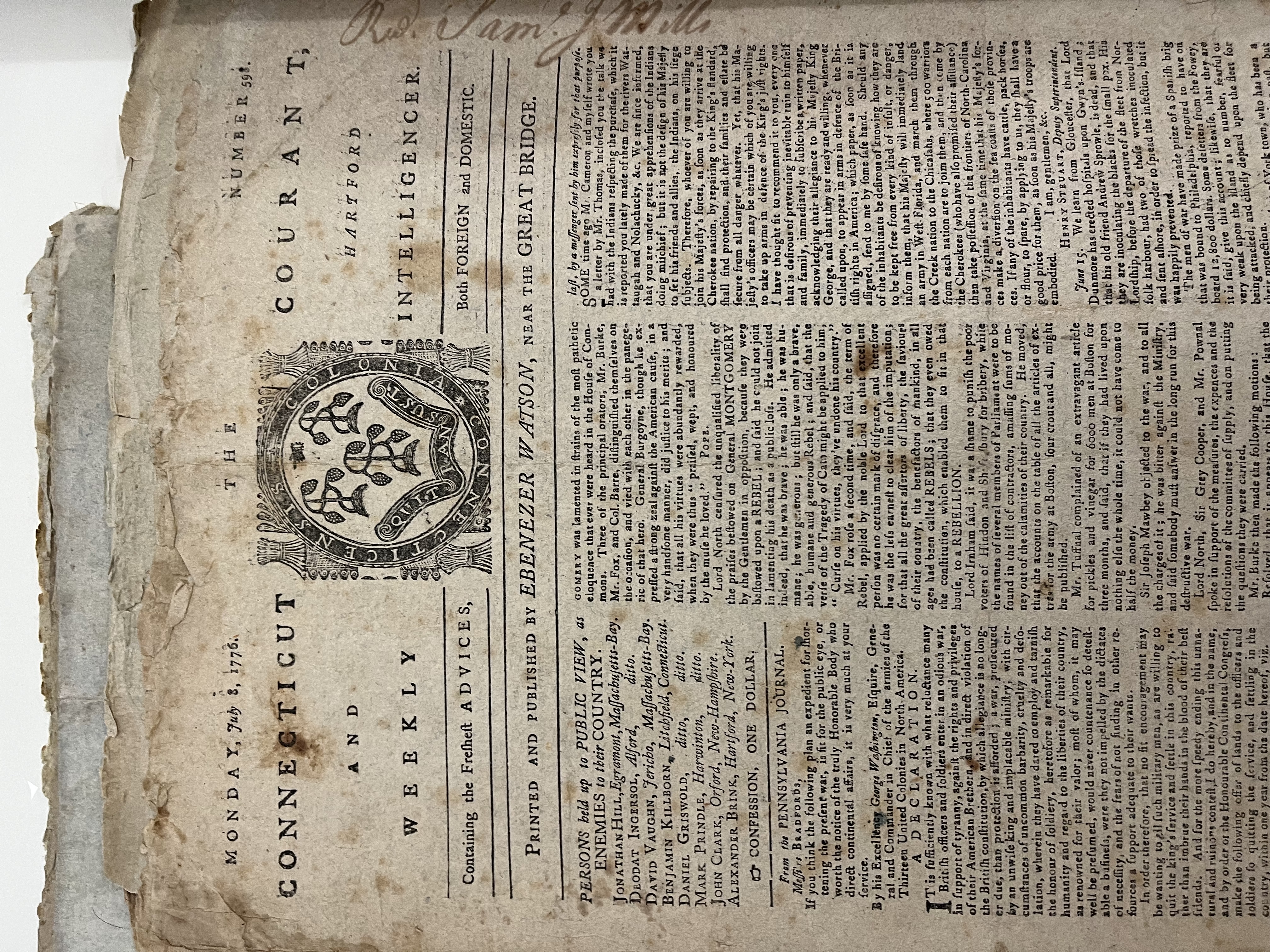
One challenge of cataloging newspapers is the tendency for irregularity in publication cadence. From the cataloger’s perspective, the newspaper which started as The Connecticut Courant is an intriguing example of this irregularity. Complicated publishing history makes the work of the cataloger interesting to say the least. The irregularities show up in numbering schemas (volumes, issue numbers., Arabic vs. Roman numerals used, etc.) and title changes, complicated further by publisher and printer changes, especially in a long-running newspaper. The Connecticut Courant features all of these irregularities, changing titles four times up until 1914, which is the last year of holdings in the APS Library.
The issues of The Connecticut Courant, including variant titles and accompanying supplements, contained in the 11 boxes held in the APS Paine newspaper collection are not arranged in standard title-specific order, but rather in a loose chronological order, often being duplicated among the boxes. Aside from the unique arrangement of the Thomas Paine Papers, I believe the reason why The Connecticut Courant is arranged chronologically is because, despite going through at least seven title changes, it was colloquially known as The Connecticut Courant throughout the decades published. Consequently, the cataloger maintains this unique and original order, respecting both original APS and Paine collection arrangements. If the newspaper was not part of a special collection with a unique arrangement, the cataloging would revert to standardized serial organization, adhering to title changes throughout time. Every time a newspaper changes its title, a new catalog record is made. In the case of The Connecticut Courant in the Paine collection, while all issues are housed together under one call number (Paine 72A C75) and in one location in the library, there are five separate catalog records representing the given title changes, three of which bear the title The Connecticut Courant. To illustrate the title changes chronologically:
The Connecticut Courant (1764–74)
The Connecticut Courant and Hartford weekly advertiser (1774–78)
The Connecticut Courant (1778–78)
The Connecticut Courant and the weekly intelligencer (1778–91)
The Connecticut Courant (1791–1914)
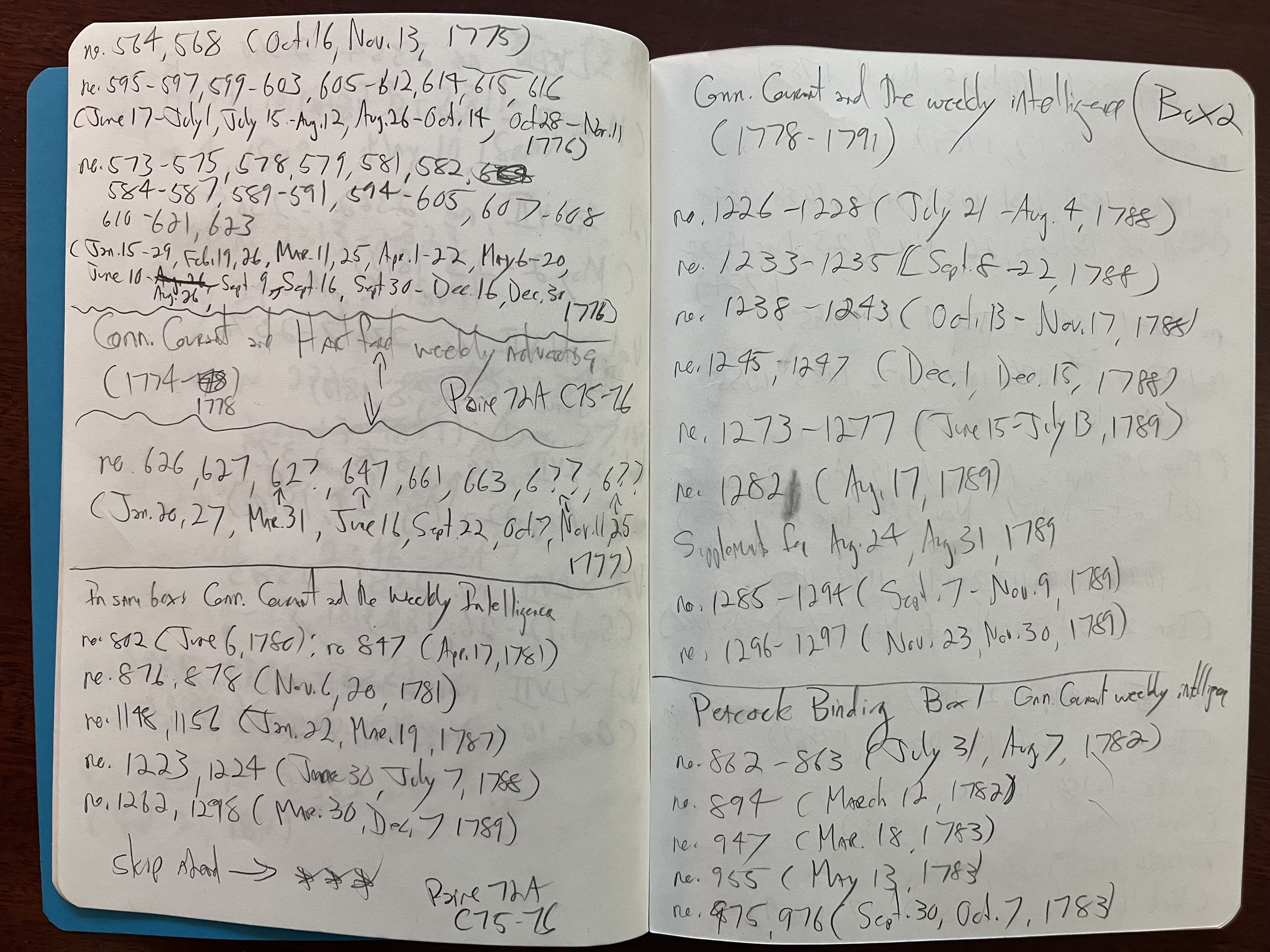
Generally speaking, what is in the catalog is not necessarily all that is on the shelf when it comes to the newspapers, especially one as complex as The Connecticut Courant. For instance, it was discovered that there was no record at all for The Connecticut Courant and Hartford weekly intelligencer, which was published during the height of the American Revolution. Instead, it’s simply housed with The Connecticut Courant with no separate record in the catalog, until now. Furthermore, information on which issues are held was largely absent in our catalog. The reason is simply that cataloging serials has evolved since The Connecticut Courant was first cataloged at the APS after being donated by Richard Gimbel in 1971. Hence, updating was called for. What this involved was counting the issues individually, writing the count by hand, then typing in the issue numbers in the catalog record. Once the record is updated, the issues are visible and accessible in a note. Below is a page of such handwritten counting for The Connecticut Courant. For the library, the handwritten tabulation of newspaper issues must go fairly quickly and must be accurate. The process feels like exercise: both mind and body must rest awhile after being hunched over the newspapers, counting and noting all the aforementioned irregularities. I could have typed the issues right into the record using a computer, but I prefer simple handwriting (or scribbling in this case) into a notebook.
Why go through all of this work? The answer is very important, especially in the 21st century, when detail and depth in knowledge tends to be compromised in favor of speed and convenience. Although it is magical to type in a phrase or word in Google and have text information or an image at one’s fingertips, what is usually being offered is an approximation without authoritative information to support it. Without authoritative information such as a library catalog record from an established institution or a published bibliography, much knowledge is in danger of being lost.