



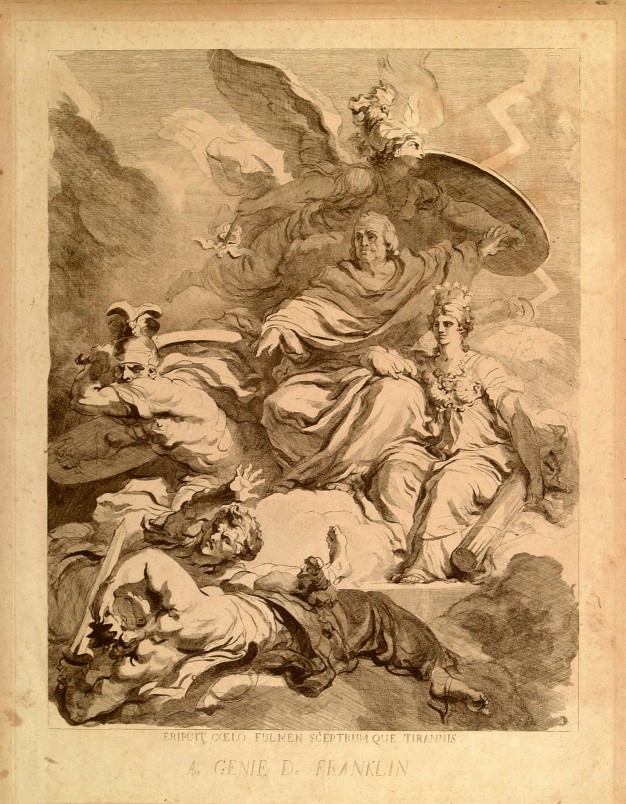
Header Image:Jean-Honoré Fragonard, The Genius of Franklin (Au Génie de Franklin), undated, https://diglib.amphilsoc.org/islandora/object/graphics%3A6107
French painter and printmaker Jean-Honoré Fragonard and his sister-in-law Marguerite Gérard imagined Benjamin Franklin as a daring Prometheus. In their 1778 etching, Franklin descends from the heavens with lightning in tow, just as Prometheus had stolen fire from the tyrant gods to gift to humanity. Below the image reads “ERIPUIT COELO FULMEN SCEPTRUM QUE TIRANNIS.” That is, “he snatched the lightning from the sky and the scepter from the tyrants.” Blending lightning rod with stolen scepter, Franklin becomes both Prometheus and Zeus. Science and republicanism take on godly consonance as Minerva, the goddess of wisdom, deflects lightning with her shield over Franklin’s head, and Mars, the god of war, vanquishes Avarice and Tyranny. The United States had stolen the scepter from Great Britain. The democracy of scientific knowledge had planted its roots in American soil.
Science has been a central thread of American history and its mythologies since the nation’s founding. In the United States, we grow up learning about Franklin’s experiments with electricity, and even Thomas Jefferson’s proclivity for natural history. This is hardly a groundbreaking insight, but it is one that often receives less attention than it deserves. In his longue durée study of science in the federal government (published over a half-century ago), historian of science Hunter Dupree wrote that “science has been a formative factor in making both the federal government and the American mind.” The framers had laboriously meditated on the place of science in American society and government. In the Federalist Papers, James Madison invoked “equilibrium,” “balance,” and direct references to relationships in chemistry and the work of naturalists to explain the inner workings of democratic government. Jefferson saw within natural history a “universal language,” a classificatory system that reflected the stability and orderliness so needed by a nascent, heterogeneous nation. For prominent Philadelphians William Bartram and Charles Willson Peale, science and society showed translatable order in their designs. One could look to nature as a paragon of order in diversity.
At the same time, an American inferiority complex would uncover an old world in the “New,” challenging European scientific hegemony with ancient tales of North American natural history. All of which would be used to justify American political and economic purpose, including the evils of plantation slavery and the dispossession and displacement of Native Americans.
Yet this central thread—these practices of the “Age of Reason”—has often been left untied, a peripheral concern of the American historical profession. For whatever reason, Americanists and historians of science have often struggled to speak to one another. At the 1964 annual meeting of the American Historical Association, Dupree argued that Americanist historians needed to take a more serious look at the history of science. They needed to break out of a constrictive state of consciousness that assumed nothing of note happened in American science until World War II. A half century later, historians Sally Kohlstedt and David Kaiser continued the call to “strengthen the bonds” between the history of science and American history. New scholarship, especially from the 1980s onward, had started to piece this story together, but the conversational silence stubbornly remained.
Approaching the 250th Anniversary of the United States, the American Philosophical Society is telling the stories of “America’s Scientific Revolutionaries.” At its core, this project suggests that science was baked into the cake of the United States from the very beginning, just as Dupree had insisted decades ago. But recognizing science as a central thread of American history means more than simply recontextualizing the names and faces that have been front and center in our history textbooks for generations. It requires revealing the diversity of all those who practiced, read, and witnessed science and especially those whose stories have largely gone untold. Starting with this essay, a series of blog posts (and additional events) will do just that. This is one of the goals of “America’s Scientific Revolutionaries," a multiyear project headed by the APS’s Center for the History of Science and funded by the Richard Lounsbery Foundation. Beyond Franklin, Jefferson, Benjamin Rush, and other familiar faces with powdered wigs are many relatively obscure names and faces who made contributions to the early chronicles of American science.
As the foremost American scientific society in the British colonies and then the Early Republic, the American Philosophical Society boasted an impressive domestic and foreign Membership. Of course, the privilege of Membership remained reserved for white men (excepting Princess Ekaterina Dashkova of Russia, elected in 1789). I will explore the work of lesser-known Members, but I will also use the networks surrounding APS Members to explore the lives of those who were forced to practice science at the margins, from botanist Jane Colden to astronomer and surveyor Benjamin Banneker.
This blog series is about science at our roots. Through short biographies, we will explore an essential correlation: how the United States came into being in a supposed Age of Enlightenment. How did science give shape to a fledgling nation? How did it provide hope and opportunities for both the powerful and the weak? How did it participate and perpetuate the violence and exclusion embedded in American society? Was any part of it particularly and peculiarly American? And, in the end, what can we learn from all of this?
References:
Daniela Bleichmar, Visible Empire: Botanical Expeditions and Visual Culture in the Hispanic Enlightenment (Chicago: University of Chicago Press, 2012).
I. Bernard Cohen, Science and the Founding Fathers: Science in the Political Thought of Thomas Jefferson, Benjamin Franklin, John Adams & James Madison (New York: W.W. Norton & Company, 1995), Chapter 5.
James Delbourgo, A Most Amazing Scene of Wonders: Electricity and Enlightenment in Early America (Cambridge: Harvard University Press, 2006), 3-4.
James Delbourgo and Nicholas Dew, eds., Science and Empire in the Atlantic World (New York: Routledge, 2008)
Hunter Dupree, Science in the Federal Government: A History of Policies and Activities to 1940 (Cambridge: The Belknap Press of Harvard University Press, 1957), 2.
A. Hunter Dupree, “The History of American Science—A Field Finds Itself,” The American Historical Review 71 (Apr., 1966): 863-874
Sally Gregory Kohlstedt and David Kaiser, “Introduction,” in Sally Gregory Kohlstedt and David Kaiser, eds., Science in the American Century: Readings from Isis (Chicago: University of Chicago Press, 2013), 1-6.
Christopher Looby, “The Constitution of Nature: Taxonomy as Politics in Jefferson, Peale, and Bartram,” Early American Literature 22 (1987): 252-273.
Susan Scott Parrish, American Curiosity: Cultures of Natural History in the Colonial British Atlantic World (Chapel Hill: The University of North Carolina Press, 2006)
Londa Schiebinger, Plants and Empire: Colonial Bioprospecting in the Atlantic World (Cambridge: Harvard University Press, 2004)
Caroline Winterer, How the New World Became Old: The Deep Time Revolution in America (Princeton: Princeton University Press, 2024), Chapters 1-4.