



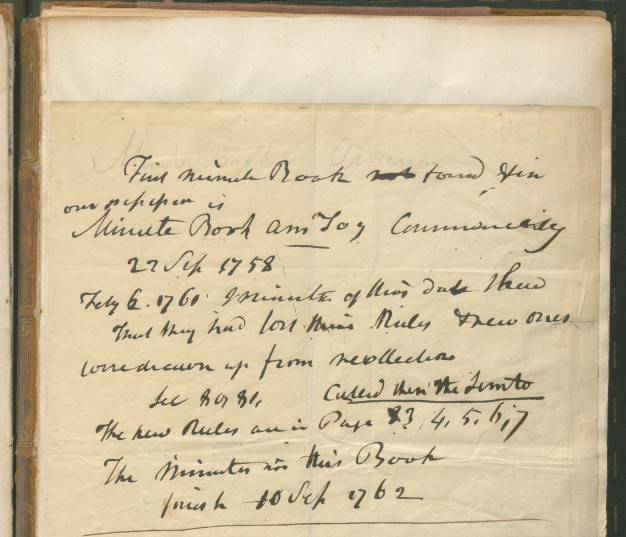
Title page, Junto Minutes, page 3, APS Digital Library
In 1743 , Benjamin Franklin and his fellow founders of the American Philosophical Society didn’t know that they would become the founding minds of a new country. They didn’t know their meetings would set the foundation for more than 200 years of “useful knowledge.” What they did know was that the young American colonies needed new ideas and practical guidance, and that a gathering of learned men in Philadelphia might be a good place to start. They called themselves the “Junto,” stemming from the Spanish word “together.” In 1768, the Junto joined with another local group to become today’s American Philosophical Society.
In the 1760s, the new American Philosophical Society set guidelines for their meetings. They’d gather for their general meeting twice a month from October to May, then monthly the rest of the year. At all times, the Society was meant to have in its Membership at least one of each of the following: a physician, a botanist, a mathematician, a chemist, a mechanician, a geographer, and a natural philosopher as well as a President, Treasurer, and Secretary. They’d discuss all manner of topics like agriculture, botany, physics, chemistry, morality, new arts, trades, and manufactures, and “New Methods for saving Labour.” Early members included Benjamin Franklin, who founded the Society with botanist and explorer John Bartram and others, Philadelphia physicians like Thomas Bond and Adam Kuhn, the second Mayor of Philadelphia Edward Shippen, and influential businessmen like Israel Pemberton and Henry Drinker.
I like to imagine these thinkers gathered around a table littered with books, papers, and pens, the group chattering amongst themselves in the candlelight. A mysterious gathering in the middle of a moonlit Philadelphia. That’s only in my imagination, though, as order was important in these meetings. We know from their recorded minutes that the conversation was spirited. They discussed their current personal and professional projects as well as business of the Society. And, at each meeting, they’d put forth two questions to discuss the next time they met. Gathering at 6 or 7 in the evening, meetings were formally stated to end by 10 p.m., and even then, they didn’t always make it to their second query.
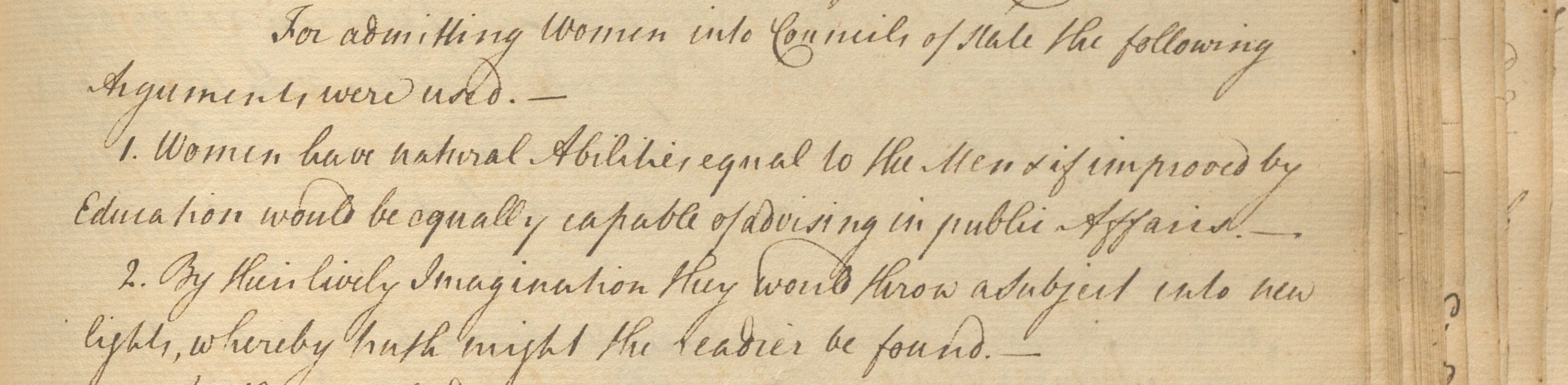
The group discussed various matters of great importance, like whether women ought to be permitted in government. Members argued that “Women have natural Abilities equal to the Men & if improved by Education would be equally capable of advising in public Affairs.” One pointed to history, recounting that “The Affairs of England was never better managed nor was the glory of the English Nation ever carried higher than when conducted by the Councils of Elizabeth or Anne.” Others contended that women were too soft in disposition for politics, that “Their natural timidity and want of Courage” might limit them, and that women’s participation in the broad world around them could “make them less attentive to domestic Affairs” and even “destroy the Peace of Families.”
After considering the merits and risks of allowing women into government, they decided against it.
An intriguing pattern in the Junto minutes are the questions that were skipped. Did the group find themselves overexcited about one question and run out of time for the other? Did they think it wasn’t worth answering?
One of my favorite rejected queries comes from Owen Biddle, a polymath scientist, merchant, clockmaker, and Revolutionary War colonel. In October of 1766, he asked: “Is there any thing ominous in dreams or visions, or is there any communication between departed spirits + living persons?”
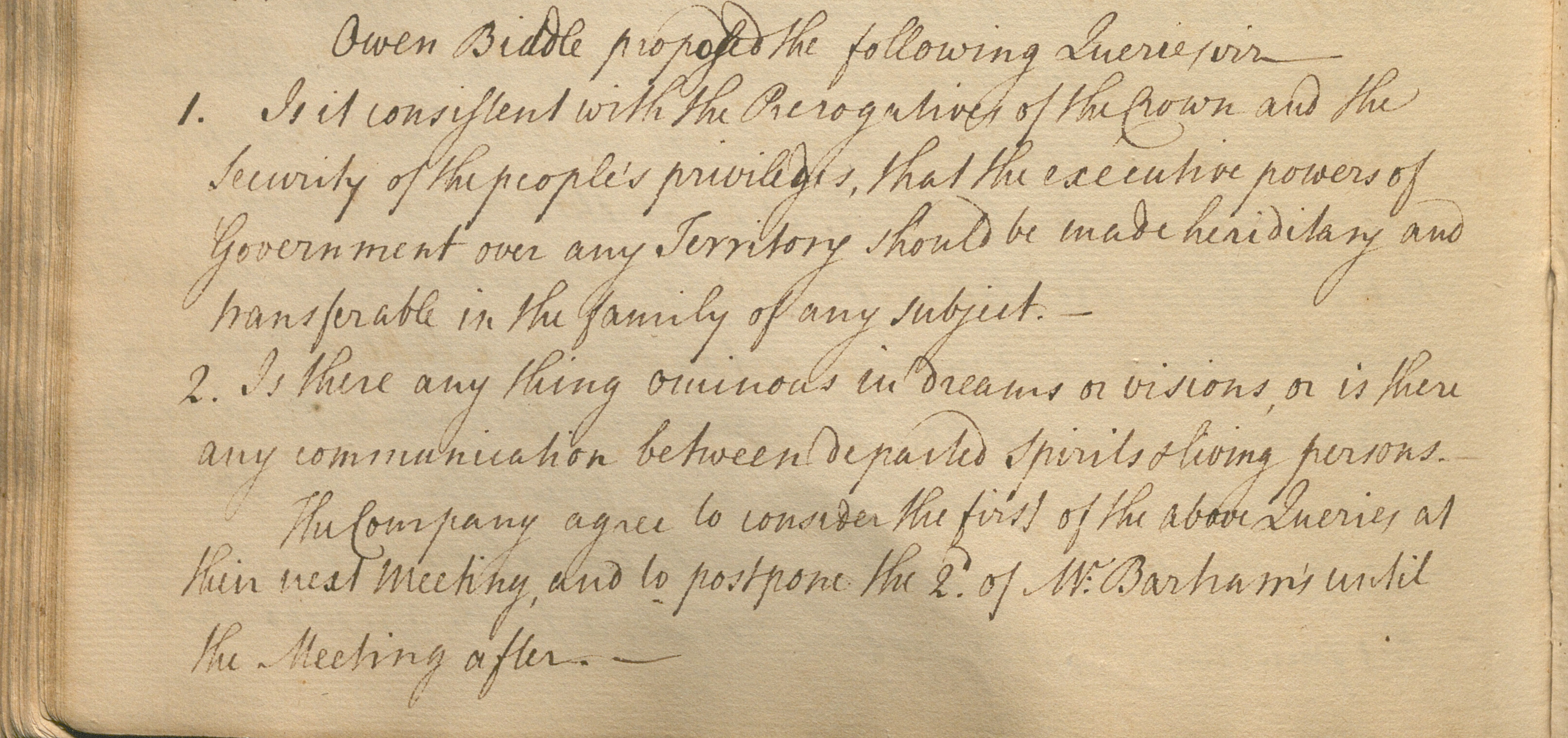
The question was tabled, as the group preferred to answer his first question on the whether government powers ought to be hereditary. Was Biddle disappointed? What might they have shared if they’d discussed this strange question?
In August of 1761, businessman and receiver general of Pennsylvania Edmund Physick put forth another fascinating query: “What are the common Causes that occasion the Downfall of an Empire?”
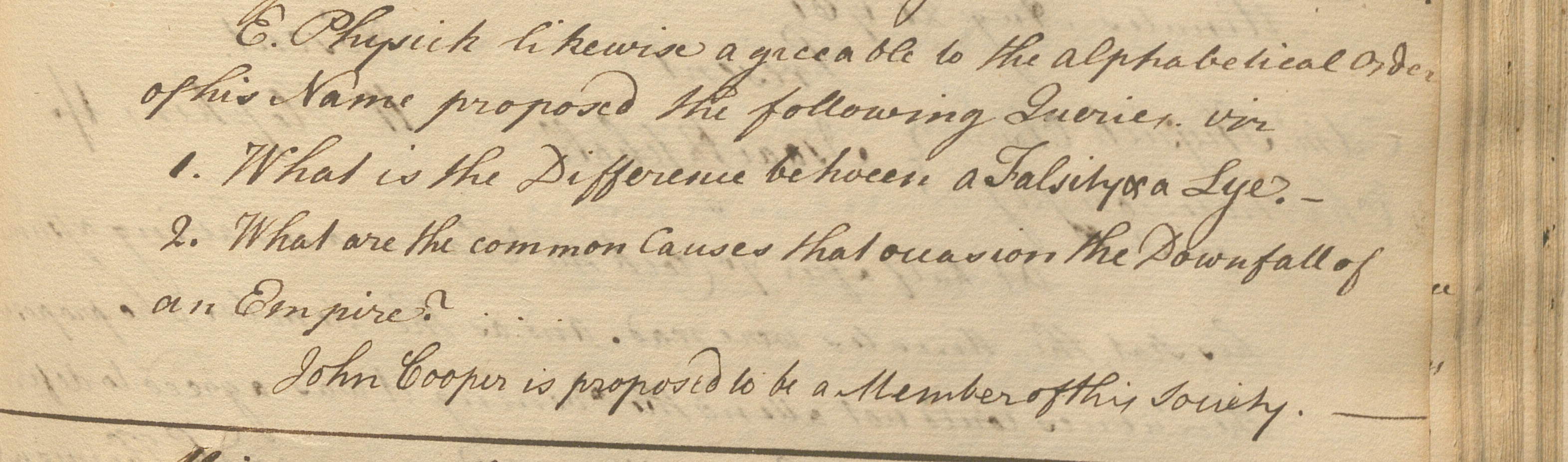
This question was “thrown into Stock.” The irony of an agent of the British Empire asking this question strikes me. Perhaps he saw the writing on the wall. Maybe, he was simply thinking back into history, pondering the end of the Greek and Roman Empires that so inspired American Revolutionaries only a few years later.
Of course, sometimes the clock simply ran out. On May 11, 1759, the notetaker documented pages of documentation on the question “Which is the best time to Transplant Tulips, Strawberrys, Currants + Goosberrys?” It seems the conversation lost momentum. But, they gave up in style, deciding, “The Currants + Goosberrys are deferred.”
