


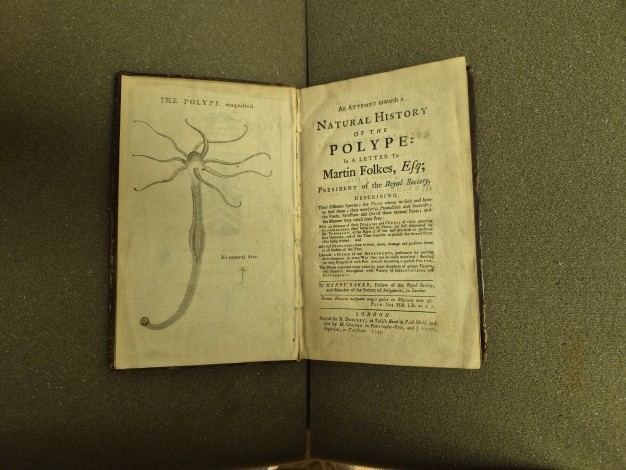
Frontispiece and title page of Baker, Polype (1743)
I took up a short term fellowship at the American Philosophical Society in May 2025 in order to help me complete research for my current book project, Enlightenment Visibilities. I’m trying to understand the phenomenon of popular microscopy in the Enlightenment: why was microscope work suddenly so popular in the middle of the 18th century? Of course, I am interested in what kinds of scientific questions drove the work of elite researchers. But more importantly, I am fascinated by what may have compelled regular folks to take this up as an ingenious pursuit.
I’ve become particularly interested in the annotations that readers left in books published about microscopes and microscopic natural history in the period. For the past few years, I’ve been making visits to as many rare book rooms as I can in order to turn over the pages of the works of 18th-century microscopy. As of the writing of this blog post, I have consulted over 625 individual volumes. Thanks to my fellowship at the American Philosophical Society, I was able to add 40 titles to that list, including some volumes that had only just recently been acquired by the Library and had not yet been accessioned into the general collection at that time. I’m so grateful for the incredible assistance and support lent by the team at APS that enabled me to get my hands on these remarkable books from the Gall Collection.
I have found that, by and large, books about microscopes are consistently annotated, apparently more so than other kinds of books about science or natural history. I think this has to do with the sheer astonishment that readers experienced when first encountering the manifold marvels of the microscopic world. For example, it is one thing to have your mind blown with the revelation that there are moons circulating Jupiter. Judging by the popularity of Bernard Fontanelle’s Conversations on the Plurality of Worlds (1686), the new discoveries in cosmology and astronomy of the 16th and 17th centuries surely stimulated widespread curiosity and speculation. However, it’s another thing entirely to realize there is an entire universe of microscopic structures and creatures that have always existed all around us ever since the beginning of time, but which have only just now come into view. Just think about how profoundly strange that notion would seem to the culture that first discovered this truth. That the alarming ubiquity and proximity of these strange forms of life triggered an even more thorough-going re-evaluation of what it means to be human. The engagement with the microscopic world triggered a kind of proprioceptive dislocation, a sense that we don’t understand anymore what it is to live as a human amid a nature that is so much more complex and varied than anyone ever thought possible.
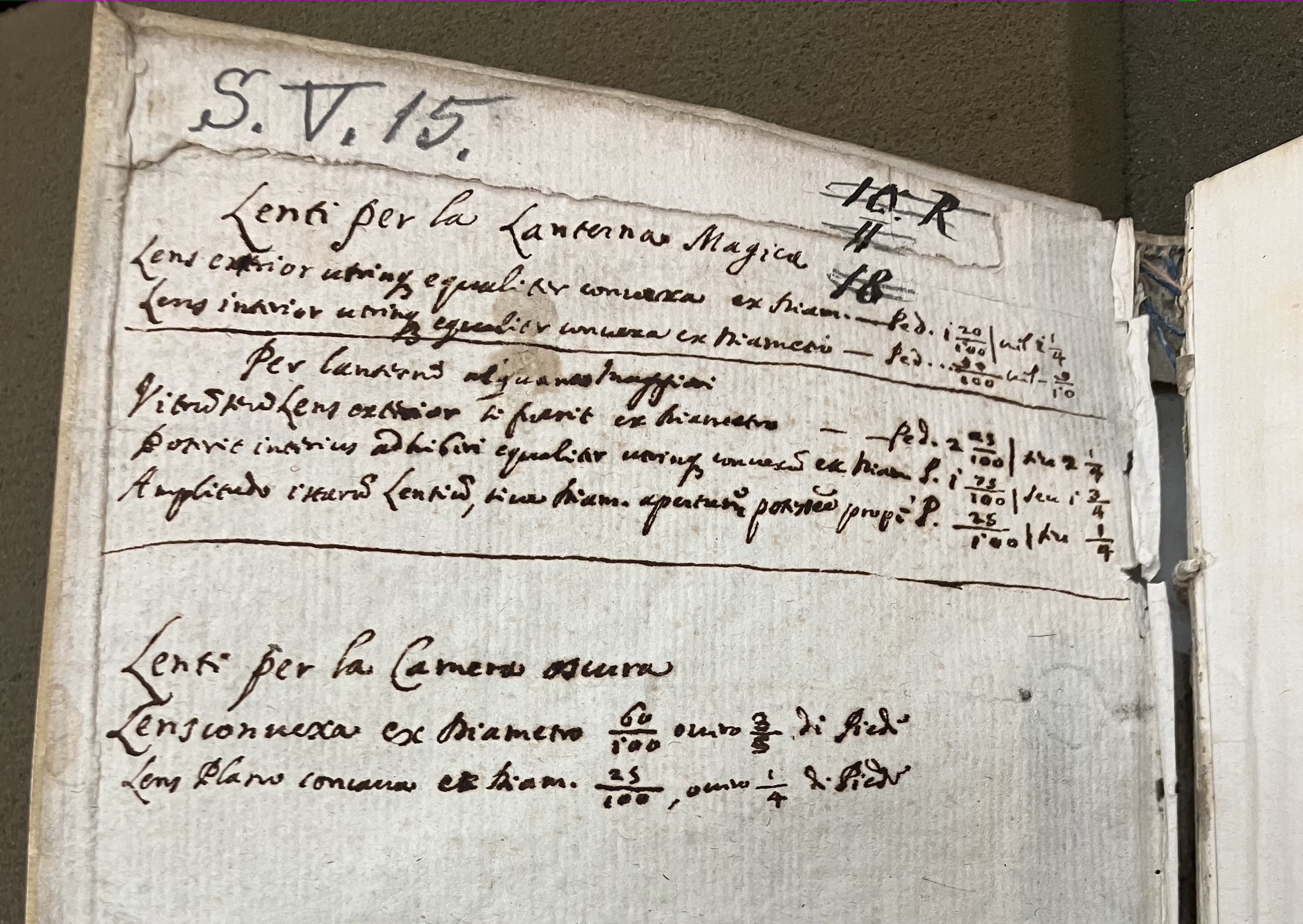
In many ways, what I have found in the pages of the books at the APS tracks with what I’ve been finding in the pages of the books at other institutions. Many of these books seem to have had contemporary readers who were quite eager to figure out how to use microscopes themselves, and to experience firsthand the marvels of the microcosm. The copy of Henry Baker’s An Attempt Towards a Natural History of the Polype (1743) that the Library only just acquired appears above. It has markings that indicate that the reader was especially interested to learn how to raise and care for these astonishing microscopic creatures, as well as how to best prepare them as specimens for viewing. This seems of a piece with the interests of a reader of Carlo Manzini’s L'Occhiale All'Occhio Dioptrica Practica (1660), also a new acquisition from the Gall Collection, who took the time to list down on the front endpaper the lens magnification required for various optic applications. People clearly read these books in order to figure out how to do microscope work.
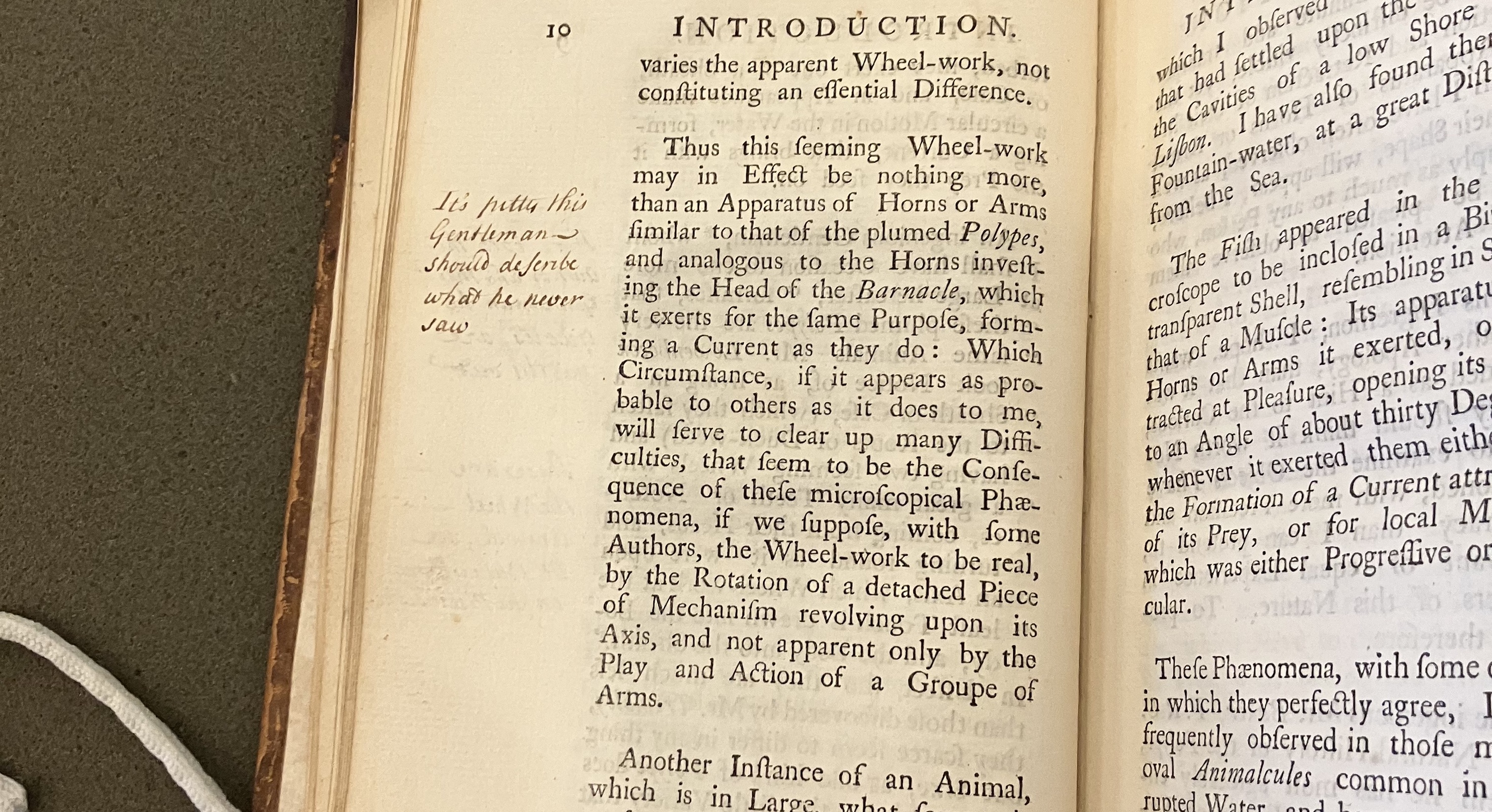
Indeed, if some readers may have been novices seeking advice on how to replicate the wonders they were reading about, others were highly experienced microscopists who knew the state of the science quite well and weren’t shy about recording their opinions and criticisms. The APS’s copy of John Needham’s New Microscopical Discoveries; Containing Observations on the Calamary (1745), shelfmark 591.8 N28, seems to have been owned and annotated by a “Richard LeHunte,” who signed his name to the titlepage. LeHunte’s copy of the book is aggressively marked up with a series of delightfully snippy annotations in the margins of the first pages of the book. Apparently, LeHunte was unimpressed with Needham’s account, and he found frequent cause to remark in the margin that Needham contradicted the apparently superior work of Henry Baker on the subject. Thus on page 9 we learn, “Here both the author and the gentleman he quotes are vastly out. These are – the Wheel – animal, see Mr. Bakers Book on the Microscope.” A page later, the annotator dismissed Needham thusly, “It’s pitty this Gentleman should describe what he never saw.” The annotations peter out after page 13, perhaps because LeHunte gave up in disgust?
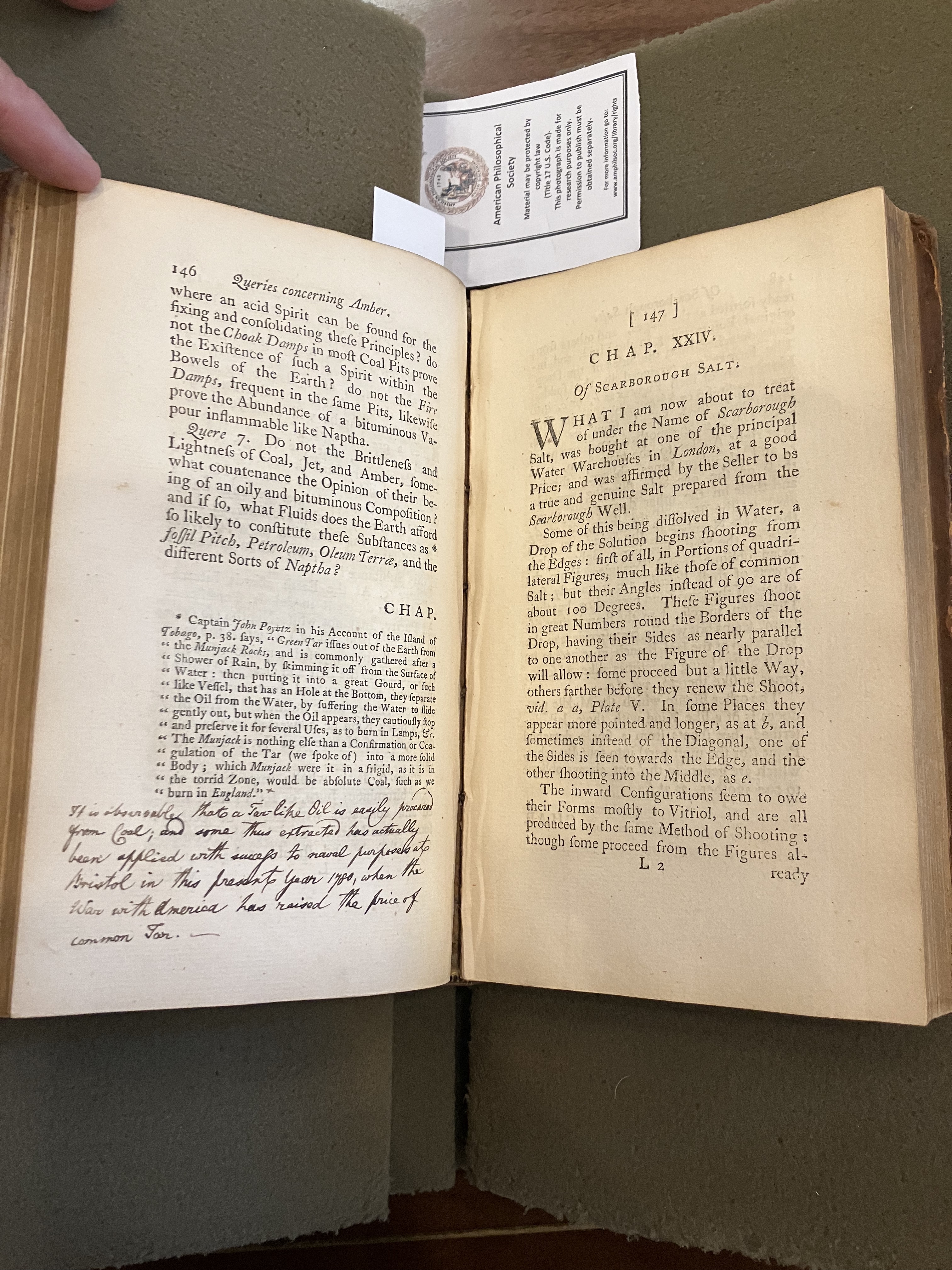
LeHunte knew his onions, but it would be a mistake to assume that all readers of 18th-century microscope texts were experienced practitioners up-to-date on the latest discoveries. In fact, there’s plenty of evidence to indicate that readers dipped into these texts out of curiosity for what might’ve been nothing more than idle amusement, and brought their own interests and obsessions to bear on their experience of the book. I could point to the copy of the second edition of Henry Baker’s Employment for the Microscope (1764) held at the APS, shelfmark 578 B17E. This is without a doubt the most influential of all the works of Enlightenment microscopy. It effectively ignited the fad, and it sold in vast numbers through multiple additions throughout the 18th-century. It’s the book that I have found to be most commonly annotated, and readers engaged deeply and variously with the wide range of fascinating information that Baker conveyed about the microscopic world. It is quite common to find readers calling attention to the beautiful flights of physico-theological rapture that Baker sprinkles throughout his text, not to mention marking off practical advice about how to configure and manipulate their instruments or their specimens. But in this case, the annotator—identified as Edward Robson of Emanuel College, Cambridge from the ex libris annotation on the front endpaper—was only moved to exercise his pen on a single occasion. It was in response to a passing observation that Baker made on page 146 about amber being perhaps related to bitumen and other “fluids of the earth.” There, Robson wrote, "It is observable that a tar-like Oil is easily procured from Coal; and some this extracted has actually been applied with success to naval purposes at Bristol in this present year 1780, when the War with America has raised the price of common Tar." And so we know the annotator and the date—so often unknowable in the case of the annotations I find—yet we are left with an unsolvable puzzle: why did Robson care so much about coal tar oil, and why was he moved to remark about it here, in this book?