




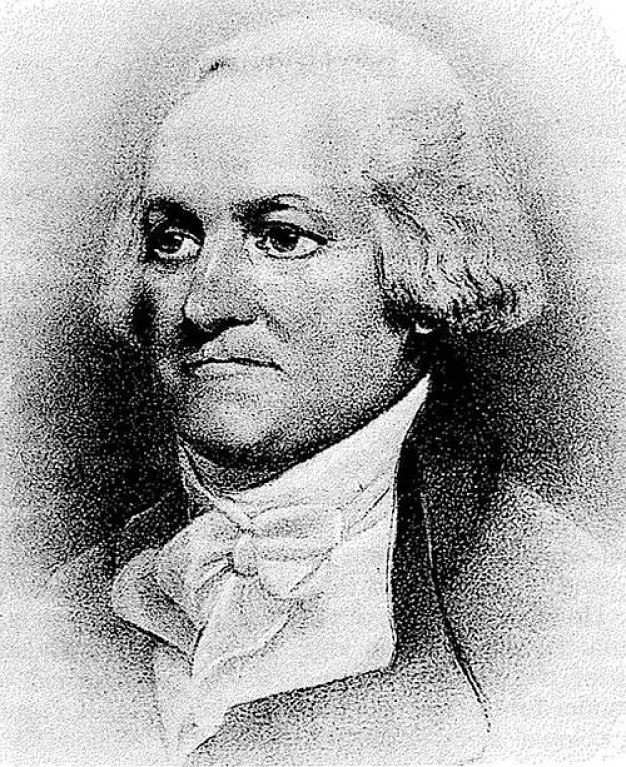
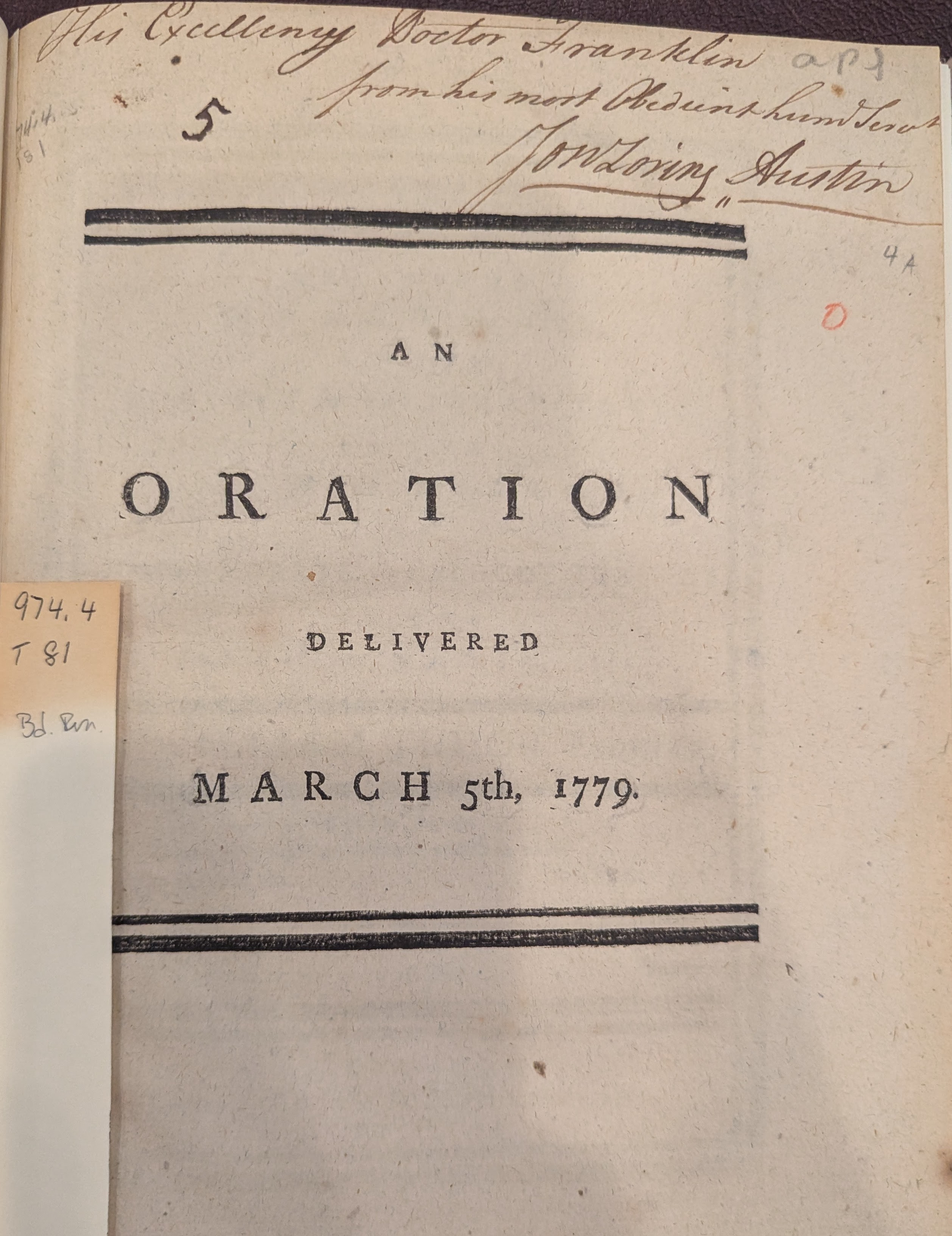
On the boardroom bookshelves at the American Philosophical Society (APS), there is a small bound copy of an oration by the former Judge Advocate of the Continental Army, William Tudor, in March of 1779 commemorating the ninth anniversary of the Boston Massacre. The speech—one of many examples of revolutionary rhetoric printed at the time—bears a compelling inscription: “To His Excellency Doctor Franklin” from fellow diplomat Jonathan Loring Austin. Orations had long been of interest to Franklin and the Society, but this work was particularly aligned to a political project that many Americans pursued throughout the conflict with Great Britain: revolutionary civic education.
Tudor began his oration explaining that “man was born to delude and be deluded; to believe whatever is taught, and bear whatsoever is imposed.” But American Patriots, Tudor averred, were “vigilantly attentive to the sacred, unalienable rights of man [and] equally studious in the glorious principles of liberty.” Undeluded, good Americans learned a critical lesson in March of 1770: the British Empire could not claim to uphold Americans’ liberties while shooting at their bodies. However reductive Tudor’s thesis may have been, the Harvard-trained lawyer and his fellow Revolutionaries embraced their roles as political educators and viewed their communities as political classrooms. “So intelligent, so well-informed an auditory” would heed Tudor’s message, delivered in “language that becomes a freeman to use when addressing a free assembly” as he laid out his “sentiments as they arise warm from a heart devoted to the interests of this, my parent country.”
On this occasion, Tudor’s lessons spoke to a wide audience and communicated basic principles of the revolutionary movement. Though Britain “distinguished” itself in martial glory, commerce, and “all the useful arts and sciences,” Parliamentarians stripped colonists of their liberties and enabled a misguided monarch to turn into a tyrant. Britain’s constitution was “not only corrupted, but perverted to purposes diametrically opposite to its original intention.” Officials “assumed a superiority” that justified violent military force to assert authority, regardless of any American liberties they infringed along the way. However, the victims of the Boston Massacre, Tudor argued, offered “this salutary lesson written indelibly with their blood”: that “confusion, murders, and misery” always accompanied an army backed by an unjust government. “Let us forever retain the important lesson,” Tudor demanded. Americans were “a free and wise people,” who would “never suffer any citizen to become too popular–much less too powerful.” Boston’s martyrs, Tudor explained, had “taught their countrymen … [the] wisdom” of revolution against tyranny.

Such language in Tudor’s oration reflected a direct effort to teach Americans about the principles of their resistance movement. No one was more invested in this overtly educational effort than Benjamin Franklin. Two months after Tudor’s address—and, potentially, around the time Franklin received a copy of it—Congress asked him to develop a “little book” filled with illustrations of British “cruelties,” “malice[,] and wickedness.” Children and their families could easily learn about the evils of the British Empire and, presumably, the righteousness of the Revolution from such a work.
Tudor and Franklin were participating, in other words, in an interconnected political education initiative. They, and many others, set out to instruct people on both the tyranny of the enemy and the virtue of the Revolution. Moreover, when Patriots turned to colleges, free schools, and academies in the 1780s to, as Benjamin Rush put it, promote “just ideas of laws and government,” they drew on a political and educational mission that started in the throes of Revolutionary war. Tudor’s oration, Franklin’s book, and Austin’s correspondence all reveal that arguments over who should learn and what they should learn were key components of the unrest that pervaded American society in the eighteenth century. Moreover, the process of, as the APS and its Members called it, “promoting useful knowledge” has always been a politically contested part of America’s revolutionary story.
References
Robert Parkinson, The Common Cause: Creating Race and Nation in the American Revolution (The Omohundro Institute and University of North Carolina Press, 2016)
Benjamin Rush, A plan for the establishment of public schools and the diffusion of knowledge in Pennsylvania; to which are added thoughts upon the mode of education, proper in a republic: Addressed to the legislature and citizens of the state. (Philadelphia: Thomas Dobson, 1786).
William Tudor, An Oration Delivered March 5th, 1779, at the request of the inhabitants of the town of Boston; to commemorate the bloody tragedy of the fifth of March, 1770 (Boston: Edes & Gill, 1779), 5. Held at the American Philosophical Society, call number 974.4 T81.
Franklin and Lafayette’s List of Prints to Illustrate British Cruelties, c. May 1779,” Founders Online, National Archives, https://founders.archives.gov/documents/Franklin/01-29-02-0477
“Marquis de Lafayette to Benjamin Franklin, 12 July 1779,” Founders Online, National Archives, https://founders.archives.gov/documents/Franklin/01-30-02-0061
“From Benjamin Franklin to David Hartley, 2 February 1780,” Founders Online, National Archives, https://founders.archives.gov/documents/Franklin/01-31-02-0310
“From Benjamin Franklin to Marquis de Lafayette, 9 December 1780,” Founders Online, National Archives, https://founders.archives.gov/documents/Franklin/01-34-02-0093
“Jonathan Loring Austin to Benjamin Franklin, 12 July 1779,” Founders Online, National Archives