

Wealth, War, and Society in Early America: Insights from the APS Manuscript Collections



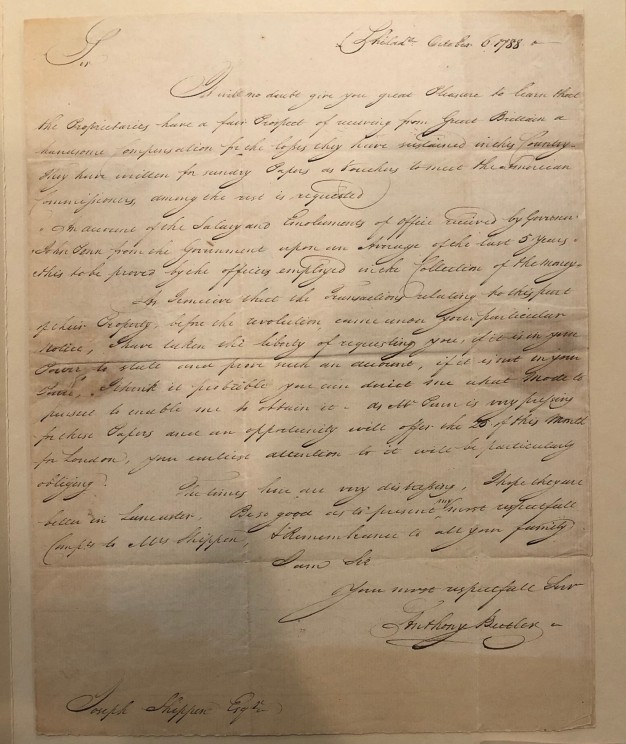
Header Image: A letter from Anthony Butler to Joseph Shippen dated October 6, 1788 concerning news of compensation to Pennsylvania proprietors from Great Britain “for the losses they have sustained in this Country…” Burd-Shippen Papers, Series 1: Correspondence, Box 4, American Philosophical Society. Philadelphia, PA.
My current research project examines the relationship between war, finance, and political power in the American northeast between 1739 and 1789. Focusing on the period from the War of Jenkins’ Ear through the American Revolution, I portray these events as parts of a singular process of imperial state-building and development of colonial economic autonomy and financialization. Provisioning and financing armies and navies across significant distances fostered decentralized war economies. I also examine how political influence over the economy of early America allowed well-connected individuals to accumulate wealth and social power through the era of the American Revolution.
The manuscript holdings at the American Philosophical Society contain extensive and informative materials on late-18th-century land speculation, public finance, governance by merchant elites in Pennsylvania, and a significant body of other documents illuminating the relationship between property, capital, and the state in the half century preceding the American Revolution as well as the early national period. The George Clymer papers contain many standardized written instruments printed for the conveyance of land. These written instruments reveal the economic, political, and legal structures supporting the acquisition of land among the 18th-century American merchant class. These records show how wealthy citizens of the early United States, such Edward Price, Tench Francis, and Henry Drinker exchanged tracts of land. They also illustrate the role of judges, such as George Bryan of the Pennsylvania Supreme Court, who oversaw attestation to the exchanges of land in the early republic. Further documents within the collections of the APS indicate the significant, recurrent, legal transactions necessary to support investment in land speculation in the 1780s. For example, the extensive articles of agreement between George Clymer and others regulated the sale of the “Franklin Patent” lands by setting price floors, rules of accounting, determining power of attorney, terms on which to settle with squatters, and public provisions such as schools for settlers.
The manuscripts at the APS provide information bridging the social, economic, military, and administrative histories of the colonial and Revolutionary eras of American history. The Burd-Shippen Papers document an extensive network of family, martial, mercantile, and political interaction in mid-18th-century Pennsylvania. The collection offers a broad chronological arc of the activities of the Shippen merchant family and particularly their interactions with the family member Colonel James Burd during the French and Indian War. These records show the family-based development of western settlement and the colonial American state. They further indicate the critical overlap between urban commerce and the formation of town governments in Pennsylvania. Examples from this collection include correspondence between figures such as James Burd, Thomas Cookson, James Hamilton, Thomas Barkley, and Johannes Kern concerning land deeds and financial instruments used to finance and establish legal rights of ownership in early Lancaster. Letters in this collection reveal the inter-regional and transatlantic commercial networks involved in the social and economic development of Pennsylvania in the second half of the 18th century. Correspondence indicates the importance of trading ties between Philadelphia and Maryland, the circulation of bills payable in London, and the pervasive influence of transatlantic credit structures. Supplementing such correspondence are mercantile and personal financial accounts, such as those of Robert Philip and John Hollingsworth, which record routine business of debt collection, wage payment, and the logistical management of shipping. These accounts record the vital role of the flour and iron trade as sources of mercantile wealth which merchant families like the Burds and Shippens channeled into the establishment of towns. Such records indicate that Philadelphia’s merchant families served as a key nexus between Atlantic commerce and the militarizing frontier towns to the west.
Many of the most interesting documents in the Burd-Shippen papers are those indicative of political economy and governance from the 1750s onward, particularly concerning the outbreak of the French and Indian War. At this time, the thematic focus of the papers became increasingly to include the troubles of public administration, land disputes, and diplomacy. James Burd’s correspondence with Edward Shippen and Governor James Hamilton featured heavily during this period. Burd operated as a key representative of Pennsylvania’s elites like Shippen and Hamilton in contested regions, where he addressed settlers’ petitions, maintained fortifications and roads, and handled relations with George Croghan and the Six Nations. This period reveals the tensions of maintaining public order during periods of conflict. Petitions from Pennsylvania settlers address local conflicts over taxation and roadbuilding between frontier settlements. After 1754, correspondence increasingly centered on treaties, addressing fears of frontier vulnerability, recruiting laborers, supplying arms, paying wages, and preventing food scarcity. Many of these documents reflect local and imperial perspectives on defense and Native American threats. Colonial officers such as Hugh Mercer, Edward Ward, and William Clapham correspond with Burd and others concerning supply shortages at garrisons and the difficulties of local defense. The Burd-Shippen Papers illustrate the inextricability of mercantile business and credit, local administration, and warfare in late-colonial Pennsylvania. This rich archival source reveals how merchants like Burd and Shippen served as intermediaries between imperial officials, provincial leaders, and settler communities. The papers also show how these same merchants played very direct roles in the militarization of British American society during the Seven Years’ War by funding and organizing the military infrastructure of the colony during periods of imperial conflict.
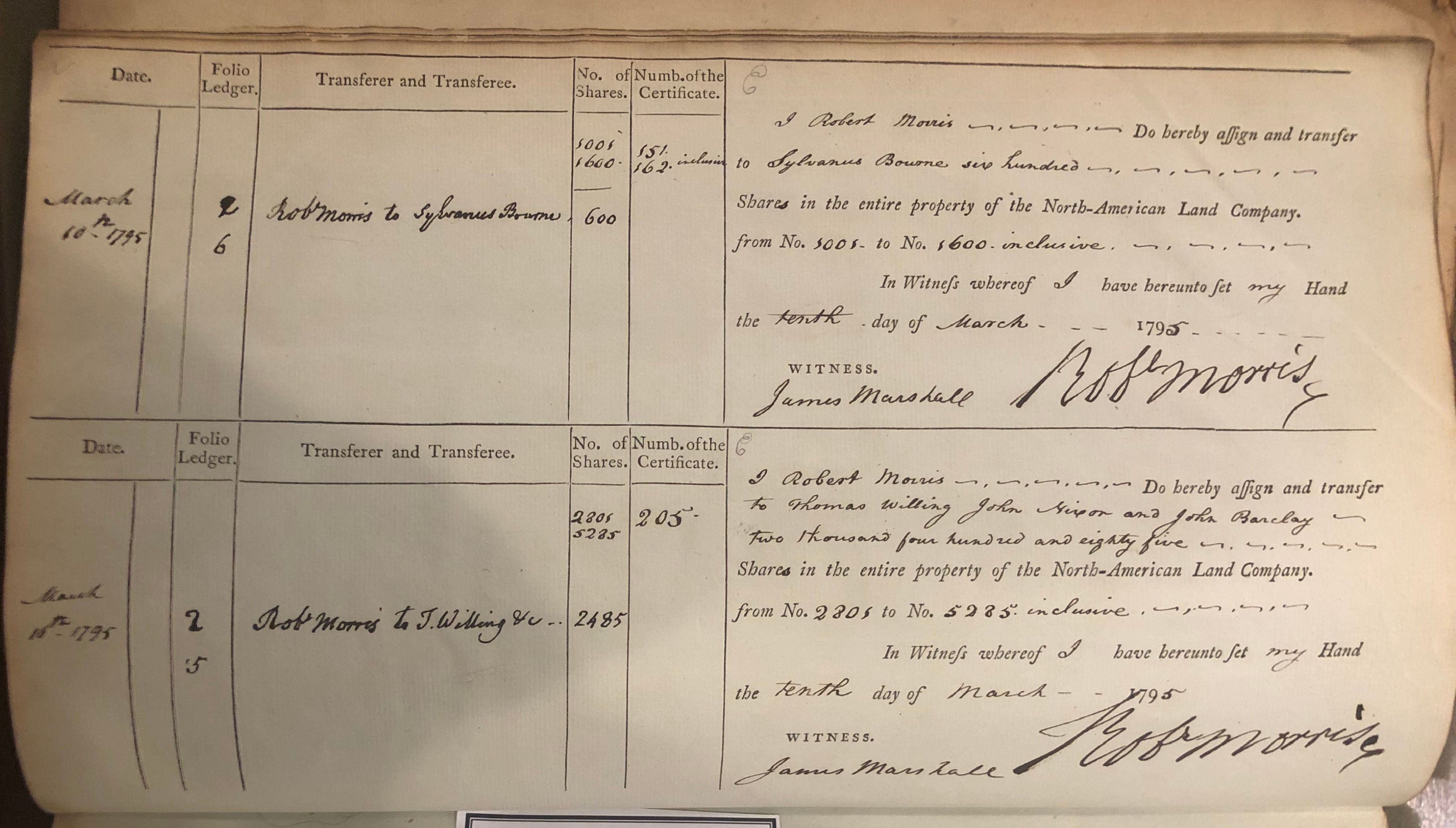
Many of the themes in the Burd-Shippen Papers concerning the relationship between early American merchants and the state also appear in other manuscript collections at the APS. Many show how such relationships were pertinent through the American Revolution and into the early national period. For example, the Hare-Willing Family Papers indicate trends in the relationship between merchant firms and the Revolutionary state. These documents contain uninterrupted chains of business activity and networks contributing to everything from the Philadelphia wholesale business in the early 1750s, to monitoring the French fortification near Oswego, to negotiations concerning debt in the Bank of North America minutes in 1789. Many of the most thought-provoking pieces in this collection relate to Robert Morris, the famous financier of the Revolution, whose postwar indebtedness required significant negotiation and collateral, as reflected in the writings of merchant-financiers involved in the foundation of the Bank of North America.
The collections at the APS provide a remarkable opportunity to investigate the world of politics, finance, and society in 18th-century America. From legal agreements to account books, to family correspondence, these records demonstrate how early Americans navigated commerce, credit relations, and war from the local to transatlantic levels. Working with these manuscripts has allowed me to connect large-scale processes of war and state formation to the everyday lives of individuals who shaped the economy and politics of early America.