

“The Trouble of This Enquiry”: Thomas Jefferson Responds to Correia da Serra Regarding Publishing the Lewis & Clark Expedition



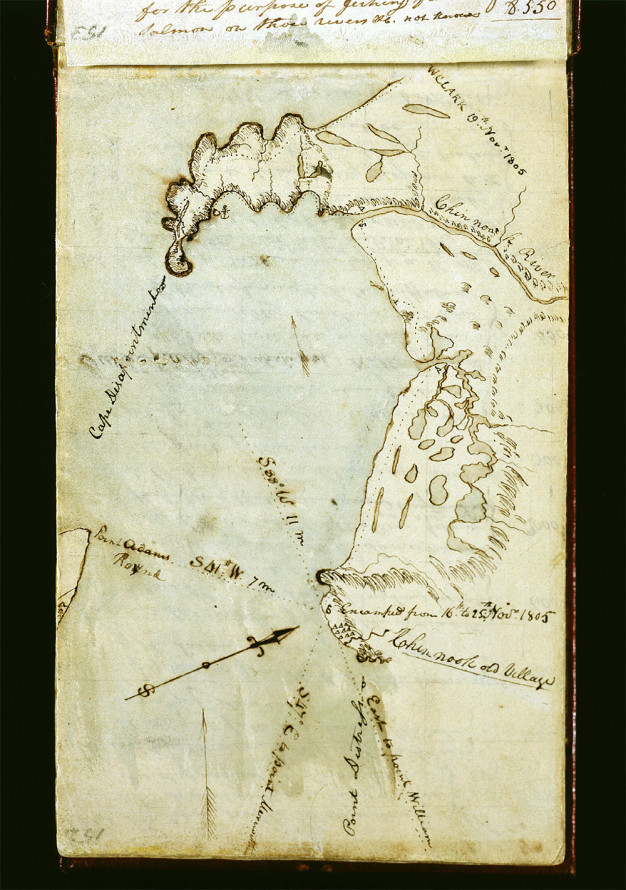
Mouth of the Columbia River (Cape Disappointment), 1805 Nov. 16–25, Page: 152. Lewis and Clark Journals, Mss.917.3.L58. American Philosophical Society.
On April 26, 1816, Thomas Jefferson penned a letter to his friend José Francisco Correia da Serra regarding an inquiry about Captain Lewis’s papers. The letter lives among the Thomas Jefferson Papers at the American Philosophical Society. At first glance, this letter is simply a list, itemizing the physical papers, journals, and maps that resulted from Meriwether Lewis’s expedition with William Clark, and the other members of their party to the Pacific Ocean. Yet, the list offers a remarkable treasure trove of details about the documents and data generated, how the data was kept and stored, and the dispersal of these items.
These details reveal two important things. First, the list demonstrates the importance to Jefferson, Correia da Serra, and even Meriwether Lewis of maintaining a careful provenance of all data related to the excursion. Second, the letter itself provides a case study of the difficulty that arises when research that is considered important for many people and different audiences remains unpublished for many years, a circumstance with which modern researchers can identify.
The expedition led by Lewis and Clark, known as the Corps of Discovery, had explored the lands west of the Mississippi that comprised the Louisiana Purchase. Between 1804 and 1806, they covered approximately eight thousand miles, documenting details about the peoples they encountered, flora and fauna they observed, and creating maps of their journey that were made for the benefit of and at the behest of the United States Department of War. At the time, Thomas Jefferson was the President of the United States, and as he noted in the letter to Correia da Serra:
They [the journals, documents, and other items] are the property of the government, the fruits of the expedition undertaken at such expence of money and risk of valuable lives. They contain exactly the whole of the information which it was our object to obtain for the benefit of our own country and of the world but we were willing to give to Lewis and Clarke [sic] whatever pecuniary benefits might be derived from publication and therefore left the papers in their hands, taking for granted that their interests would produce a speedy publication, which would be better if done under their direction.
It is worth noting that the Corps of Discovery comprised over 45 soldiers, hunters, blacksmiths, gunsmiths, French engagés (boatmen), and other civilian volunteers. The party also included York, an enslaved man who had been with Clark since his childhood, who acted as a French-Canadian interpreter, and Sakakawea, an Indigenous woman of Hidatsa heritage, who Lewis and Clark relied upon as a source of cultural knowledge, language interpreter, and negotiator. All the members of the Corps of Discovery contributed to the expedition’s findings. Today, many remain hidden in the process of collecting and interpreting the expedition’s data. Jefferson, being Jefferson, wanted to ensure credit was awarded to those he deemed to be the parties responsible for the success of the endeavour, so he reserved “pecuniary benefit” solely to Lewis and Clark.
When the journey concluded in 1806, Jefferson left the plan of publishing safely in the hands of Lewis and Clark. In 1807, the plan seemed on track. Lewis published a prospectus, advertising for subscribers to a grand three-volume work in newspapers such as Philadelphia’s Democratic Press. The ambitious work, which promised a narrative of the journey, a map “on a mammoth scale,” and scientific findings from the journey, never came to fruition, however. In 1809, Lewis died under mysterious circumstances at an inn along the Natchez Trace. Meanwhile, Lewis’s publisher declared bankruptcy. Suddenly, Jefferson’s best intentions of letting Lewis and Clark reap the “pecuniary benefits” of their expedition were thwarted, and he was no longer President.
Seven years passed. Clark eventually published a one-volume narrative of the expedition titled History of the Expedition under the Command of Captains Lewis and Clark, but unlike the promised three-volume work, it did not contain the expedition’s scientific data. When Correia da Serra wrote to Jefferson in 1816, it seems likely that he inquired about the status of the data specifically. Correia da Serra was also a man of science, who published extensively on zoological classification. He was also one of the *estrangeirados*, Portuguese exiles who traveled abroad. Correia da Serra had founded the Portuguese Academy of Science, was a corresponding member of both the Royal Society of London and Paris’s Académie des Sciences, and he became a Member of the American Philosophical Society in 1812. He maintained correspondence and sent data and specimens as requested within his vast scientific network, and he continued to pursue his own scientific research, traveling to Virginia, Tennessee, Georgia, and north to Canada. Correia da Serra likely sent his inquiry about the Lewis and Clark expedition findings to Jefferson with the specific goal of discovering when he and his fellow scientists might have access to their data and findings. Since the data was never published, the expedition’s valuable findings were not made readily available to other practitioners of science.
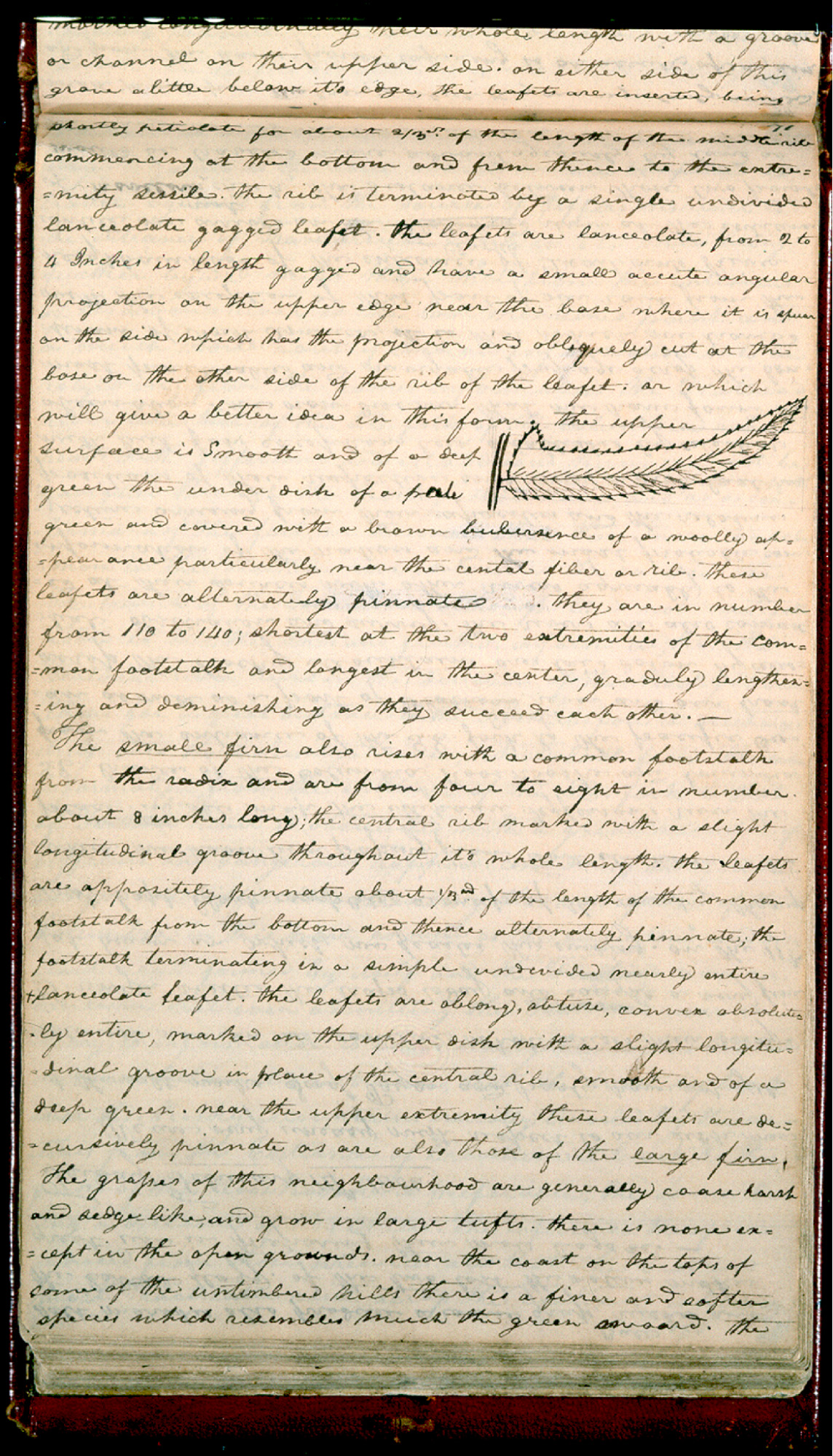
Still, a record remained somewhere. Based on this letter, Jefferson seems to have made a careful accounting of what items from the voyage existed, the state in which they remained, and where they might be found. …Mostly. He noted that the 10–12 “pocket volumes” documented the journey day-by-day, describing them carefully: octavos, bound in Morocco. After each was filled, Jefferson wrote, Lewis would put each into “a separate tin case, cemented to prevent injury from wet,” but that they were delivered to him “uncased,” so they likely remained uncased in 1816. Jefferson detailed when he thought volumes would be in the hands of publishers the War Office, a fellow APS member like Charles Wilson Peale or Benjamin Smith Barton, based on their respective personal investments and scientific specialties.
From these details, it is apparent that Jefferson still felt invested in maintaining the data even if he had lost hope of its publication. His new goal was “reclamation and security of the papers” with the plan of placing them “on deposit with the Philosophical Society” on behalf of the government. The deposit of the Lewis and Clark documents is one of the earliest instances of federal deposit into a library collection, a program dating to 1813. Correia da Serra, like other scientific practitioners who wanted access to the expedition data, would need to visit the collection in Philadelphia to learn any specific details. Jefferson apologized for involving his friend “in the trouble of this enquiry,” since both their expectations had been disappointed in the lack of publication of the expedition’s scientific data.
While Jefferson’s intention was to offer Lewis and Clark the opportunity for profit, the value of printed texts lies beyond the monetary gain and personal reputations of the authors and printers. Jefferson’s letter demonstrated his personal appreciation of how the data was organized, stored, and reported. He expressed the benefit the data provided for the country in his letter to Correia da Serra. Ultimately, his choice to reserve the rights of publication to Lewis and Clark for their personal credibility and individual fiscal gain resulted in a loss, as the publication of the expedition’s account and findings would have proven invaluable to the global scientific community. The correspondence between Jefferson and Correia da Serra illuminates how keenly that loss was felt. Fortunately, because of the clear provenance of the data, Jefferson was able to recover most items and place them on deposit at the APS. Today, via the APS, the data is available widely, with much of the Lewis and Clark Journals collection digitized. Modern scholars are able to benefit from exactly what Correia da Serra hoped for in his time: access to “useful knowledge,” upon which they might build their own new discoveries.
References
- Cardoso, José Luís. “Correia da Serra: the Formation of an Enlightened Scientist.” Gávea-Brown: A Bilingual Journal of Portuguese-North American Letters and Studies 50 (2025). Brown Digital Repository. Brown University Library. http\://hdl.handle.net/10400.5/101834. Accessed August 30, 2026.
- Diogo, Maria Paula, Ana Carneiro, & Ana Simões. “The Portuguese Naturalist Correia da Serra (1751-1823) and His Impact on Early Nineteenth-Century Botany.” Journal of the History of Biology 34 (2001): 353-393.
- Fenelon, James V. & Mary Louise Defender-Wilson. “Voyage of Domination, “Purchase” as Conquest, Sakakawea for Savagery: Distorted Icons from Misrepresentations of the Lewis and Clark Expedition.” Wicazo Sa Review 19, No. 1 “America Indian Encounters with Lewis and Clark” (Spring 2004): 85-104.
- Fern leaf (Polystichum munitum, Christmas fern), 1806 Feb. 13, Page: 71. Lewis and Clark Journals, Mss.917.3.L58. American Philosophical Society.
- Jackson, Donald L. “The Race to Publish Lewis and Clark.” Pennsylvania Magazine of History and Biography 85, No. 2 (April 1961): 163-177.
- Letter from Thomas Jefferson, Poplar Forest, to José Francisco Correia da Serra, 26 April 1816. Thomas Jefferson papers, 1775-1825, Mss.B.J35, Box: 1. American Philosophical Society.
- Mouth of the Columbia River (Cape Disappointment), 1805 Nov. 16-25, Page: 152. Lewis and Clark Journals, Mss.917.3.L58. American Philosophical Society.
- “Prospectus For Lewis & Clark Map and Official Report -- Tour To The Pacific Ocean, Through The Interior of the Continent Of North America,” The Democratic Press (August 10, 1807): 1-4.