

“Slugging It Out in the Trenches”: Alice Anderton and the Ethics of Indigenous Linguistics



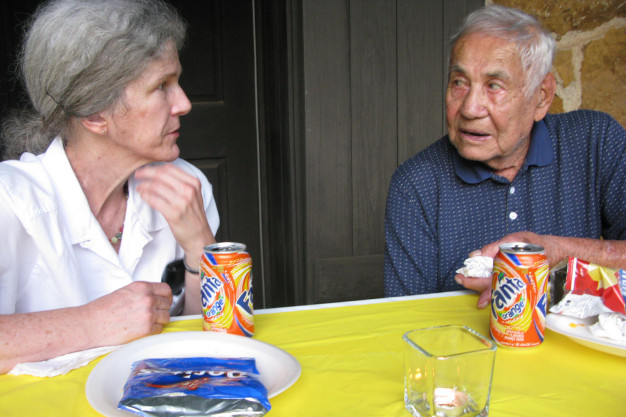
L–R: Alice Anderton and Randlett Edmonds, a Caddo elder and speaker.
This previous June and July I had the immense pleasure of being the American Philosophical Society’s Daythal L. Kendall fellow. While I enjoyed evenings exploring Philadelphia during its peak activity—the World Cup and America’s 250th birthday coinciding with my arrival—I spent my days working on the Caddo language at Library Hall. While I primarily worked with the Melnar Collection of Caddo language recordings, the materials that perhaps affected me the most were the Alice J. Anderton papers, housed within the William O. Bright collection.
Alice Anderton (1949–2016) was a linguist and language activist, primarily working with the Comanche, Ponca, and Caddo languages, whose materials came to the Society in the form of correspondence sent to Bill Bright. Most of her archived writings are, on the face of it, quite mundane: They consist primarily of her applications to professorships, project reports, and newsletters from small language revitalization-focused organizations she ran. In the margins of these pieces and in personal communications, however, a remarkable history of what it means to do linguistic work with American Indian languages emerges.
In a 1995 letter to Bright discussing her ongoing applications to teaching posts, Anderton writes that she has been “slugging it out in the trenches for years, mostly at my own expense, working in Indian communities…” and that she knows “the political and social realities of real world applied linguistics.” In applying to Oklahoma University, she says that she does not value “linguistic theory as such over the applications of linguistics required in [Oklahoma]; so I won’t get bored and leave in a year or two.” Anderton consistently acknowledges a political element to her linguistic work, and implicitly draws a line between herself and a formal, distant class of linguists who are perhaps uninterested in American Indian languages beyond what they can provide to an understanding of language writ large.
Anderton also describes a deep, emotional and interpersonal aspect to her linguistic work, in ways rarely seen in the field. In a final report on the Native American Language Preservation Program, a project she ran for two years at Oklahoma University, she highlights within the project not a generic scientific value but the way it has given back to tribes. On why working with the Caddo was so vital, she writes: “The amazement of young Caddoes who have heard Turkey Dance songs all their lives as they watched the women dance in their beautiful and stately dashtuhs, but never dreamed that some of the songs recount graphically some rather violent aspects of Caddo history.” In a Pathways newsletter sent out in 1997, Anderton’s “wonderful experiences” are of “teaching young Comanche students at the University of Oklahoma and Cameron University who tell of surprising their grandmas with a phone call in Comanche” and “witnessing the birth of the first Caddo Valentine.”
Invariably, Anderton centers in her research the people, and not the languages as impersonal objects of study. Her writing illustrates a deeply heterodox linguistic methodology that has few parallels in any linguistic canon. For Anderton, the field of linguistics should be concerned as much with speakers as it is with what is spoken, and has the power to be a deeply restorative and sensitive discipline, beyond the distant and solitary academic endeavor it is for so many. Her work housed at the APS not only expands our understanding of the history of linguistics in America, but also provides a novel set of ethics and expectations to consider for any linguist working with endangered languages and Indigenous communities. Her humanistic approach in fact only becomes more relevant to reflect on as the face of linguistics continues to shift further towards computation and AI. Perhaps most helpful for any linguist seeking to reflect on their own work, whether it be about language learning models or Indigenous language preservation, is Anderton’s relentless optimism: “I guess I am an optimist at heart, even when I know better. Look what I do with my life now—working for languages most of which will soon die. But some few may (probably will) make it… Besides, hope is more fun!”