

The Surveyors: Andrew Ellicott, Benjamin Banneker, and the Boundaries of Nation and Knowledge


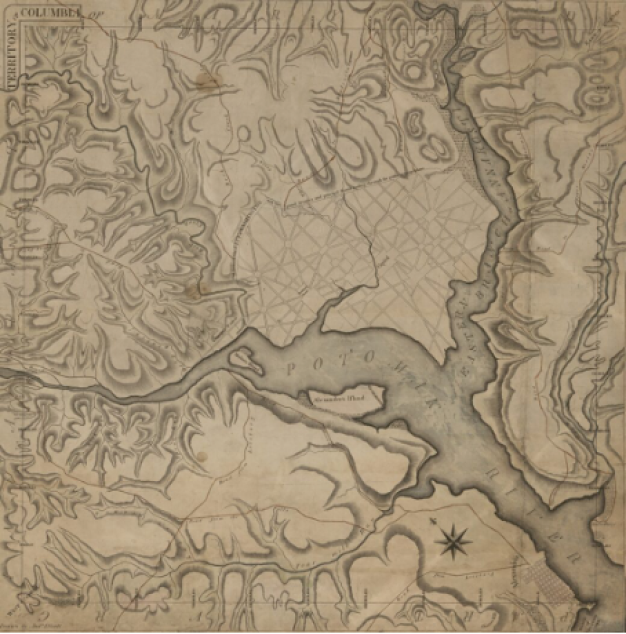
Header Image: The first map of the federal district, Andrew Ellicott’s Territory of Columbia (1793), https://www.whitehousehistory.org/photos/where-oh-where-should-the-capital-be-white-house-history-number-34-photo-1
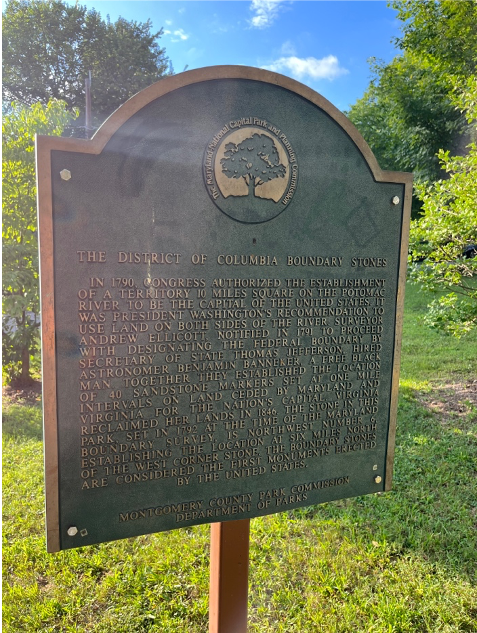
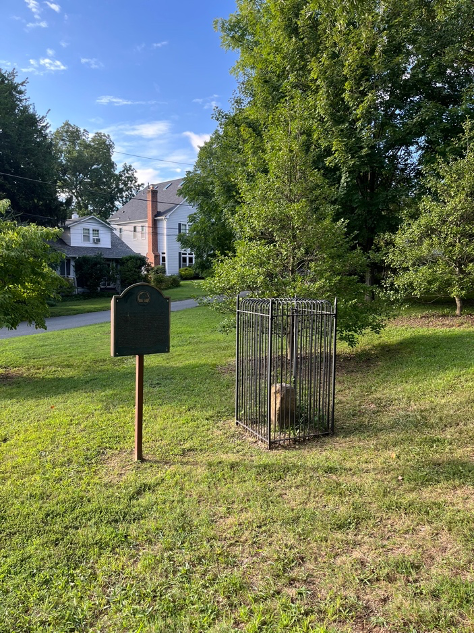
I grew up in Washington, D.C., four blocks away from the Northwest 6 Boundary Stone. In 1792, a team of surveyors led by Andrew Ellicott laid that stone as they were plotting out the ten square mile area of the new federal district. The stone sits along Western Avenue, across from Fort Bayard Park, where I used to go sledding in the winter and play catch with my father in the summer. I, along with other D.C. Public School students, learned the names Andrew Ellicott and Benjamin Banneker growing up. They were the surveyors of the city, and a notable example of a white man and a Black man working together in Early America. Indeed, a magnet school in the Shaw neighborhood bears Banneker’s name, and my parents’ house sits just a block south of Ellicott Street. In high school, a friend and I made a documentary video of our neighborhood for an AP human geography class, featuring some footage and history of the boundary stone. Predictably, the footage was comically boring. But the idea, I guess, was to try to communicate a sense of the layered history, or deeper history, of the place of the neighborhood. To show a sedimentary layer beneath its current landscape of New Deal-era brick box homes with their tumor-like additions.
The boundary stone, even if only slightly, contributed to my sense of self. It monumentalized the origins of a border that determined essential facts about my life: what schools I went to; what sports leagues I joined; my U.S.-state identity (or lack thereof); my parents’ voting rights; and, of course, my own future voting rights. And, as I write this blog post, it clearly lives on as a data point in my memory. Boundaries, like census data, carry power we often take for granted. They are things, even technologies, that are made, remade, and validated over many years, until we forget where or when they began.
Ellicott helped draw the boundaries of the early nation. In the early 1790s, Ellicott and Banneker created the boundary lines of the new federal capital; their science in post-revolutionary America literally gave shape to the United States. In doing so, they became an iconic story of how the rigid racial boundaries of 18th-century American life could also be redrawn. The moral was the message. The sign above the Northwest 6 Boundary Stone makes no mention of Ellicott’s brothers, Isaac Roberdeau, George Fenwick, or Isaac Briggs, nor the field laborers who aided in placing the boundary stones. Instead, it mentions only Ellicott and Banneker, how they laid the foundations of the nation’s capital “together.”
Andrew Ellicott was born on January 24, 1754 in Bucks County, Pennsylvania to a Quaker family with modest means. His father Joseph served as High Sheriff of Bucks County from 1768 to 1769, became a member of the Provincial Assembly, and developed impressive skill as a clockmaker, which drew him into the circles of both Benjamin Franklin and David Rittenhouse. Joseph and his wife Judith gifted their children a love for science and mathematics. Andrew likely received his education at a local Quaker school in Solesbury before he ventured off to Philadelphia to study with Robert Patterson, an Irish-American mathematician and teacher who would go on to be a Professor of Mathematics at the University of Pennsylvania and director of the United States Mint from 1806 to 1824. By his early teen years, Andrew displayed remarkable mathematical talents and assisted his father with clockmaking. In 1770, Joseph purchased land on Patapsco River in Maryland with his brothers Andrew and John, where they founded a milling business and the town of Ellicott’s Mills in 1772. When the Revolutionary War broke out, the young Andrew abandoned his Quaker customs and joined the Elk Ridge Battalion of the Maryland state militia. He rose to the rank of Major.
Ellicott knew his talents were better put toward technical work. In 1780, after the sudden death of his father, Ellicott took over the mill and clockmaking business. In local newspapers, he advertised for a helping hand to run the businesses, hoping to spend more of his time on calculating ephemerides, or celestial positions for almanacs, and other scientific endeavors. In 1784, a wonderful opportunity emerged. Ellicott was appointed one of the Virginia commissioners responsible for refining the boundary between Virginia (the area that is now West Virginia) and Pennsylvania. David Rittenhouse joined as a commissioner representing Pennsylvania, and Ellicott developed a close friendship with the admired astronomer. Their work extended the Mason-Dixon line to today’s southwest corner of Pennsylvania. The next year, Ellicott worked again with Rittenhouse and Andrew Porter to draw the western line of Pennsylvania from the Ohio River in the south to Lake Erie in the north. By the middle of the decade, Ellicott had made a formidable name for himself: the man who would help give the new country its geographic shape. The American Philosophical Society elected him a member in 1785. A decade later, George Washington would appoint Ellicott as the commissioner to determine the boundary between the United States and Spain, including the 31st parallel north, established by Pinckney’s Treaty, or the Treaty of San Lorenzo.
But Ellicott’s most remembered work began in 1791, when George Washington called upon him to survey the ten square miles around the Potomac and Anacostia rivers for the new federal district. Ellicott hoped to enlist the help of his brothers, who he had trained for previous surveying work, but they were tied up with completing a survey in New York. He hired engineer Isaac Roberdeau to assist, and asked his cousin George Ellicott to take on the observatory work. George was busy too, however. So George reminded Andrew of his neighbor, Benjamin Banneker, a free Black man of 60 who had recently retired from his tobacco farm. A couple years ago, George had noticed his neighbor’s keen interest in astronomy. He lent the retired tobacco farmer several instruments and books and promised to occasionally stop by and answer any questions he might have. At the age of 58, Banneker stunningly started to teach himself complex mathematics and astronomy, well enough to handle sophisticated scientific instruments and produce ephemeride calculations for his own almanacs. Andrew Ellicott’s invitation came to Banneker as a remarkable opportunity. Travelling south from Ellicott’s Mills to the banks of the Potomac, Banneker spent his nights lying on his back staring into a zenith sector, watching stars cross the meridian, and meticulously recording the times of their transits with an astronomical regulator.
Banneker was born on November 9, 1731 on a farm in Baltimore County. His grandmother was a white woman who came to Maryland as an indentured servant. After completing her period of indenture, she cultivated a small farm and purchased two enslaved people, both of whom she eventually freed. While the documentation is sparse, it is likely that she married one of them, named Bannaka. Their daughter Mary married a free man named Robert, originally from Guinea, who took her name. Benjamin was their oldest child. Benjamin’s grandmother taught him how to read and write, and he continued his education at a nearby school alongside both white and Black children. In his twenties, he gained some local fame for hand carving a wooden clock that kept perfect time. With his father’s death in 1759, Benjamin took over the tobacco farm. He struggled to find intellectual community as he kept up with work on the farm. Then the Ellicotts arrived. With George’s tools and books, Banneker made his first eclipse calculation in 1789.
Banneker would become a legend. His life has received far more attention than Ellicott’s, an irony of history given the dearth of sources in the Banneker archive. Myths have consequently surrounded his memory (and legacy). He never met with Thomas Jefferson at the White House (there was no White House at the time), nor is there evidence that he reconstructed Pierre L’Enfant’s design of the city from memory after George Washington dismissed the Frenchman. He did, however, write to Jefferson directly, challenging Jefferson’s conviction that Black people were intellectually inferior. On August 19, 1791, Banneker sent his almanac to Jefferson with an attached letter. “I apprehend you will readily embrace every opportunity to eradicate that train of absurd and false ideas and oppinions which so generally prevails with respect to us,” he wrote, “and that your Sentiments are concurrent with mine, which are that one universal Father hath given being to us all, and that he hath not only made us all of one flesh, but that he hath also without partiality afforded us all the Same Sensations, and endued us all with the same faculties, and that however variable we may be in Society or religion, however diversifyed in Situation or colour, we are all of the Same Family, and Stand in the Same relation to him.”
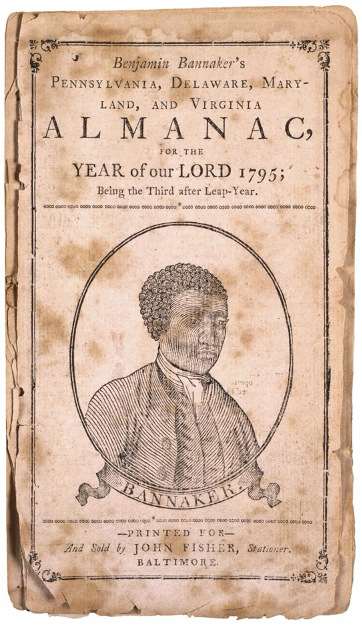
As scholar Britt Rusert notes, the little archival evidence of Banneker that remains is a reminder of “the elusiveness of African-American science in the eighteenth century, a science that clearly existed in many vernacular forms…but had not yet been captured by an emerging print sphere.” While Banneker’s story was told and retold over centuries, direct evidence of his participation in the survey of the federal district did not appear until the 1980s, when Ellicott’s report of expenditures was discovered among the Thomas Jefferson Papers at the Library of Congress. Ellicott received $5 a day, while Banneker received $2, appropriate for an assistant surveyor (Isaac Roberdeau also received $2 a day). It is hard to say anything definite about the relationship between Banneker and Ellicott, but it seems it was both respectful and productive. Ellicott was raised by an anti-slavery Quaker family. Just before Banneker had joined the federal surveying team, he had sent a letter to Andrew Ellicott concerning his almanac. Ellicott forwarded it to James Pemberton, president of the Pennsylvania Abolition Society, which led to the publication of Banneker’s first almanac in 1792.
When historical episodes pass into the realm of parable, separating fact from fiction becomes a painstaking task. While just one of many who worked on the surveying team, who even finished his work only several months into the job, Banneker became the most recognizable name of the bunch. And for good reason. Like Jane Colden, Elizabeth Paschall, and other scientific revolutionaries, Banneker’s resolve displayed revolutionary possibilities outside of just the sciences. Banneker, an astronomer and surveyor, appealed to the early beginnings of a long tradition of protest in the United States. In his letter to Jefferson, Banneker insisted that Jefferson, in principle, knew the “injustice of a State of Slavery” when he raised his pen against the “Arms” and “tyranny” of the British Crown. “We hold these truths to be Self evident,” Banneker quoted back to Jefferson, “that all men are created equal, and that they are endowed by their creator with certain unalienable rights, that among these are life, liberty, and the pursuit of happyness.”
References:
Abbott, Carl. Political Terrain: Washington, D.C., from Tidewater Town to Global Metropolis. Chapel Hill: The North Carolina Press, 1999.
Banneker, Benjamin to Jefferson, Thomas. August 19, 1791. Founders Online. https://founders.archives.gov/?q=Benjamin%20Banneker&s=1111311111&sa=&r=3&sr= (accessed August 8, 2025).
Bedini, Silvio A. The Life of Benjamin Banneker: The First African-American Man of Science. Baltimore: Maryland Historical Society, 1972.
Bedini, Silvio A. “The Survey of the Federal Territory: Andrew Ellicott and Benjamin Banneker.” Washington History 3 (1991): 76-95.
Bowling, Kenneth R. The Creation of Washington, D.C.: The Idea and Location of the American Capital. Fairfax, VA: George Mason University Press, 1991.
Bush, Robert D. “Editor’s Introduction,” in Robert D. Bush, ed. Surveying the Early Republic: The Journal of Andrew Ellicott, U.S. Boundary Commissioner in the Old Southwest, 1796-1800. Baton Rouge: Louisiana State University Press, 2016.
Herschthal, Eric. “What kind of abolitionist was Benjamin Banneker? Reluctant activism and the intellectual lives of early black Americans.” Slavery & Abolition 42 (2021): 669-690.
Mathews, Catharine Van Cortlandt. Andrew Ellicott: His Life and Letters. New York: The Grafton Press, 1908.
Perot, Sandra W. “The dairymaid and the prince: race, memory, and the story of Benjamin Banneker’s grandmother.” Slavery & Abolition 38 (2017): 445-458.
Reps, John William. Monumental Washington: The Planning and Development of the Capital Center. Princeton: Princeton University Press, 1967.
Reps, John W. Washington on View: The Nation’s Capital Since 1790. Chapel Hill: The University of North Carolina Press, 1991.
Rotella, Carlo. The World Is Always Coming to an End: Pulling Together and Apart in a Chicago Neighborhood. Chicago: The University of Chicago Press, 2019.
Rusert, Britt. Fugitive Science: Empiricism and Freedom in Early African American Culture. New York: New York University Press, 2017.