


Transparency roll of Philip Kahclamet, Kiksht speaker, standing next to his car. During fieldwork he traveled with Dell Hymes, and earlier with linguist Walter Dyk, throughout northern Oregon and southern Washington.
The Center for Native American and Indigenous Research (CNAIR) has recently completed processing of several collections relating to Indigenous peoples and languages of North America, and more generally relating to linguistics and linguistic anthropology. Researchers can now spend time browsing the collections of the linguists Dell H. Hymes, Michael Silverstein, Bruce Nevin, and Bruce Pearson.
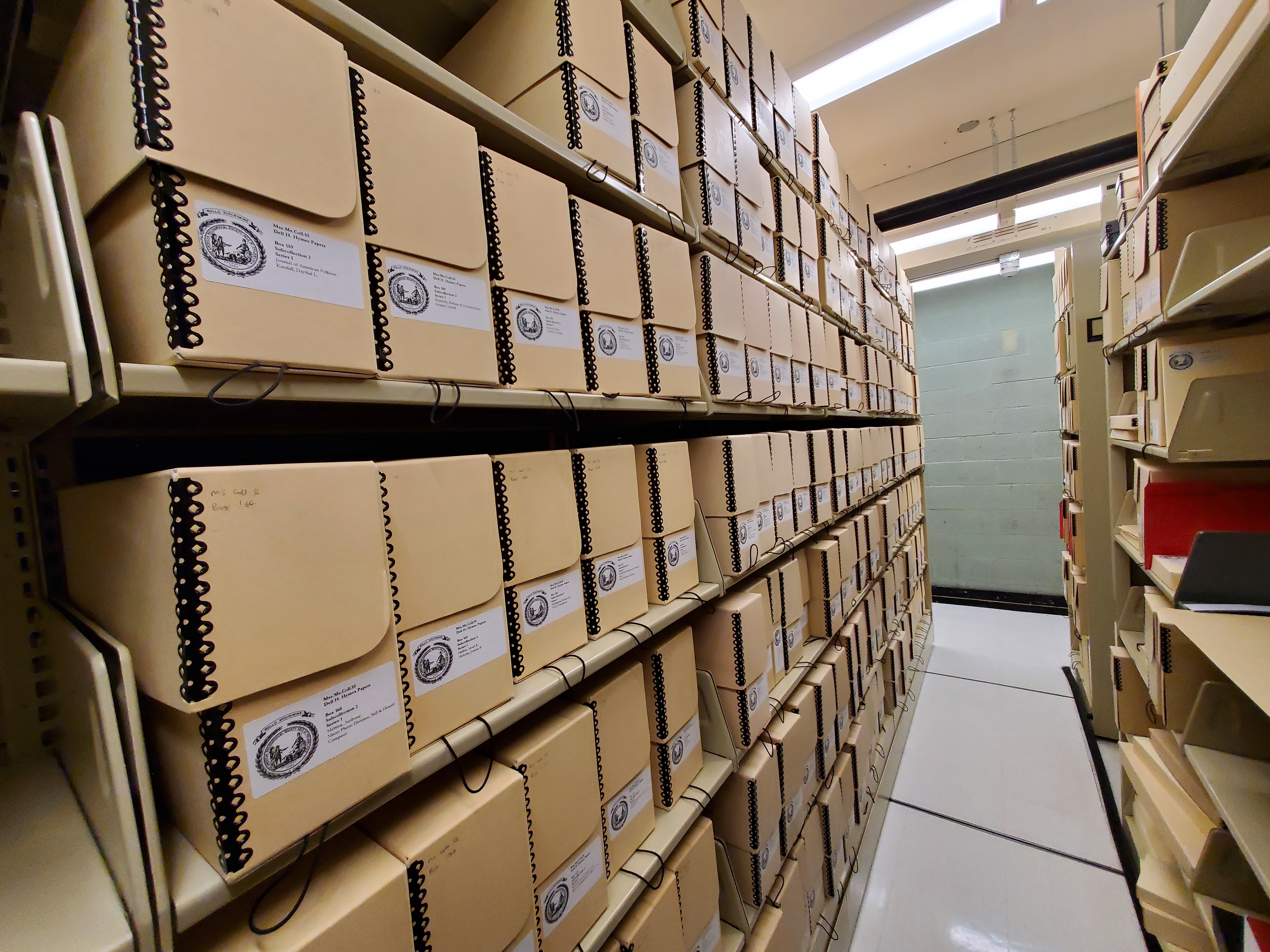
Dell H. Hymes Papers (Mss.Ms.Coll.55)
Long-time fans of the American Philosophical Society’s manuscripts processing team may recall that there has been a Dell H. Hymes Papers finding aid on our website since 2005. That collection (now Subcollection 1) was processed by Ann Reinhardt and comprises papers donated by linguistic anthropologist Hymes from his office at the University of Pennsylvania. More than half of this is the records of the Language in Society journal, and various other committees and professional correspondence.
The newly-described Subcollection 2, donated after Hymes’s passing, is around twice its size, and is broadly everything else. Due to his iterative working process and penchant for keeping many copies of everything, significant work was needed to make this collection navigable. It includes many other committees and conferences, more professional and personal correspondence, research notes especially on ethnopoetics, a vast amount of works by Hymes (including unpublished books), and an equally vast amount of manuscript drafts by others within his network.
Of relevance to CNAIR are original fieldnotes and personal correspondence from his time with speakers of the Kiksht language (the Wasco-Wishram dialect of Chinook). Philip Kahclamet and later Hiram Smith told stories to Hymes starting in the 1950s, and Hiram Smith and his family kept up with Hymes in the subsequent decades. Original fieldnotes, as far as I was able to identify them (having been loose throughout his files), are in Subcollection 2, Series III, Subseries A.
Hymes himself was widely accused of having sexually harassed his students while at the University of Pennsylvania, resulting in the removal of his portrait in 2018 from the Graduate School of Education and discussion by academics around if and how to incorporate his work today. However, these two subcollections together extend far beyond Hymes himself, and are of significant interest to those studying the origins and professional networks of linguistic anthropology, and various schisms in linguistics and anthropology, throughout the 20th century.
Michael Silverstein Papers (Mss.Ms.Coll.282)
One of Dell Hymes’s (1927–2009) colleagues in the late 1960s and early 70s was Michael Silverstein (1945–2020, APS 2008), a linguist whose fieldwork with Kiksht speakers was more extensive. Silverstein primarily worked with Ida White, George Forman, and Emma Bellinger to create audio recordings and binders of transcripts. The 67 reel-to-reel tapes from this fieldwork, recorded at a slow speed and amounting to hundreds of hours of audio, are among the full sets that have been digitized and made available in our Digital Library.
These, along with Hymes’s fieldwork and materials from many other collections, are being contributed to the Plateau Peoples’ Web Portal. The project, of which the APS is an institutional partner, is built on the Mukurtu platform and enables tribes from the Columbia Plateau to curate access portals ("tribal paths") to otherwise disparate digitized archival materials, making them locally accessible and restrictable by the tribes. The Confederated Tribes of Warm Springs of Oregon is one of the tribal partners, and several language and culture workers at Warm Springs (Valerie Switzler, Radine "Deanie" Johnson, Rain Circle and Sahara Circle) visited the APS in summer 2025 with Rob Moore of UPenn to look through the then-unprocessed Silverstein papers.
The Michael Silverstein Papers at the APS mostly relates to his Chinookan language research. His other research went to the University of Chicago and the Australian Institute of Aboriginal and Torres Strait Islander Studies. Other major collaborators with Silverstein and Hymes in Oregon included David (Dave) and Kathrine (Kay) French, whose work compiling a dictionary makes another significant part of this and the Hymes papers. Their own collection at the University of Washington Libraries (collection number 5496) is extremely extensive.

Bruce Nevin Papers (Mss.Ms.Coll.264)
Bruce Nevin is a linguist who has been working with the Pit River Tribe to document and help revitalize the Achumawi language since the 1970s. His growing collection at the APS includes 32 reel-to-reel tapes with Lela Rhoades and other speakers, card files, and a Fieldworks Language Explorer database. These represent several stages of the same fieldwork, with the database constantly updated, with revisions to this day.
The audio recordings have been digitized and the finding aid can be browsed here. The card files have been whittled down from their shoeboxes into archival boxes. The ancestor of the Fieldworks Language Explorer software, now widely used by field linguists worldwide, was titled Shoebox, as an homage to this practice of organizing vocabularies to create dictionaries in shoeboxes.

Bruce Pearson Papers (Mss.Ms.Coll.265)
Three Indigenous Nations of Oklahoma worked to document and revitalize their languages with linguist Bruce Pearson, in quite different ways. Weènchipahkihëlèxkwe (Touching Leaves Woman/Nora Thompson Dean), fluent speaker of Unami Lenape and sustainer of Lenape ways, among others worked with a young Bruce Pearson to document stories, histories, and vocabularies. This relationship with the Delaware Tribe of Indians of Oklahoma began in the 1960s and continued to the 2000s. From 1969, Pearson worked with the Absentee Shawnee Tribe of Oklahoma to create a dictionary, which picked up steam in the late 1980s. In 1994, Jim Bland of the Wyandotte Nation of Oklahoma invited Pearson to use historical documents to create pedagogical materials in Wyandot, resulting in a book in 1996. These relationships are represented in Series I through III respectively (and notebooks in Series IV) of the Bruce Pearson Papers finding aid.

In this collection and others described here are the voices of a number of dedicated language speakers, language learners, and knowledge keepers, who devoted their energy to not only documenting their languages but also making dictionaries and other pedagogical resources for use by generations to come. A key part of our Center's mission is to connect the collections to their descendant communities today so that they may continue to be used and to evolve.