




This blog post is inspired by a note penned by the American physician, professor, and botanist Benjamin Smith Barton (1766-1815). On this scrap of paper, Barton lists tools for measuring atmospheric humidity. Surprisingly, his eclectic inventory not only includes mechanical instruments like a hygrometer, but also plants like the Wild Oat. Barton’s note illustrates how, in the eighteenth and nineteenth centuries, plants were enlisted as instruments to anticipate atmospheric changes. What follows is a short piece of fiction that addresses these blurred boundaries of what constitutes and can constitute a weather-reading instrument, starting from the point of view of the plant.
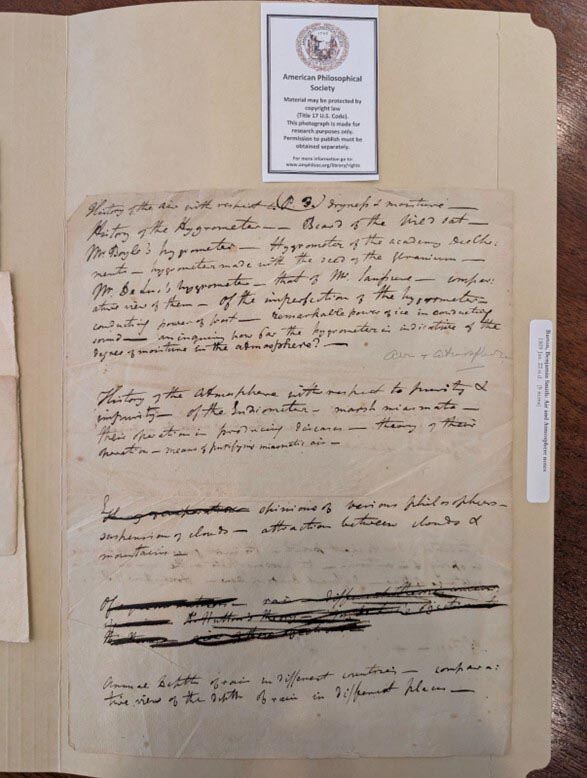
Barton’s list. See Mss.B.B284d. Violetta Delafield-Benjamin Smith Barton Collection. Box 11. Folder: Air and Atmosphere notes, 1809 Jan. 22 – n.d. File #9. American Philosophical Society, Philadelphia, PA.
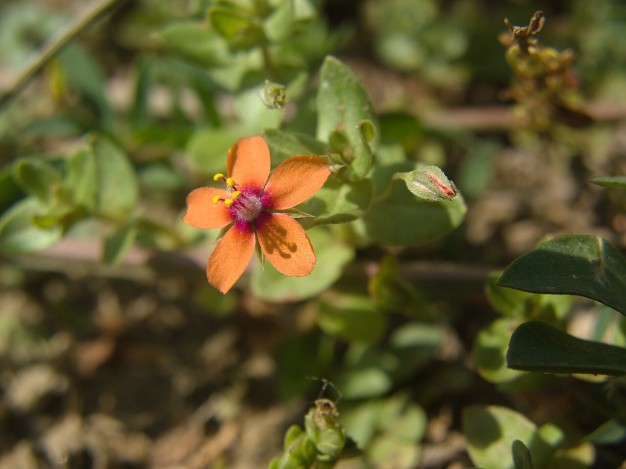
My name is Scarlet Pimpernel, and I read the weather. I was born and raised in this sandy soil, near the cobblestone road leading to our Vegetal Public Square, but that is not what happened to my parents. They are not from here; they were formed on faraway seacoast fringes. On a dew-infused morning, human fingers grasped my grandparents' seed, and a single pip was hidden in the crevice of a paper envelope. The granular sheets barely held my parents as they crossed the Great Wet Blue Mass, tumbling until they reached land.
When their bodies finally felt the embrace of the nearly frozen soil, it was at once familiar and foreign. Through many summers and winters, they learned to balance between belonging and unbelonging. The frost here is harsher than anything they had known, yet their fragilized stems were never fully frail. The sun burns stronger, but still, they found ease in places wasted and overlooked between the Walking Paths. Familiarity grew as our legs spread and our arms sprawled.
It is here that I, together with my brothers and sisters, learned our ABC’s: the Wild-Oats’ Ambulation, the Geranium’s Breaking Away, and our own Connivance. With our Alphabet, we speak to the Rain. We hear its whispers in the heavy dew that rises at daybreak. We hear its screams in the aqueous drops that fill the air. We respond with Connivance: our oval petals and star-shaped sepals slowly converge inward, sheltering our stamen. As the sky breaks open, our closed calyx protects us, and we remain unharmed. Only sometimes, when the wetness is never-ending, the clouds muffle the words, and the thunderstorms surprise our exhausted bodies. Yet, once the sun shines again, beads of moisture clinging to our red-orange flowers, we are ready to tell the story of a new day.
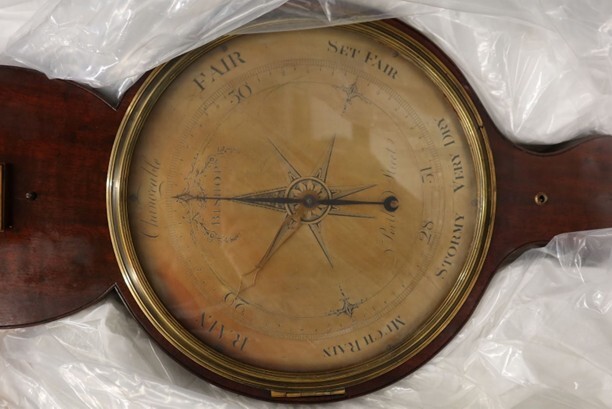
Banjo Barometer by Samuel Bishop. Catalog Number 58.61. American Philosophical Society Museum, Philadelphia, PA.
References
Barton, Benjamin Smith. 1814. Elements of Botany: Or, Outlines of the Natural History of Vegetables, vol 2. (2nd ed.). Philadelphia: printed for the author.
Barton, Benjamin Smith, and Robert Desilver. Elements of Botany: Or, Outlines of the Natural History of Vegetables, vol 1. (3rd ed.). Philadelphia: Robert Desilver.
Mss.B.B284d. Violetta Delafield-Benjamin Smitch Barton Collection. Box 7. Folder: Botanical notes and manuscripts. Files #1, #5, #9. American Philosophical Society, Philadelphia, PA.
Mss.B.B284d. Violetta Delafield-Benjamin Smitch Barton Collection. Box 11. Folder: Air and Atmosphere notes, 1809 Jan. 22 – n.d. File #9. American Philosophical Society, Philadelphia, PA.
“The Scarlet Pimpernel.” The Wildlife Trusts, https://www.wildlifetrusts.org/wildlife-explorer/wildflowers/scarlet-pimpernel