




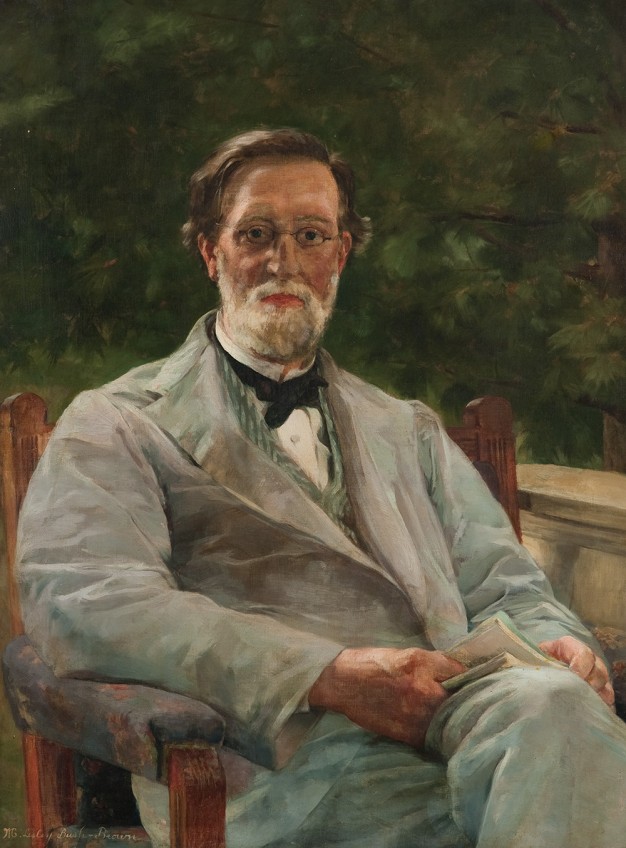
Margaret Lesley Bush-Brown, J. Peter Lesley, c. 1894-1895, American Philosophical Society Digital Library.
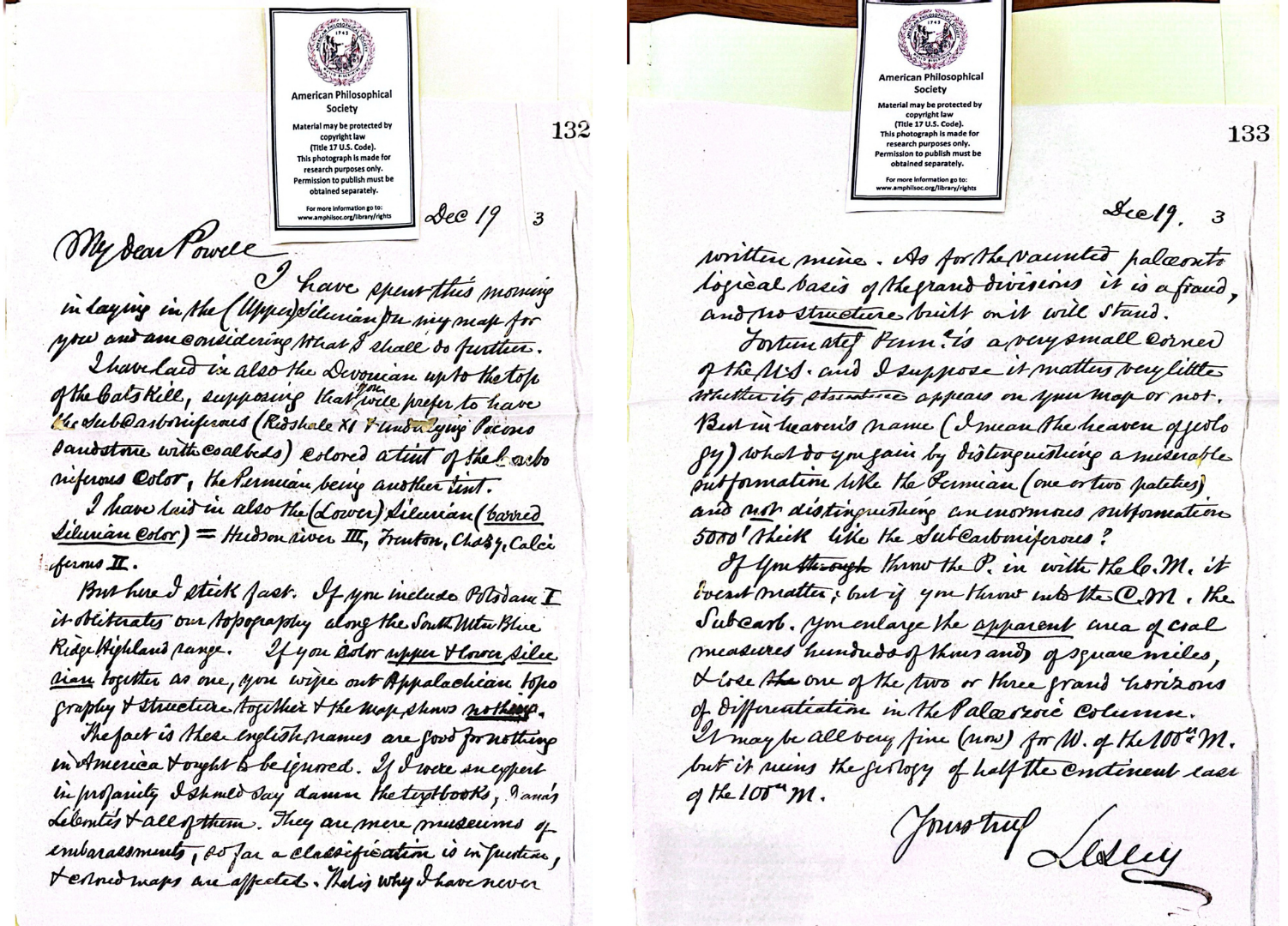
On December 19th, 1883, geologist J. Peter Lesley (APS 1856) penned an exasperated letter to the director of the United States Geological Survey (USGS), John Wesley Powell (APS 1889). Powell had tasked Lesley with preparing a geological map of Pennsylvania as part of his larger project to produce a geological and a topographical map of the entire United States. Congress had permitted the USGS to create such maps during their 1882 session, but a year and a half later, the potential of such a map had run up against the frustrating realities of the vast nation’s varied geologic past.
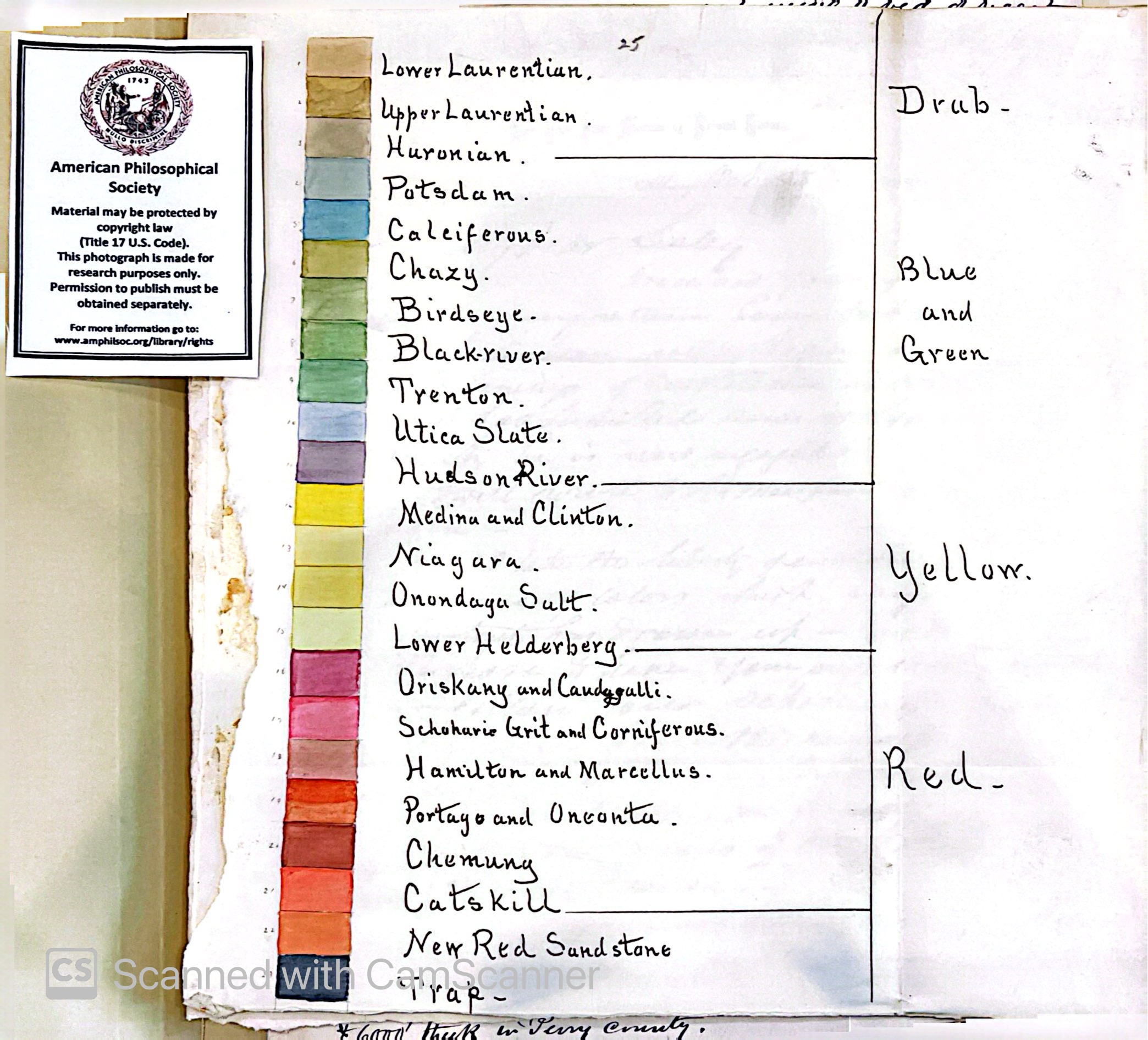
To map the whole of the United States, surveyors in each state and territory would have to use the same language, categories, and color systems, allowing Powell to stitch the maps together into one coherent picture of the nation’s geology. But the development of geologic mapmaking had created highly regionalized and even localized styles of mapping strata. States and territories had studied fossils and determined the age of different stratum and divided stratum from one another based on their observations at different sites within their region.
The practice of mapping the subterranean layers of the earth originated in England in the 1820s and only slowly gained traction in the United States in the middle decades of the nineteenth century. Early geologic mapmakers, like those who would follow later in the century, established categories for geologic ages that reflected their local geology, even naming eras and geologic formations after the sites of their inquiry. The Devonian Era received its name from Devon, England. The Cambrian from Cambria, the Roman name for Wales. Transported across the Atlantic and eventually westward across North America, the divisions of the earth and names for its layers crafted thousands of miles away sat uncomfortably on the land.
Lesley experienced exactly that as he attempted to translate his geological map of Pennsylvania into the categories established in England. Writing with clear frustration, Lesley complained, “The fact is these english names are good for nothing in America + ought to be ignored…As for the vaunted paleontological basis of the grand divisions it is a fraud, and no structure built on it will stand.” Studying local fossils and strata, Lesley and other geologists had established their own categories and divisions for describing the earth’s past. Lesley’s letter captures the core challenge for this first attempt at creating a geologic map of the United States: Geologic maps depict the earth vertically. By focusing on horizontal correlation across regions, this early effort at mapping the earth’s strata flattened the earth’s many layers. Lesley’s letter offers an exciting window into the fraught and messy process of dividing, categorizing, and mapping the earth’s deep past at the end of the 19th century.
References
Mss.B.L56. J. P. Lesley to J. W. Powell, December 19, 1883. J. P. Lesley papers Series I 1881 August - 1884 February. Box 21. Folder: [J. P.] Lesley to [J. W.] Powell 1883 December 19. American Philosophical Society.
Mss.B.L56. James Hall to J. P. Lesley, October 28, 1882. J. P. Lesley papers Series I 1881 August-1884 February. Box 21. Folder: James Hall to [J. Peter Lesley]1882 October 28. American Philosophical Society.
Mss.B.L56. J. P. Lesley to Prof. James Hall, October 31, 1882. J. P. Lesley papers Series I 1881 August-1884 February. Box 21. Folder: J. P. Lesley to James Hall 1882 October 31. American Philosophical Society.
For an example of discussions about early stratigraphic mapmaking in England, see Mss.B.M93. Edward Everett to Sir Roderick Impey Murchison. Sir Roderick Impey Murchison Correspondence Series II: Reproductions 1830-1867. Box 1. Folder: August 15, 1854 - Everett, Edward, 1794-1865 - Letter to Sir Roderick [Impey Murchison]. American Philosophical Society.