



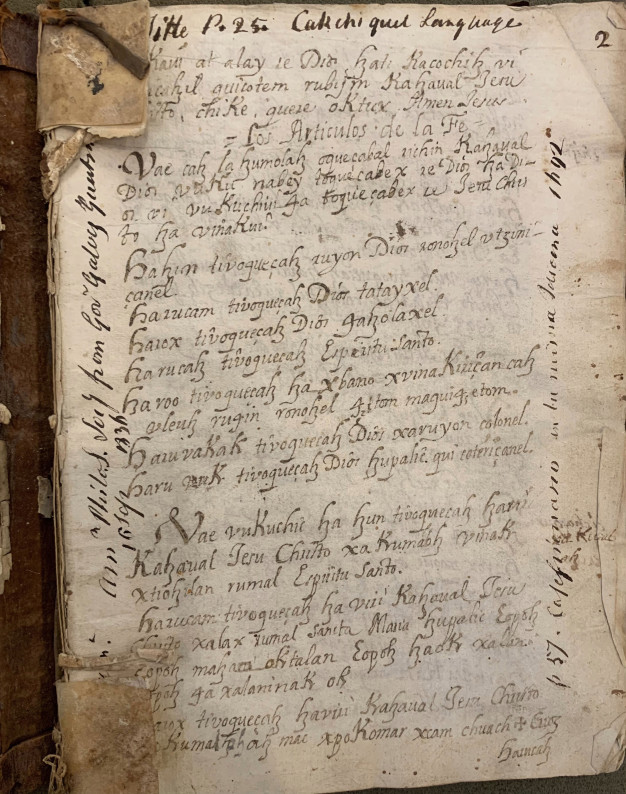
Title page of Doctrina Christiana
In 1692, an unknown Dominican priest authored a Doctrina Christiana in Kaqchikel, a Highland Mayan language. The Doctrina, a text used to explain aspects of the Bible and Christianity more generally, has not been widely studied. Apart from a somewhat faithful translation by Daniel Brinton in 1884, the Doctrina has largely gone unnoticed. Here, I highlight the section titled Arte de la lengua cakchiquel, a grammar of the Kaqchikel language nestled among the other content such as confessionaries, questionnaires, and discussions.
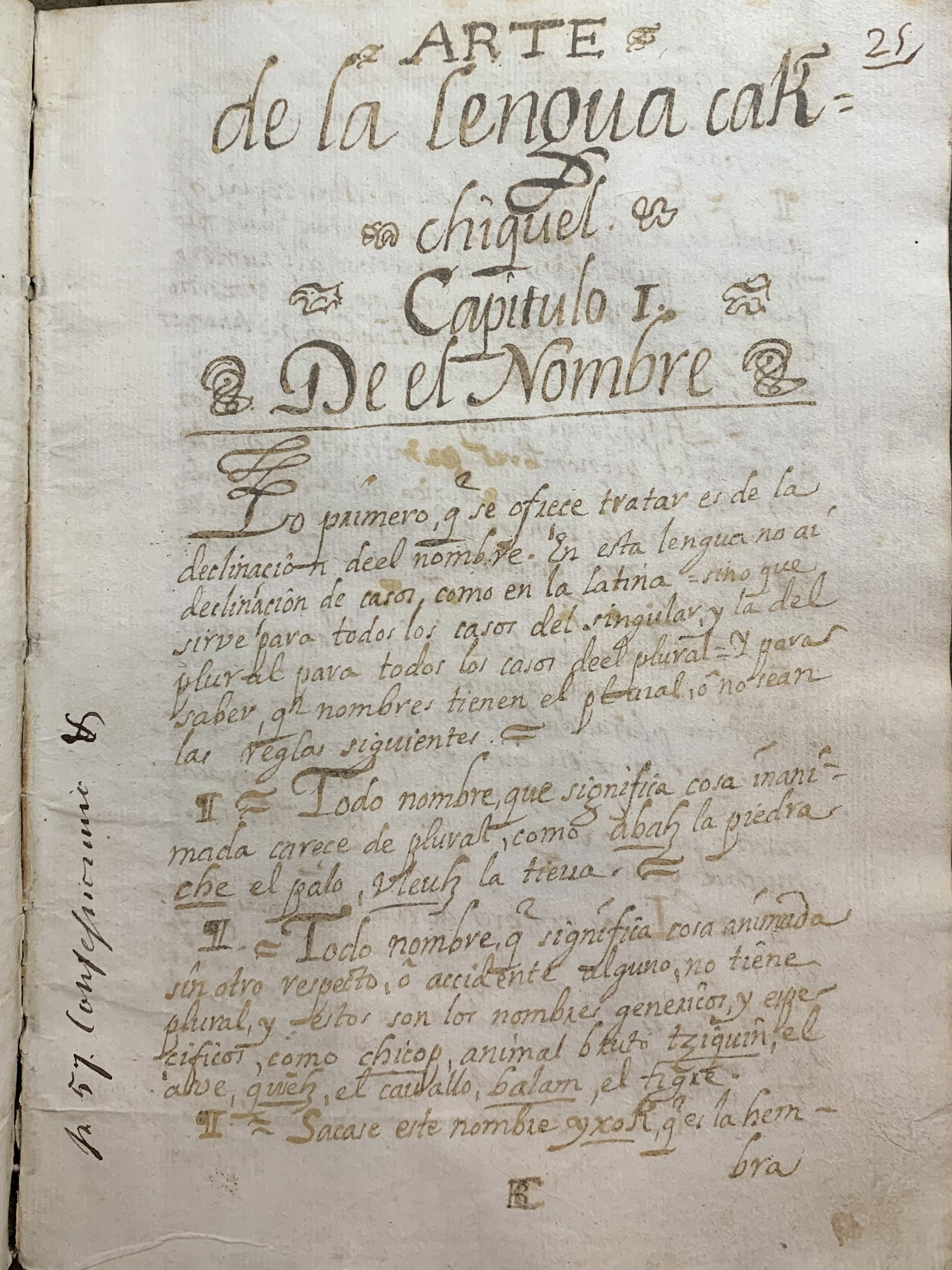
In the 17th century, when many grammars of Mesoamerican languages were written, it was common for a grammar to appear as a separate text. Although the same friar may have written a dictionary, grammar, and pastoral text, they were often printed or published separately. It is unusual for a grammar to be incorporated into a mostly pastoral work like the Arte de la lengua cakchiquel. However, given that the purpose of the grammar was to convert Indigenous, Kaqchikel-speaking people to Christianity, it is entirely logical and particularly illustrative that the grammar is written alongside doctrinal texts.
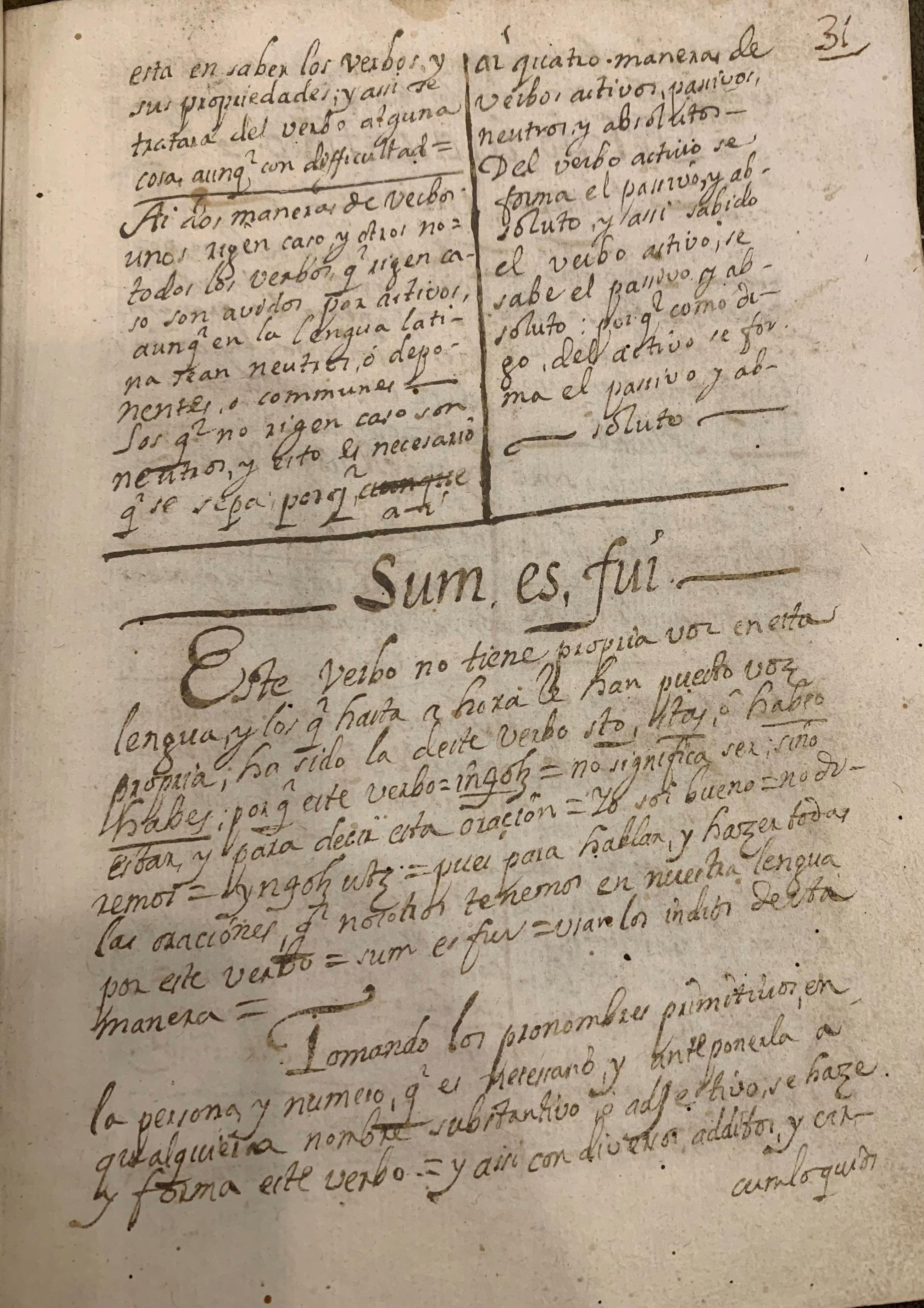
The grammar section is quite short at only 54 pages (26 leaves) of the 208 in the text. Handwritten in one or two columns per page, it is divided into six chapters. A friar studying the language could pick up the grammar and walk away with a passing knowledge of how the language works. The chapter layout and organization clearly reflect a reliance on the Latin grammar (Introductiones latinae) written by Antonio de Nebrija, a Spanish humanist of the late 15th century, whose work greatly influenced the missionary linguists of the Americas. As with contemporary grammars of other Mesoamerican languages, friars, like the author of the Arte de la lengua cakchiquel, innovated grammatical categories or modified them to suit their own descriptions of Indigenous languages. For example, in Kaqchikel there is no copula (commonly called a linking verb). The anonymous author acknowledges this fact and explains that speakers make equative statements by using a pronoun and a noun or adjective (inutz, ‘I am good’). Although the innovations by friars may seem like a deviation from the Graeco-Latin grammatical model, I contend that friars, like the unknown author of this Arte, continued the humanist tradition by describing Indigenous languages in their own terms instead of exclusively relying on a restrictive model.
Besides the linguistic content of the grammar, the religious content found throughout the Doctrina presents a fascinating look into the theology of Dominicans attempting to evangelize in the Highlands of Guatemala in the late 17th century. Dominicans were in fierce competition with Franciscans for the souls of Maya people in Highland Guatemala and adopted different techniques for conversion. Dominicans frequently incorporated Kaqchikel Maya spiritual terms into explanations of Christianity including concepts like God, Hell, and the Devil, while the Franciscans mostly did not. Because these Mayanized terms appear so often, the Doctrina can be seen as a distinctly Dominican example of a linguistic and pastoral document.
