




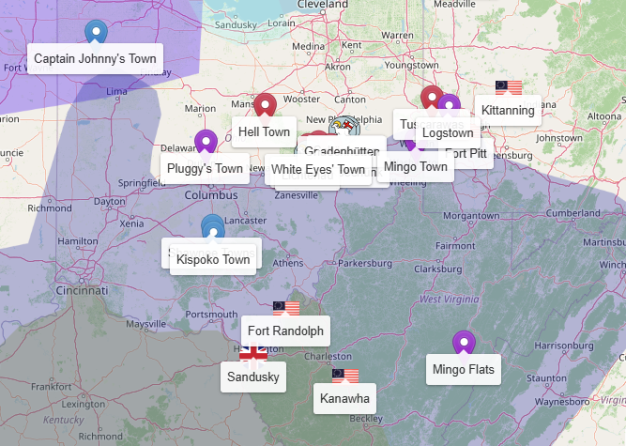
Indigenous towns and territories and settler forts in the Ohio Valley. See an interactive version of this map here.
Welcome to “Indian War” and Indigenous Diplomacy, 1776, a project of the Center for Digital Scholarship at the American Philosophical Society. This newsletter will run from July through December, following the events of the Jasper Yeates papers in real time. Today, we present the first installment as a crosspost with The Revolutionary City. To subscribe to the newsletter, please visit therevolutionarycity.org/subscribe.
Two hundred and fifty years ago today, the Second Continental Congress took care of some important business: appointing Jasper Yeates, a Lancaster-based lawyer, as Commissioner of Indian Affairs of the Middle Department. “A conference [with Indigenous leaders] will be held at Pittsburgh on July 20, which Congress hopes you will attend,” Pennsylvania delegates Benjamin Franklin and James Wilson wrote in a letter to Yeates. “Although this may be inconvenient, we know that your regard for the public will outweigh any consideration of your private affairs. You will shortly hear further from us."
In Pittsburgh—if all went according to plan—Yeates would participate in a treaty council, an extended meeting between representatives of the Thirteen Colonies and various Indigenous nations. Derived from a Haudenosaunee political practice, by 1776, treaty councils had become the standard format for negotiations between settlers and Indigenous peoples. Rather than focusing on the production of a legally binding written document, as in the Western conception of a treaty, these councils were process-focused meetings aimed at building and maintaining reciprocal relationships between participants. Attendees often numbered in the dozens or hundreds, and—in order to ensure community input—often included women and children. Over the course of weeks, participants dined together, honored the recently deceased, narrated the history of their relationships, gave speeches, and exchanged strings and belts of wampum, “small, cylindrical beads of shell” strung together to encode information.