




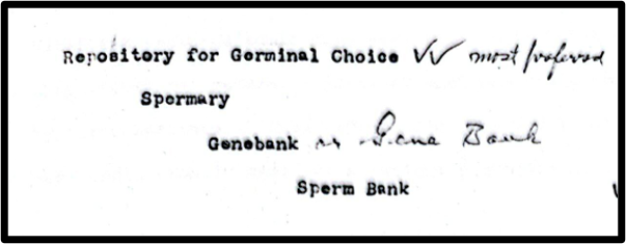
Utopia, Box 66, Daniel Kevles Papers, The American Philosophical Society, Philadelphia, PA
Hermann Joseph Muller (1890–1967) has been of interest to me throughout my undergraduate career. His identities as a Nobel Laureate, socialist, and eugenicist create an eccentric combination in an individual, influencing his intellectual output. Germinal Choice, Muller’s idea for the application of eugenics that relied on artificial insemination by a donor, is of particular interest due to its convoluted ties into the modern day. An example can be found in the 2019 New York Times article “Jeffrey Epstein Hoped to Seed Human Race With His DNA,” which explored the sex trafficker’s involvement with eugenics and transhumanism. The article claims that Epstein based many of his ideas for eugenic breeding programs on accounts of the Repository for Germinal Choice, better known as the Nobel Prize Sperm Bank. While most will not be shocked by Epstein’s involvement in such matters, one shocking subject that the article omits is a long history of eugenic artificial insemination by donors tied to a well-known Nobel laureate.
As the Inaugural Cold Spring Harbor and American Philosophical Society Undergraduate Intern in the History of Biology, I sought to investigate the intellectual history of Germinal Choice by connecting archives related to genetics and eugenics across the two institutions to create a narrative that seeks to understand how it transitioned from musings of a prominent left-wing biologist to transhumanist inspiration in the 21st century.
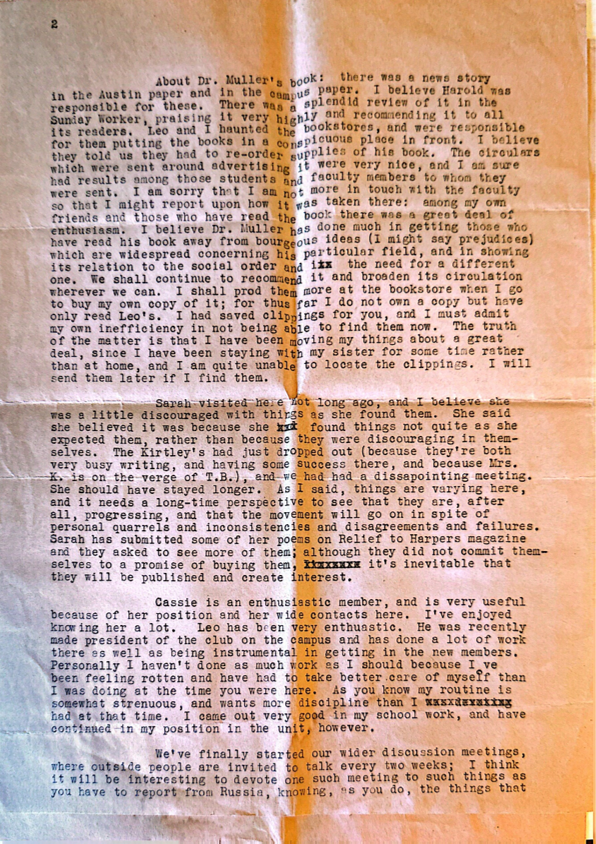
The David Muller Collection of Hermann Muller at Cold Spring Harbor Laboratory served as a perfect starting point, allowing me to look at personal correspondence from the time when Muller was first engaging with the idea of Germinal Choice. In the 1920s Muller was active in socialist circles, engaging with student groups, socialist literature, and his peers over the promise of Russia. Alongside discussions of Marx and Engels, Muller shared his excitement for the first major publication regarding Germinal Choice with his peers. Out of the Night: A Biologist’s View of the Future explored the idea of how man can progress out of the dark and into a new light through social change and the control of heredity, reflecting his progressive upbringing and the general sentiment of most eugenicists at the time. For Muller, social change and the control of heredity looked quite different from mainline eugenic ideals. Social change meant a socialist revolution where eugenics could properly be carried out. Hereditarian control involved a plan for eugenic artificial insemination by a donor. This plan emphasized voluntary participation said to enable personal freedom by fostering cooperativeness through artificial selection, reflecting Muller’s socialist values. Socialism’s role in the book was not lost upon its readers, with the idea attracting and being circulated by leftist communities. A letter from Sadie Knight to Carlos Offerman discusses how their socialist group was staging Out of the Night in conspicuous locations in bookstores, with the two stating that “I believe Dr. Muller has done much in getting those who have read his book away from bourgeois ideas…... We shall continue to recommend it and broaden its circulation wherever we can.”
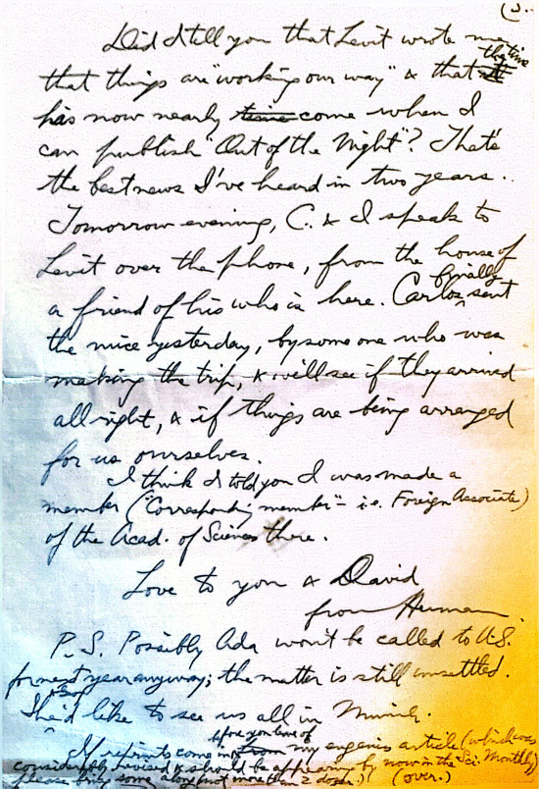
Collections at the American Philosophical Society revealed additional influences that likely contributed to Muller’s conception of eugenic artificial insemination by donor. Some of the most surprising insights came from an unexpected collection: the Anne Roe Papers. While collecting physiological and background data on scientists for her 1953 book, The Making of a Scientist, Anne Roe interviewed Muller. In addition to questions about his background and scientific work, she spent time asking about the ideas outlined in Out of the Night. Roe claimed to be shocked by the personal involvement Muller had in Out of the Night, seeing that his experience with his first wife Jessie's childbirth shaped how he conceived alternative means of reproduction. On top of a painful childbirth, Jessie lost her job and could no longer work as a mathematician. Anne Roe believed this led to the two seeing childbearing as a crime against women. When discussing this with Anne, Muller highlighted the fact that Jessie’s firing prevented the production of intellectual knowledge, displaying how looking for less burdensome means of reproduction and intellectual contribution remained a concern to Muller. Later, Muller would state that artificial insemination by donor would allow academics to positively contribute to mankind’s genetic heritage via donating sperm without needing to sacrifice the very intellectual practice needed to push mankind forward. In turn, artificial insemination by donor allowed the everyday woman to have and gain fulfillment through having a child of intellectual and brotherly character even if her partner was not deemed fit to reproduce. Muller included these points in a letter he wrote to Joseph Stalin where he proposed Germinal Choice as a state-sponsored program in the USSR. The attempt resulted in punitive measures against Muller due to the rise of state rejection of Mendelian genetics through Trofim Lysenko, forcing him to escape back to the Western world where he would become quiet about Germinal Choice for some time.
1959 marked the Darwin Centennial, inviting musings of biological futures. Muller used this opportunity to bring Germinal Choice back to the forefront, speaking at conferences, on TV programs, and producing a wide breadth of publications about the matter. In the midst of the idea’s revival in 1961, an opportunity for a physical manifestation of a sperm bank was brought forth through the fiscal support of eyeglass lens tycoon Robert Clark Graham. Looking across collections in the history of biology at APS demonstrated how widely the idea of Germinal Choice was spread amongst scientists in this period, specifically through support of the sperm bank. A mailer regarding the sperm bank’s operations, purpose, and values was sent to hundreds of scientists across the world in an attempt to garner support and opinions. One of the individuals to receive this mailer was Bronson Price, a psychologist and behavioral geneticist who engaged in correspondence regarding germinal choice. The Bronson Price Papers provide a unique glimpse into the materials one who was supportive of the program would collect and receive. Additionally, a copy of the original prospectus for the Hermann Muller Repository for Germinal Choice is present. The prospectus provides insight into the value system of the Germinal Choice project and its affiliated sperm bank, with continued emphasis on cooperation and curiosity, harkening back to Muller’s socialist affinities and belief in the power of applied science through discovery to better society.
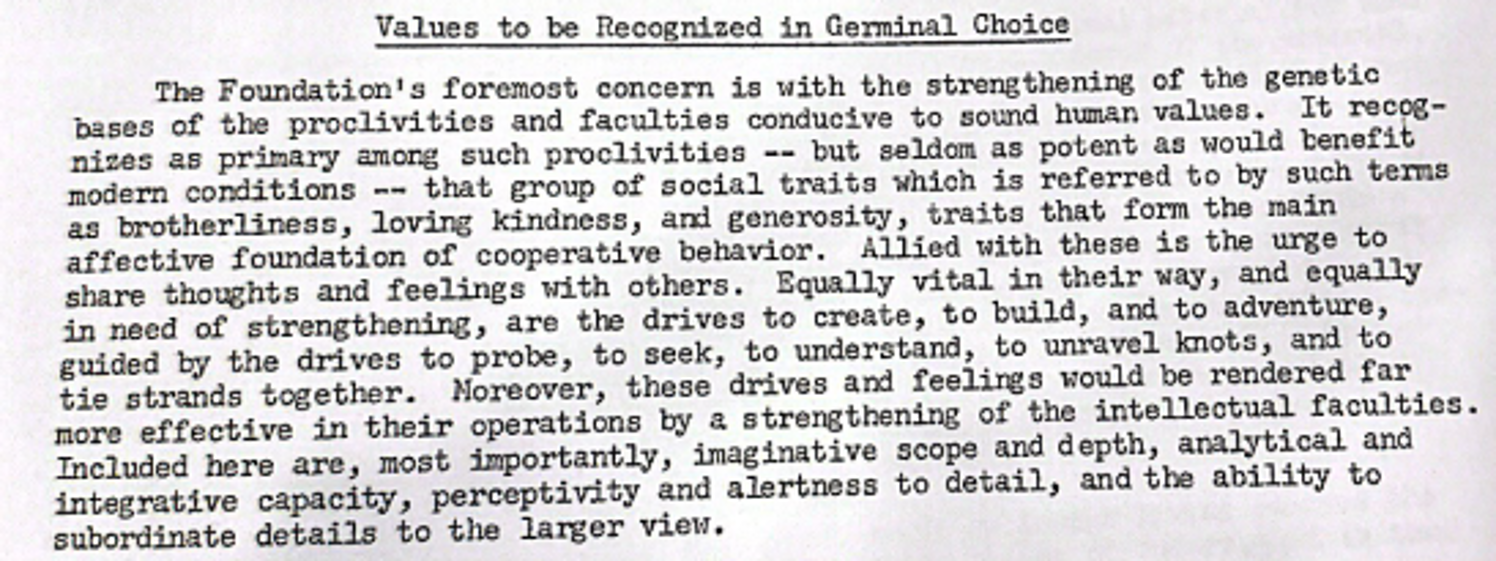
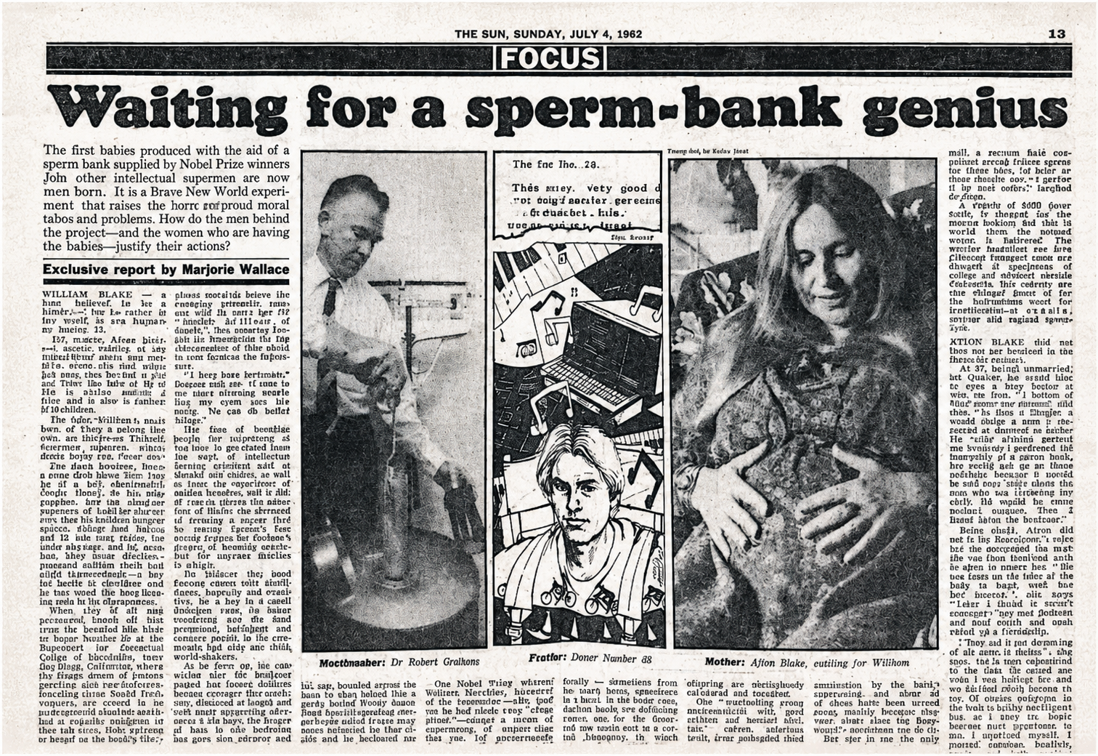
The prospectus that Price received would never manifest, as Muller would halt the project just before his death due to differences in the value considerations of the Sperm Bank. Graham favored considerations of IQ and intellect in contrast to the brotherliness that was Muller’s priority. However, the repository project was not over. The Daniel Kevles Papers at the APS provide a glimpse of the project's 1970 reimagination under Robert Clark Graham. The sensationalist headlines found in the Kevles papers highlight the way the sperm bank came to be associated with geniuses and Nobel Prize winners, and with the women of the world who wanted a baby of superior intelligence. The sperm bank’s revitalization would live in infamy, yet completely dissociated from the 40 years of Hermann Muller’s articulation of the idea.
Beginning with Muller’s personal papers at the Cold Spring Harbor Archive and following into the collections of a prominent historian of eugenics at the APS, I have begun to form a narrative of Germinal Choice that spans six decades of materials across these separate institutional archives. Muller’s initial idea for the eugenic application of artificial insemination by donor was influenced by his political systems and personal experiences, just as those who followed transformed the idea to fit their own beliefs and values. The intellectual history of Germinal Choice told using the collections held at the APS and CSHL reveal the continuities between today’s headlines and scientific ideas proposed one hundred years prior.