



Header Image: Portrait of Benjamin Rush, New York Public Library Digital Collections and Portrait of General Hugh Mercer, New York Public Library Digital Collections
The Battle of Princeton on January 3, 1777 was an American victory, but cost 75 American lives. One of those casualties was General Hugh Mercer, a Scottish-born leader said to be nearly as skilled militarily as George Washington himself. History remembers Philadelphia’s own Benjamin Rush tending to Mercer’s brutal injuries, eventually succumbing to them on January 12, 1777. In correspondence to Richard Henry Lee, Rush told a more complicated story about the ordeal—one in which Mercer died on January 6th and then came back to life (?) on the 7th. Could this part of the historical record have the wrong information on General Mercer’s death, or was Rush simply an unreliable correspondent?
Rush described the battle’s aftermath in his memoir. A revolutionary and trusted physician, Benjamin Rush was assigned to tend to soldiers in New Jersey after the Battles of Trenton and Princeton. He, another physician, and a few younger surgeons met their patients in Bordentown, about eight miles from Trenton, just after the battles. Rush recounted General Mercer’s wounds, including bayonet stabs to the abdomen as well as a head wound from a blow by the butt end of a musket. He suspected it was this wound that killed Mercer. He claimed the general died a week later, although other accounts place his death on January 12th, nine days after being wounded in battle.
In the moment, Rush had more to say about Mercer. On January 6th, 1777 (accidentally written as 1776), three days after Mercer sustained his injuries at Princeton, Rush wrote from Bordentown updating Richard Henry Lee in Baltimore on recent events. In this letter, Rush mourned Mercer, stating the general had fought bravely, suggesting Congress provide him a full military funeral, and asking Lee’s opinion of sending a letter to Mercer’s widow. Rush was clearly writing about a dead man. However, if the consensus is that Mercer died on January 12th, what is the meaning of this letter? Perhaps Rush actually wasn’t by Mercer’s side and had received bad information from someone else. Maybe Mercer was in such poor health that Rush assumed his death was imminent. Possibly, he wanted some to believe the general was dead.

On January 7th, Rush wrote to Lee again. In this letter, he described Mercer as struggling, but clearly alive. He asked Lee to let Mrs. Mercer know that the general was “considerably better, and that there are reasonable hopes of his recovery.” He stated that he had been with him since the previous day and would not leave him until he was “out of danger.” The general was in good spirits, sleeping, drinking, and talking cheerfully.
Rush did not mention what he wrote in his previous letter about Mercer’s death, carrying on as if he had said nothing of the general’s funeral and widow. He claimed he had been with Mercer since the day before, making it unlikely that he had updated Lee after his first letter with better information, and complicating the idea that he received bad information from someone else while being away from Mercer. Importantly, we do not have Lee’s responses to fill in these gaps. Had Lee already told Mrs. Mercer her husband was dead? Were her children in the dark about their father’s health? Was Lee as confused when he read these letters as I am reading them more than 200 years later?
The next available letter from Rush to Lee was written on Tuesday, January 14th, 1777. By this time, the historical record tells us Mercer was dead for around two days. But not in Rush’s account. Rush wrote to Lee from Philadelphia, around 40 miles from Princeton, reporting that he had left Mercer on Saturday, January 11 “out of danger, but…exceedingly weak from the loss of blood.” He added that Mercer could not safely be moved, but stated an officer had given him permission to leave. Though Mercer had died before this letter was written, it makes sense that the information had not yet reached Rush all the way in Philadelphia. He wrote to Lee again later that day on another topic.
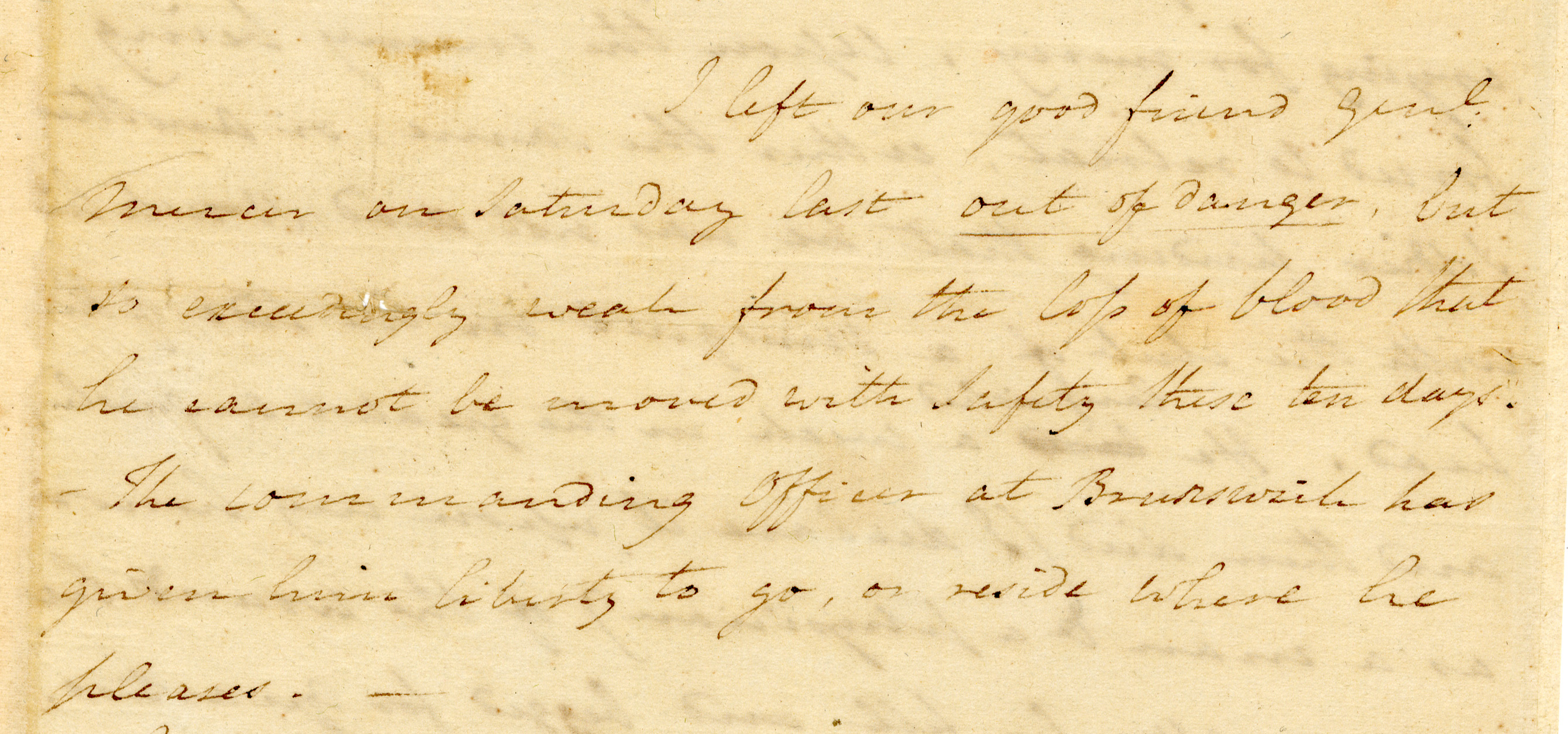
What could explain Rush’s confusing timeline of General Mercer’s wounding and death? Firstly, if Rush cleared up this discrepancy with another letter, it may have simply been lost to time. It is possible someone else sent a letter to Lee or spoke to him in person updating him on the general’s health. But then, why would Benjamin Rush assume Mercer dead in the first place? Although it seems safe to assume that Mercer didn’t really come back to life after dying on January 6th from his injuries, Rush’s letters leave us without any proof to the contrary.
Altogether, Rush’s letters and memoir regarding General Mercer’s injuries and eventual death provide a glimpse into the challenges of telling neat narratives about the past. The confusion they reveal hints at something real in itself: the violence and resultant chaos of wartime. Want to do your own historical detective work with primary sources? Check out The Revolutionary City: A Portal to the Nation’s Founding.