




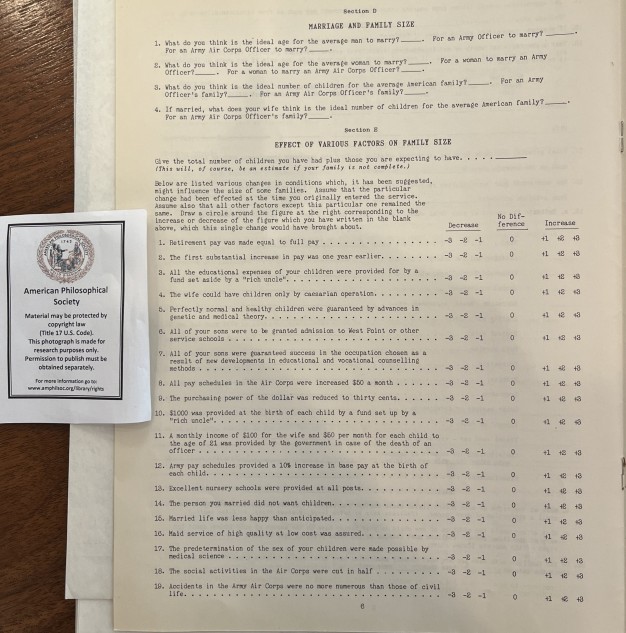
Header Image: From “Family Report Form” of the Aviator Study. See Question #3, Section E. Mss.Ms.Coll.24. Frederick Henry Osborn Papers 1903-1980. Box 10. Folder: Pioneer Fund–#5. American Philosophical Society, Philadelphia, PA.
As a historian of science and education, I am interested in ideas about “intelligence”: how they’re formulated within psychology and how they move into public understanding and educational practice. Specifically, I want to trace how IQ hereditarianism—an idea forged in the crucible of early 20th century eugenics—became integrated as “ability” in post WWII educational policy. This research brought me to the APS where I conducted research as a William S. Willis, Jr. Short-Term Research Fellow.
The APS holds a wealth of collections in eugenics spanning the late 19th well through the mid- 20th century, which offer a remarkable opportunity to study how the eugenics movement changed and adapted over this broader stretch of time. The Frederick Osborn and American Eugenics Society Papers, in particular, offer a clear window onto the emergence, in the 1930s and 1940s, of strategies of the eugenics movement that allowed a eugenic-style hereditarianism to thrive in a post-WWII liberal-meritocratic order.
Much of my prior research has focused on the National Defense Education Act (NDEA) of 1958. The NDEA was, among other things, federal funding for expanded intelligence testing and guidance counselling in the public schools. The explicit policy aim was to get ‘the naturally bright’ kids into advanced college prep science and math so they could become the next generation of scientists and engineers. The legislation also offered federal subsidies in the form of scholarships and loans for students pursuing higher education. The NDEA was passed shortly after—and widely associated with—the Sputnik crisis of 1957. Yet the longer effort of cobbling policy together actually began in early 1955, mere months after the Brown v. Board Supreme Court decision rendering de jure racial segregation of public schools unconstitutional and illegal. While advanced under the exigencies of a Cold War science race, this post-Brown expansion of standardized testing could nonetheless also remake segregation and educational disparities by “race” and class but now within schools, and according to the seemingly “race”-neutral logics of individual “ability” (Porter, 2017). The political success of the NDEA depended on a hereditarian individualism consistent with an ideological shift in the 1930s from eugenics to what Daniel Kevles refers to as “reform eugenics” (Kevles, 1995). So, I seek historical continuities between what might look to us like ‘meritocratic’ policy and its earlier hereditarian foundations.
How did IQ hereditarianism become widely accepted—and funded—as a part of national educational policy? Schools had been using mass IQ testing since the 1920s, but these practices, though widespread, were unsystematic, and not federally funded. My research suggests that additional answers need to be sought from a complementary set of causes having to do with the eugenics movement itself in its ongoing aspirations to shape population policy. Across the 1930s and 1940s eugenics was moving away from “negative” interventions targeting the reproductive sphere and toward “positive” interventions (inducements) in social arenas adjacent to reproduction, including, notably, education. Actors within eugenics made these changes as they responded to numerous scientific and political crises that had beset their movement.
A brief recap of the rise and then dissolution of mainstream eugenics will be helpful here for understanding later efforts by people like Frederick Osborn to rehabilitate it. Mainstream eugenics flourished in the early 1900s in the faith that the genetic basis of various differential human “qualities” would be soon discovered and easy to demonstrate. Yet, as genetics advanced as a science, the opposite proved to be the case. Human heredity most often turned out to be inscrutably complex and more than this perhaps not at all determinative of those differentiating qualities–integrity, solvency, temperance, affection, intelligence—allegedly so important to eugenicists in the first place. No positive evidence for widespread population-level genetic differences in said dispositions or differences was discovered. What did emerge at every turn across the late 1920s and 1930s was reliable evidence from the social sciences indicating the profound role social environment and education played in shaping human development. Prominent geneticists fled the eugenics movement, as it became increasingly clear it was energized by racism and classism and propped up behind a veneer of bad science. By 1930, the race-IQ hypothesis had been discredited among the mainstream scientific community. By the late 1930s the heritability of traits like “intelligence” was being questioned at the level of the individual. While negative eugenic interventions (e.g. sterilization and immigration restriction), intended to rid the population of ‘defective genes,’ had achieved notable policy successes in the 1920s, they were rapidly losing favor as an approach to broadscale population policy.
In 1937, the Pioneer Fund, under Osborn’s stewardship and with Wickliffe Draper’s financial backing, commissioned a fertility study with pilots in the Army Air Corps. Historians Tucker and Lombardo have examined how while the private mission of the Pioneer Fund was explicitly white nationalist, the Fund’s public outreach and intervention with the Army Air Corps were prima-facia race-neutral. They also note that the Pioneer Fund initially chose to work with the Air Corps both because, in 1937, the Corps was still all-white and because aviators were assumed to have the ‘right stuff,’ and embody eugenic ‘fitness’ (Lombardo, 2001; Tucker, 2002).
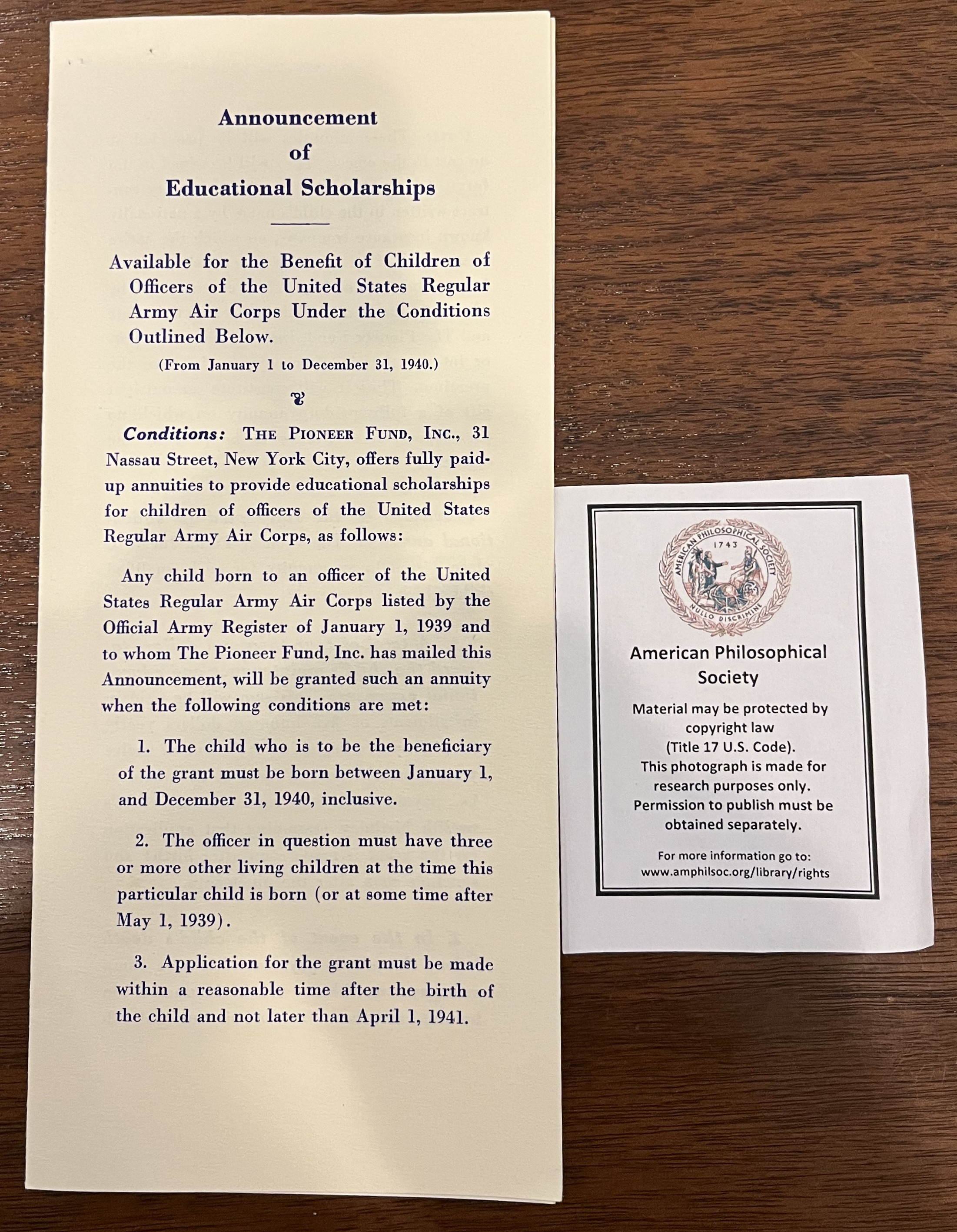
To carry out the study, the Fund hired a psychologist, John Flanagan, who would conduct an extensive survey of Air Corps officers and their wives to determine various factors that might persuade them to increase the sizes of their families. Many surveyed couples indicated they would have more children if someone covered the greater educational costs a larger family would incur. The Fund proceeded to subsidize the future educational expenses of select families through annuities, and then determined some years later that those families did indeed have more children than they might have had otherwise (Tucker, 2002).
In design, this ‘new’ eugenic policy model was concerned with familiar themes. Yet, it now proceeded, not via controversial restrictive, negative eugenic interventions, but instead through the positive inducement of educational subsidies. Here was, I argue, a shift in policy strategy that had begun to translate eugenic-hereditarian policy intentions out from the domain of reproductive intervention and into the adjacent arena of education. This, I believe, is an important part of the story of what happens to eugenics ‘after eugenics’: the translation and redirection of the eugenic-hereditarian imagination into new avenues for population policy as older approaches were thwarted.
It is crucial to note that Frederick Osborn was not interested in educational advancement as an end unto itself in the way post-WWII, NDEA-era meritocrats were. Indeed, he actually believed that too much higher education could be ‘dysgenic.’ It might delay the marriage and child-rearing of the very sorts of couples who he hoped would produce the most children. But scholarships, he believed, should be available as necessary for these people so they could begin raising a family while pursuing advanced degrees.
While Osborn himself wasn’t an ‘’educational expander’’ in the later post-WWII understanding of term (Lemann, 2000), his approach to reconceptualizing eugenic-hereditarian intervention was, I believe, readily appropriated by people who were interested in creating mass educational policy as population policy. Loosed from reproductive endpoints, such population policy would instead shape the social order by structuring educational and vocational opportunity. The NDEA itself, recall, was a program of educational subsidies (college scholarships and loans) combined with programs for standardized testing and tracking predicated on hereditarian assumptions about individual “ability.” Such reforms fell into place, of course, just as public and higher education were rapidly expanding and racially integrating.
Osborn certainly wasn’t accomplishing anything single-handedly. His efforts cooperated with and contributed to the work of a range of other experts and reformers who—with a diversity of intentions—were coming to reconceptualize social and individual difference in the interest of forming public policy in second half of the 20th century. APS offers a wealth of materials for exploring such complex interwar/post-WWII translations and adaptations, and the sway of eugenic-hereditarian thought over many of these efforts.
- References:
Kevles, Daniel J. 1995. In the Name of Eugenics: Genetics and the Uses of Human Heredity. University of California Press. - Lemann, Nicholas. 2000. The Big Test: The Secret History of the American Meritocracy. MacMillan.
- Lombardo, Paul. 2001. “The American Breed”: Nazi Eugenics and the Origins of the Pioneer Fund. Albany Law Review, vol. 65, issue 3, pp. 743-830
- Porter, Jim Wynter. 2017. “A ‘Precious Minority’: Constructing the ‘Gifted’ and ‘Academically Talented’ Student in the Era of Brown v. Board of Education and the National Defense Education Act.” Isis, vol. 8, issue 3, pp. 581-605.
- Tucker, William H. 2002. The Funding of Scientific Racism: Wickliffe Draper and the Pioneer Fund. University of Illinois Press.