
Featured Fellow: Robert Caldwell (2024-2025 William S. Willis, Jr. Short-Term Research Fellow)


The Library & Museum at the American Philosophical Society supports a diverse community of scholars working on a wide-range of projects in fields including early American history, history of science and technology, and Native American and Indigenous Studies, among others. Additional information about our fellowship programming and other funding opportunities can be found here.
Briefly describe your research project.
My ongoing research revolves around maps of tribal territories and language areas created by ethnologists and linguists since the early 19th century. Most of that research to date has been focused on maps that are concurrent with the United States or continental in scope.
The short-term fellowship allowed me to deepen the investigation of maps by examining regional composite maps and maps of micro-geographies. Doing so helped fill remaining gaps in my monograph. Indians in their Proper Place traces the cartographic, ethnographic, and intellectual history of William Sturtevant’s Early Indian tribes, culture areas, and linguistic stocks. The fellowship also helped solidify a new project focusing on state and regional ethnographic maps.
From the 19th century until World War II, ethnologists mapped tribal boundaries using both historical data and firsthand participant-observation. These maps were utilized for both larger composite maps and for use in counteracting presumptions of Native rootlessness.
The APS has a great collection of regional maps delineating regions’ Native language areas such as Harry Tschopik Jr.’s 1938 “Indian Languages in New Mexico A.D. 1600” and Marshall T. Newman’s “Linguistic map of Southern New England.” Both of these maps are important in their own right but were also important sources for the Voegelins’ 1944 map published by the American Ethnological Society, a precursor to the Voegelins’ 1966 map as well as the Sturtevant’s map I mentioned already.
Frank Speck created maps utilizing ethnographic data and delineating family hunting territories and tribal boundaries ranging from the circumpolar north all the way south to the Catawba. These sorts of maps offered Tribal Nations evidence for longstanding occupation that provided political utility in the age of the Indian Claims Commission. James Teit’s maps meticulously mapped the tribal territories in British Columbia and the Northwest US. Those maps greatly contributed to thematic cartography but continue to be important documents for litigation over land claims.
What collections did you use while working at the APS?
I worked in a number of other collections. Some of which I had identified in advance of my short-term fellowship, and some that I learned about from library staff. This research trip’s primary focus was maps, associated documents, and correspondence regarding language, culture and tribal areas that directly affected “social scientific” historical thematic maps. I spent lots of time in the Frank Speck collection, looking at James Teit’s maps, and in the Floyd Glenn Lounsbury Papers.
I also examined the Boas papers, especially his letters to Paul Kirchoff, for whom I hope to write a biography, and letters regarding democracy and Spain. I also learned of the rich interwar observations of Richard Joel Russell during his international trips during the interwar period. I believe that those contain important examples for the present political moment in which scholars find ourselves.
Lastly, the Phillips Fund collection has important research documents related to the US Southeast. Most important for me were work of Dreschel and Crawford on the Mobilian Trade Language(MTL)/ Yama. My community organization (Ho Minti Society) is currently working with linguist David Kaufman to revive MTL.
What’s the most interesting or most exciting thing you found in the collections?
That is like asking which of the precious stones is the most beautiful. The archives at APS are filled with gems. I ran across a manuscript map Indian Languages in New Mexico A.D. 1600 (1938) by Harry Tschopik Jr. I was also impressed by recently created map of Penobscot homelands in both English and Penobscot with an accompanying gazetteer. The biggest surprise I had was stumbling upon Ethnobotanical specimens in the Frank Speck collection. My mother, Vickie Holbrook, who is a gardener and keeper of wild plant knowledge was especially pleased with that find. But the most interesting thing‒and something that wasn’t on my research “bingo card” at all was a trove of interwar correspondence between academics seeking to help scholars fleeing from Fascism and war in Europe during the 1930s.
Do you have any tips or suggestions for future fellows or researchers?
Prepare well in advance of arrival. Familiarize yourself as much as possible with collections. Prioritize the collections that you page to the reading room. Take copious photos and write notes to accompany them. Taking photos of boxes and folders in your overall photo sequence help you better identify the images later. Spend some time at the end of the research day organizing the notes and photos. Go to public talks at APS and elsewhere. Take care of yourself. Take time for walks outside and leisurely lunches. Get to know the staff. These tips may be obvious or come second nature to seasoned researchers but were not obvious to me on my first trip to APS.
Any suggestions for must-see places or things to do in Philadelphia?
Philadelphia is a great walkable city with good public transit compared to most U.S. cities. If you are in Philadelphia for a month or longer, consider a side excursion; commuter rail and Amtrak make short trips to New York, Baltimore, and Washington D.C. easy.
Eat local. Bringing a sack lunch and eating in the breakroom—especially for the first week—will give you more facetime with staff and fellows. Chinatown has some scrumptious food, especially Szechuan. Take advantage of seasonal activities. If it’s summer, see the Phillies, spend time in parks and plazas, and have some “wudder ice” (Lemon or other flavored Italian ice). Get beyond the cheese steak: Try ethnic neighborhood eats and Philly style soft pretzels.
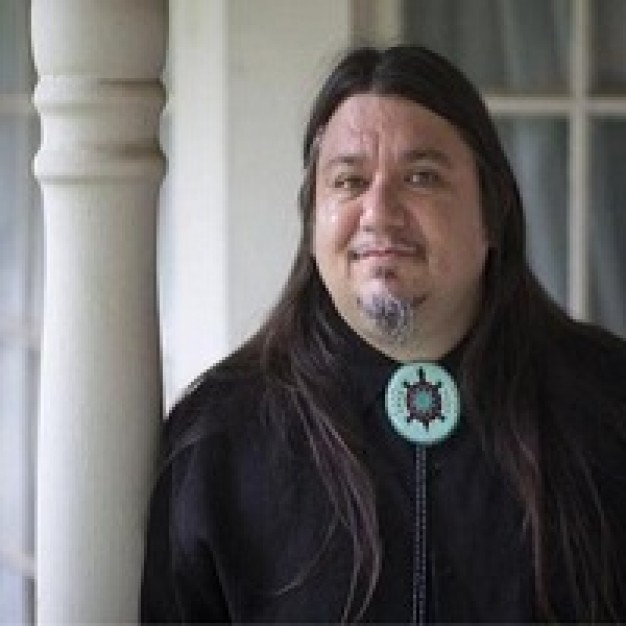
Robert Caldwell is an Assistant Professor of Indigenous Studies and Graduate Director of Indigenous Studies at the University at Buffalo (SUNY). He earned his doctorate in the Department of History and Geography at the University of Texas at Arlington. His dissertation, “Indians in their Proper Place: Culture Areas, Linguistic Stocks, and the Genealogy of a Map” explores 150 years of historical-thematic maps of American Indian homelands, languages, and cultures. The monograph is under revision with the University of Nebraska Press.