



Alyssa revisited the Wyck and Eastwick collections at the American Philosophical Society to digitize materials that fit the secondary scope (1763–1804) for The Revolutionary City. Enhanced metadata makes archival materials more accessible to researchers.
The Revolutionary City (2025) exhibition at the American Philosophical Society displayed the Catharine Haines household and medicinal recipe book from the Wyck Association Collection. I’d like to highlight two other medicinal recipes here at the APS Library: Hannah Marshall Haines’ recipe book in the Wyck collection, as well as the Wister family medical recipe book in the Eastwick Collection, 1746-1929, which can be accessed in the APS Digital Library.
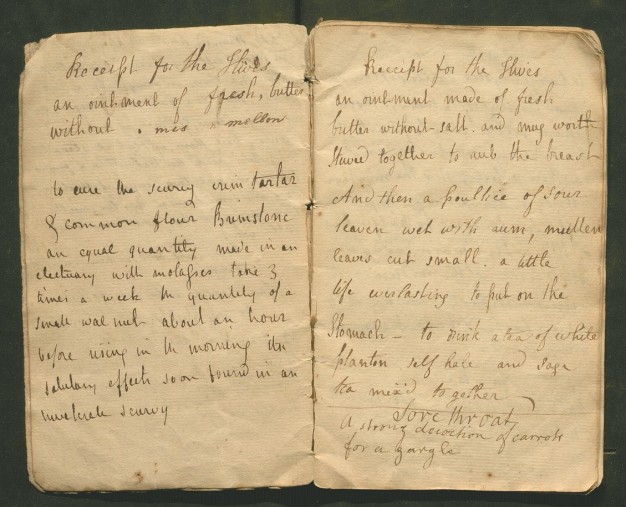
The Eastwick Collection finding aid title for the item is “Medical Recipes of Wister, Lowry, undated.” However, pencil annotations can be found in the pages that identify the script of various Wister relatives. These were most likely additions added by a descendant, whom I believe to be James W. Wister. Lowry’s name is in the beginning of the volume, hence the book being credited as belonging to her. This may be true, or it may be a misidentification from the individual who first surveyed the material when the finding aid was created. What is undoubtedly true is that the medical recipe book is composed of multiple scripts from the Wister family, including Lowry, Eliza, Hannah, and “S.W.,” who could potentially be either Sarah “Sally” or Susannah Wister. Papers were stitch-bound into a small volume and showcase the collective effort of the relatives who worked together on compiling medicinal recipes.
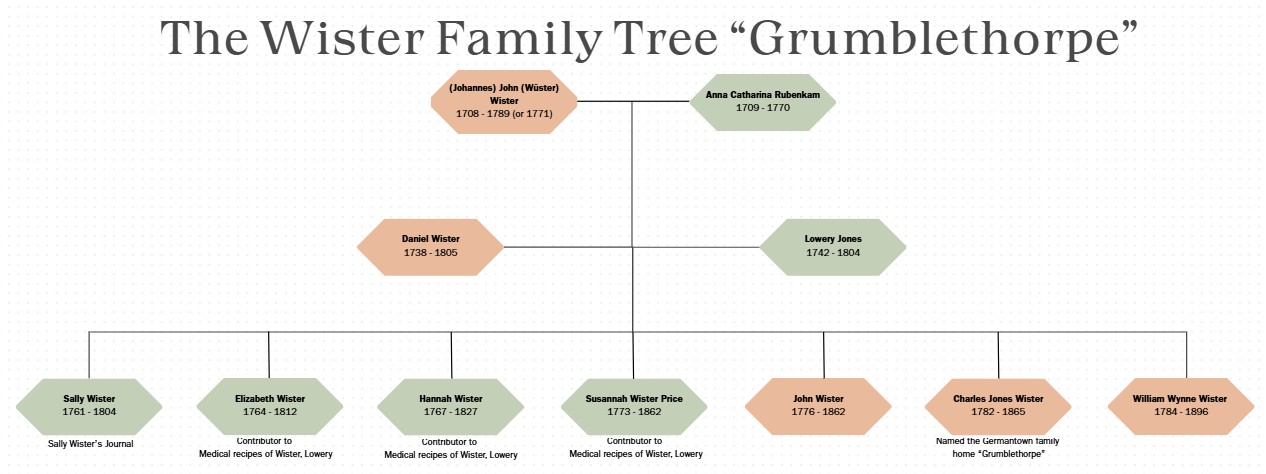
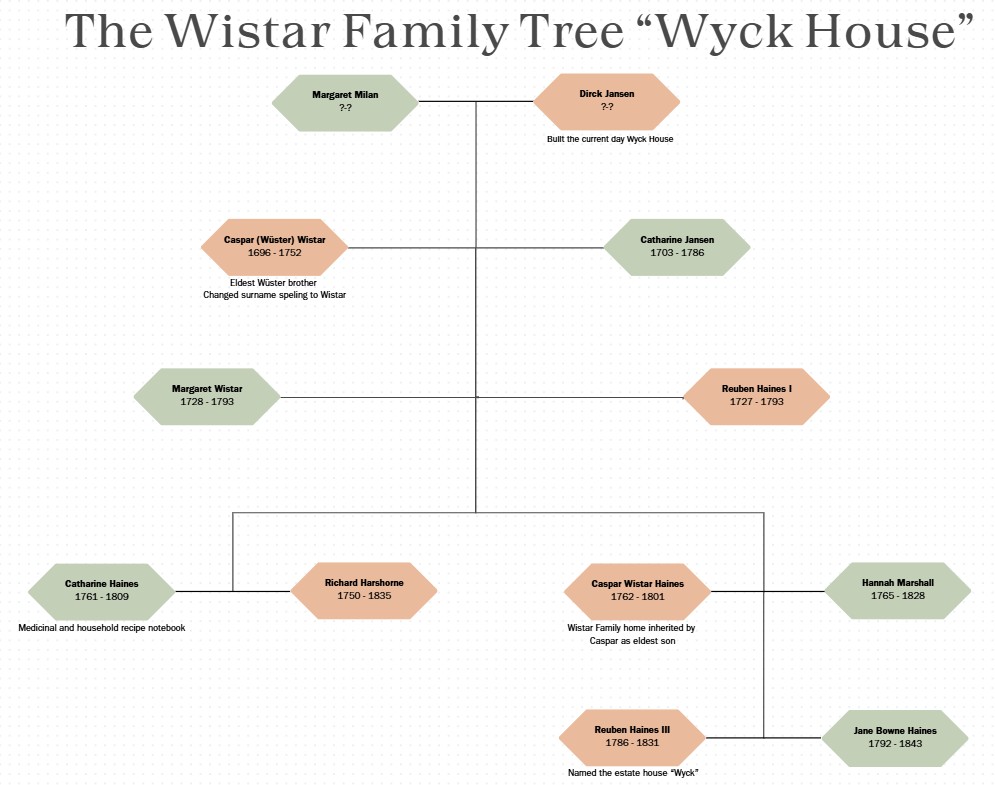
The Eastwick Collection, not to be confused, is named after the surname of a donor, whereas the Wyck Association Collection is named after the historic estate, an operational historic mansion in the Germantown neighborhood of Philadelphia. Eastwick and Wyck make up two different branches of a family tree of the Wüster Family. The eldest son, Hans Caspar Wüster (1696–1752), immigrated to the Pennsylvania colony from Palatine Germany on September 16, 1717, and later anglicized his surname to the spelling Wistar in 1722. Johannes Wüster (1708–89), immigrated to the Pennsylvania colony in 1727 and eventually began spelling the surname as Wister as opposed to his older brother’s spelling choice of Wistar. Together, the two brothers became known as Caspar Wistar and John Wister in Germantown, Pennsylvania.*
Family networks create shared knowledge as information is relayed from one relative to another, whether collaterally related or multigenerational. Hannah Marshall Haines was the sister-in-law of Catharine Haines, and the two women were cousins of the Wister family. In this instance, cousins shared medicinal recipes to practice. The Wister family medical recipe book and Catharine Haines medicinal and household recipes book are an example of these familial social networks. However, it has to be taken into consideration that the Wister and Wistar relatives may have copied some recipes from the same original source.
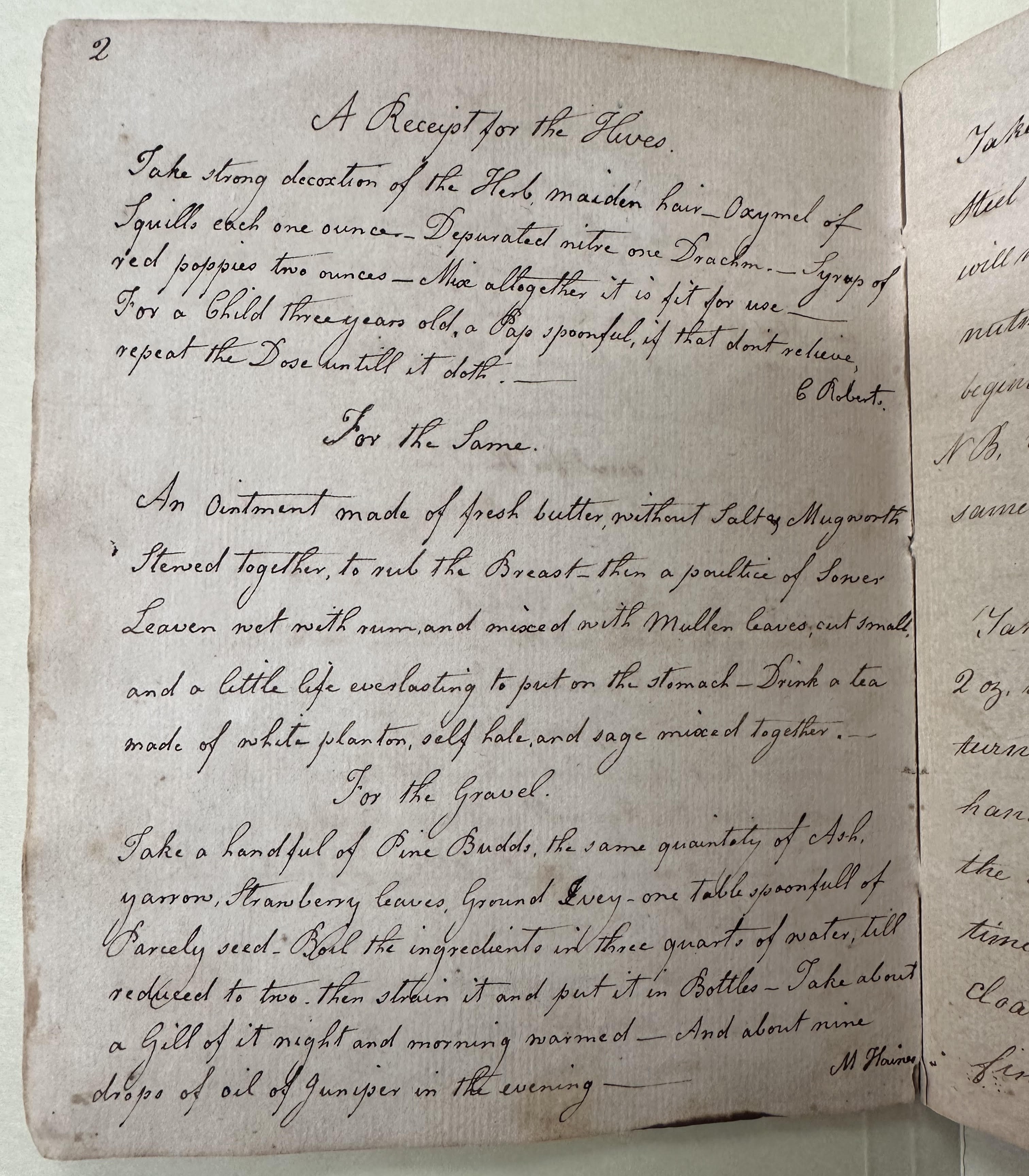
The medical recipes portray how knowledge was shared within these communities. For example, the shared recipe for the treatment of hives. In this instance, there is a direct connection between the Eastwick and Wyck collections at the APS. The Wistar/Haines and Wister families were related, but the shared knowledge exhibits the community kinship. The recipe was shared, recorded, then presumably practiced. The medical recipe book does not acknowledge the origin of the text of the recipe like others included in the volume—though hives seem to have been a concern for the Wister family considering there are three separate recipes to treat the illness.
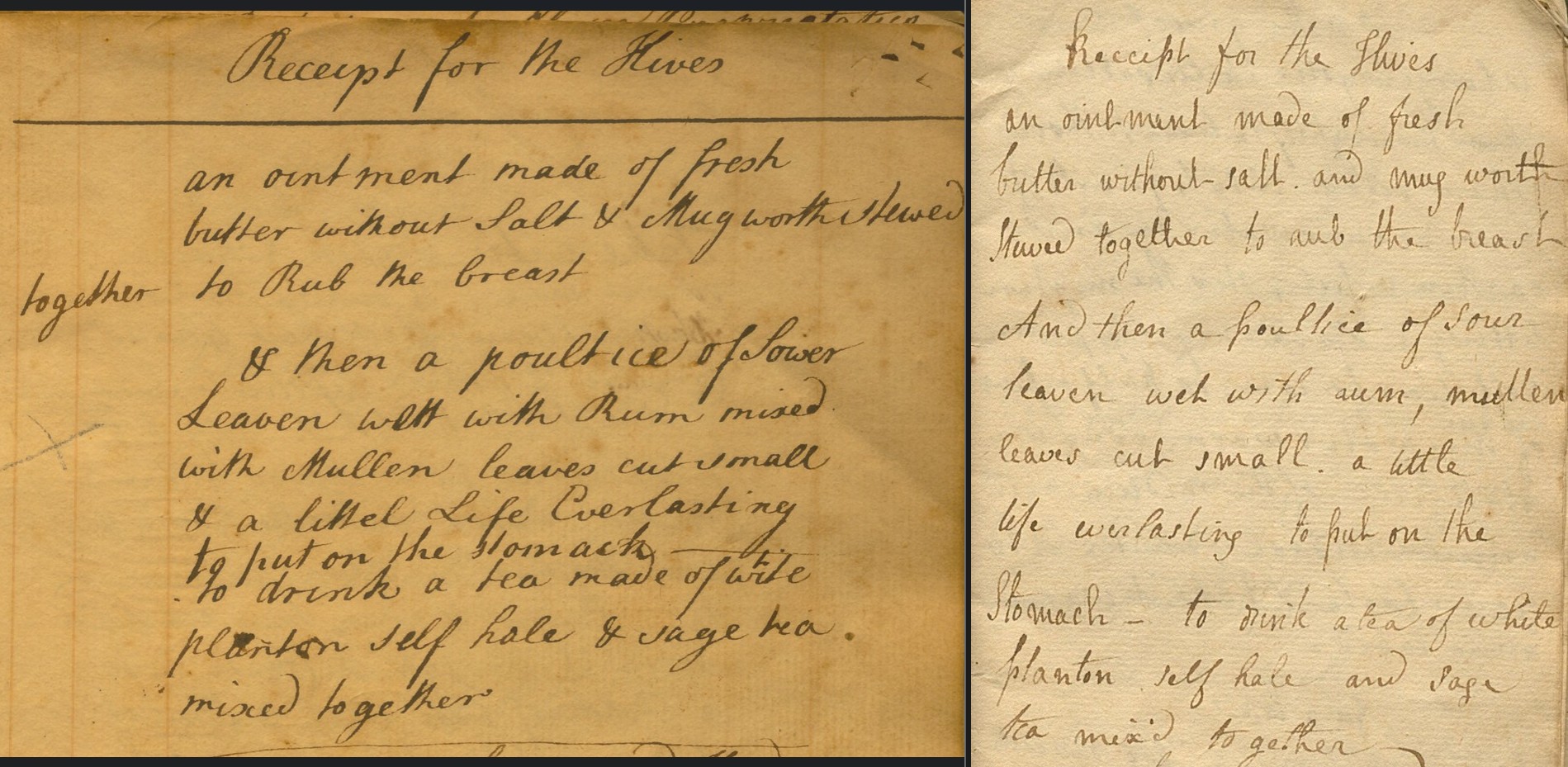
The shared hives recipe details the concoction for an ointment with the ingredients of butter, salt, mugworth, and a poultice with leaven, rum, Mullen leaves, and a little life everlasting. Lastly, drink a tea of white planton, self hale, and sage tea. The recipes also feature interesting spelling variations. The Wister family chooses the spelling “sour,” where Catharine Haines and Hannah Marshall Haines write “Sower.” The latter portrays the spelling for the farming technique rather than the correct spelling of sour, indicating, perhaps, an inclination to Quaker theology. There is also variation in the grammar and punctuation of the shared recipe. Ingredients mugwort, self-heal, and white plankton are all misspelled in the same fashion throughout the three hives recipes. Mugwort is spelled as “mugworth,” self-heal as “self hale,” and white plankton as “white planton.” Hannah Marshall Haines’ recipe for hives is grammatically written in a complete paragraph with concise instructions. The recipe from Catharine follows more proper grammar than the Wister family’s version, but there are still some errors and shorthand. Catharine would have been 15 at the time she recorded this recipe, which may account for the errors. The Wister family version, while resembling the Haines recipe, mostly lists ingredients. This may be a result of the recipe being transcribed while it was read aloud, or perhaps the scribe shorthanded the recipe.
It is important to note that Hannah Marshall Haines’ book of recipes, while undated, appears to have been written at a later date than the Wister family and Catharine’s, which date to the American Revolution era. This differentiation is identifiable by the cited credit at the end of most of the recipes. Hannah begins to document printed press gazettes, newsletters, and other paper advertisements as creditors. Many of these sources were established in the early 19th century. Presumptively, Hannah copied her recipes into a new volume where she kept everything in one, neat place.
The other two recipes for hives included in the Wister Family book vary. The first hives recipe appears to be incomplete. It begins with “an ointment of fresh, butter without” and lists a particular ingredient that is difficult to decipher. There is a gap on the page before the text continues with “to cure the scurvy cream tartar…” It is difficult to determine if this is one conclusive medical recipe where scurvy is grouped together with hives or if the relatives were unable to fully transfer and record the complete hives recipe, especially considering almost every recipe ailment title is prefixed with “Recipt for.” The final hives recipe included in the Wister family copy is for a strong decoction unlike the two ointment recipes. The first two would be recipes of topical treatment whereas the decoction treats the hives internally through digestion. Topical and ingestible medicines are still prescribed to cure the outbreak of hives. There is no mention of whether the three recipes could be supplementally applied to the affected person.
Joint recipe books include alternative recipes for sore eyes. The suggestion is to repeatedly rinse the eyes multiple times a day, yet the recipes are composed of entirely different ingredients. The Wister family recipe details “a strong decoction of Camo mile [chamomile] boiled in sweet milk to bathe the eyes.” Catharine Haines’ recipe states, “Lapus Calimanares [lapis calaminaris] 3’d worth put in a half a gill of white Rose water and shake it well.” Both encompass floral ingredients, though Catharine Haines’ recipe instructs the use of a mineral.
The Wister Family recipes do not include cooking or baking like Catherine’s does. However, food is a huge component of the ingredients for the medicinal recipes. One recipe, “100 walnuts to stop bleeding” is evidence of nut trees being utilized. Another example is a decoction of carrots that are boiled into a strong liquid to gargle for a sore throat. Food is medicine, noteworthy both in its application and its scientific conception.
*Formerly Germantown Township in Philadelphia County. The township was incorporated into Philadelphia [city] with the Consolidation Act of 1854 when the city border extended to the current day Philadelphia County border. See legislation here.