



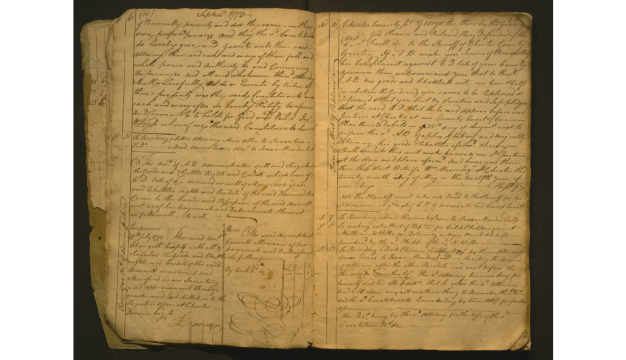
Excerpt from Nathan Sellers’s commonplace book. American Philosophical Society.
In 1743, Benjamin Franklin issued a pamphlet that called upon the “virtuosi and ingenious men” of the colonies to join a society dedicated to the promotion of “Useful Knowledge.” What “useful” meant was undeniably broad—experimental natural philosophy, engineering, surveying, invention, and many other technical crafts that created new knowledge, new infrastructure, and new wealth. As renowned members David Rittenhouse and John Bartram explored the vast distances of the solar system and the botanical specimens that lined the eastern coast of the North American continent, others concentrated on more proximate affairs. The scientific enterprise in Philadelphia—what was deemed “useful”—included the making of Philadelphia itself.
John Sellers embraced all that was useful, joining both the American Philosophical Society and the American Society for Promoting Useful Knowledge in 1768. Born in Darby, Pennsylvania in 1728, John developed a keen sense for mechanical tinkering and invention on his family farm. He took over the farm in 1752, and subsequently served as the constable of Darby Township and five terms in the Pennsylvania Assembly. He gained a reputation as a surveyor, mapping out private tracts of land and public roads, replacing a seemingly haphazard wilderness of Indian trails, water ways, and forest with an organized landscape of private property.
As Philadelphia grew in the middle of the 18th century, so too did its number of improvement societies and organizations, spearheaded by men like John. John contributed ten pounds each to the Pennsylvania Hospital, the College of Philadelphia, and the Library Company of Philadelphia. When the transit of Venus gripped the learned men of the American Philosophical Society in 1769, John joined David Rittenhouse at the astronomer’s homemade observatory at Norriton to help with observations. The APS paid John fifty shillings for “a curious levelling Instrument of a new construction” that he had made for the transit observations. By the late 1760s, John had found a tight-knit community, where astronomers and engineers grew fond of one another through their dedication to the potentially “useful.”
In 1751, John welcomed a son, Nathan. Like his father, Nathan gravitated toward things more than theories. Nathan served as a clerk for the Supreme Executive Council and worked for attorneys in Philadelphia. His journals, saved at the APS’s Library & Museum show his experience with “Inquisition[s] of the Divisions of Real Estate,” “Refunding Bond[s], Marriage Certificate[s] Before a Magistrate,” and “Form[s] of an Apprentices Indenture.” But in the end, he abandoned the legal track for engineering and invention, gradually working his way to becoming the region’s most respected wire weaver and surveyor.
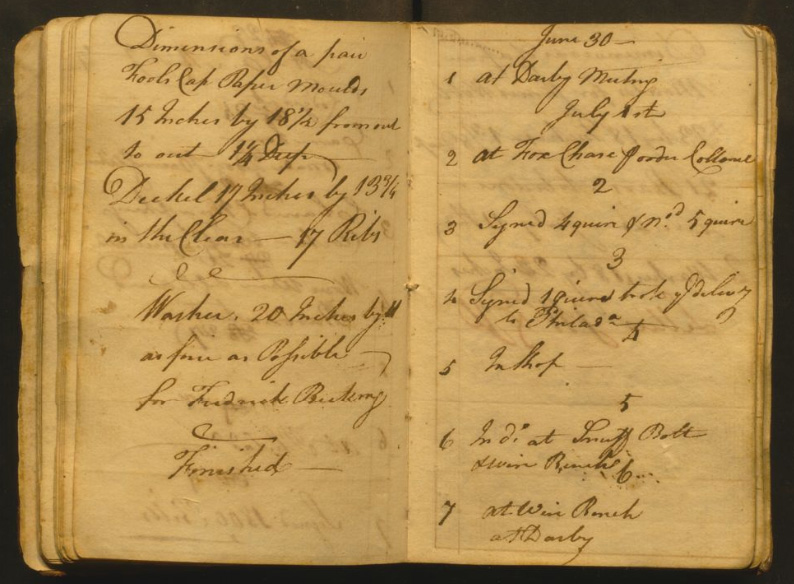
Leading up to the Revolution, John became a vocal protester against the economic policies of the British Crown. Nathan joined his local militia as a “fighting Quaker” but never experienced combat. Instead, the Continental Congress called Nathan back to Philadelphia to make screens and molds of paper money that Congress printed to pay for the war. He also made brushes and priming wires (used to puncture packets of gunpowder), indicated by his 1776 diary.
The Darby meeting of Quakers disowned John and Nathan for their involvement with the Revolution. John eventually reconciled with the meeting, but Nathan decided to join the Swedenborgian faith, a new sect that similarly promoted charity, self-education, and often the abolition of slavery. In the late 18th century, Nathan joined the Pennsylvania Society for Encouragement of Manufactures and the Useful Arts, the Philadelphia Society for Promoting Agriculture, the Society for the Institution and Support of Sunday Schools, and the Pennsylvania Society for Promoting the Abolition of Slavery. Through industry and improvement, Nathan believed he could offer a more prosperous and just pathway forward for Philadelphians. John and Nathan emerged from the war wealthier than before, industrial partners to a newly founded nation. From his home and wire shop on Market Street, surrounded by the busy economic channels of dry goods stores, apothecaries, manufacturers, inns, and saloons, Nathan became a dominant force in the planning of early Philadelphia.
It began at the shop. With his brother David, Nathan produced wire screens and molds for millers, cotton spinners, bricklayers, and individual windows and skylights. He drew business from engravers, jewelers, merchants, government offices, the Library Company of Philadelphia, and many more. He also maintained a steady surveying practice, carving out roads and real estate plots. In 1784, he joined David Rittenhouse in studying a possible canal that would run between the Schuylkill and Susquehanna Rivers.
John similarly remained involved with public affairs, serving as a representative for Delaware County at the state constitutional convention in 1789, subsequently serving in state senate. He proposed a bridge that would cross the Schuylkill and thread together major roads and the western edge of the city, and experimented with gypsum as a new fertilizer on his farm. In the 1790s, Nathan turned to finance to sustain his growing economic might. He would come to own stock in banks and turnpike and canal companies, invest in cotton and paper mills, and act as an individual lending firm for both family and friends.
After his father’s death in 1804, Nathan served on the city council from 1806 to 1812, increasing his power over Philadelphia’s future. He oversaw the city’s water and lighting works, and drafted ordinances that determined the leveling and layout of new streets and the assessments of property taxes. But his health was failing. He gave up drinking, and acquiesced to routine bloodletting, recommended by his friend Benjamin Rush. Succumbing to a “great nervous disability,” then, brought more than physical discomfort: “Having been this life until this time in very active and constant employment working diligently with my hands, it has become so habitual that I cannot agreeably be without bodily employment and indeed I doubt whether it be right for any human being who has bodily strength…”
In his book on the Sellers' dynasty in Philadelphia, historian Dominic Vitiello writes that the long arc of the infrastructure and real estate projects of the Sellers family “reflected evolving paradigms of economic development, from the Enlightenment science Nathan and his father practiced in the 18th century to the early Progressive urbanism of William and Coleman in the decades after the Civil War.” The “Enlightenment science” of John and Nathan found community and strength at the American Philosophical Society in the 1760s, evolving over the years, and through the Revolution, into the planning and building of “the foremost center of industry in the Americas,” Vitiello writes. “I think it very questionable,” Nathan wrote in his diary, “whether any Human authority—whether any man or association or combination of men should be allowed or can have the right to dictate in matters of faith—to rule over the consciences of others.” Nathan had directly profited on the Enlightenment ideal: “Liberty and Rationality are given to man…and where the authority of binding the free will is attempted…what fruit can be expected?”
References:
Bell, Jr., Whitfield J. Patriot-Improvers: Biographical Sketches of Members of the American Philosophical Society, Volume 1. Philadelphia: American Philosophical Society, 1997.
Garrett, Clarke. “Swedenborg and the Mystical Enlightenment in Late Eighteenth-Century England.” Journal of the History of Ideas 45 (1984): 67-81.
Hindle, Brooke. The Pursuit of Science in Revolutionary America, 1735-1789. New York: W. W. Norton & Company, 1956.
Peale-Sellers Family Collection. Mss B P31, Series 7. American Philosophical Society.
Smith, William, Lukens, John, Rittenhouse, David, and Sellers, John. “An Account of the Transit of Venus over the Sun, June 3d, 1769, as Observed at Norriton, in Pennsylvania,” Transactions of the American Philosophical Society 1 (1769-1771): 8-41.
Vitiello, Dominic. Engineering Philadelphia: The Sellers Family and the Industrial Metropolis. Ithaca: Cornell University Press, 2013.