



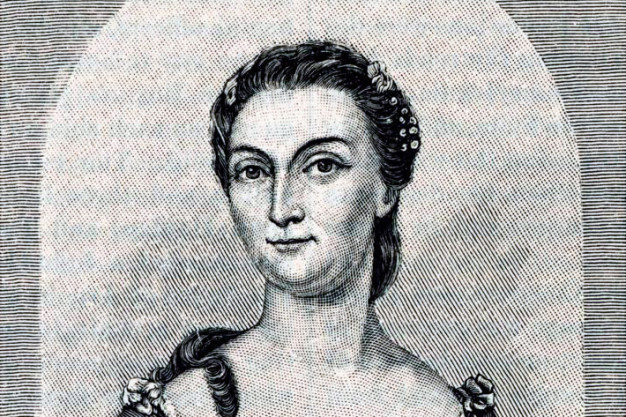
Elizabeth Graeme Fergusson
It was Saturday night. Elizabeth Graeme rushed to put the house in order, preparing refreshments and reorganizing the furniture. In the early 1760s, on the north side of Chestnut Street between Seventh and Sixth Streets, Graeme opened her home each week to the writers, artists, and philosophers of Philadelphia. It was her night. With the expected grace of an eighteenth-century hostess, Graeme had skillfully engineered acceptable transgression. Among friends, both men and women, she freely discussed the rise and fall of empires, the merits of philosophical creeds, cutting-edge theories in medicine, and the great wonders of the cosmos. Outside of the exclusive institutions of Philadelphia, such as the American Philosophical Society and the College of Physicians, Graeme’s salons allowed knowledge to circulate freely among friends and acquaintances.
They became a spectacle of intellectual finesse, earning her the later reputation of “the most learned woman in America.” Born on February 3, 1737, to a wealthy and connected Pennsylvania family, Graeme received a robust education from her parents, who taught her needlework and social graces as well as Latin, German, Greek, and the ins and outs of the Scottish Enlightenment. She was an upper-class Quaker, the granddaughter of Pennsylvania Governor William Keith. There were no public schools in Philadelphia at the time. But her parents made sure she became an educated woman.
Graeme’s father, Dr. Thomas Graeme, had studied medicine at the University of Leiden. In 1717, he traveled with the Keiths to Philadelphia as their family physician upon Keith’s appointment as Governor. He married the governor’s step-daughter Ann Diggs just two years later. In the 1720s and 1730s, Thomas became a Port Physician, an admired medical expert who would later become a founding subscriber of the Pennsylvania Hospital. Thomas talked science and medicine with his daughter, but Ann oversaw much of Elizabeth’s education. And in the winter months, she taught her daughter the responsibilities of hosting.
In 1757, at the age of 20, Elizabeth got engaged to William Franklin, the acknowledged extra-marital son of Benjamin Franklin. Perhaps to her parents’ secret delight (they had objected to the engagement), William traveled to England with his father, where he met and married another woman, leaving Elizabeth confused and heartbroken. Graeme had started writing poetry before the end of her engagement, but now her craft entered maturity, turning toward deeper themes of loss, heartbreak, and solitude. She poured herself into her art, undertaking a translation of Abbé François Fénelon’s The Adventures of Telemachus followed by a conversion of the Psalms into poetic verse.
Creativity aside, her parents worried about her emotional well-being. It would be good, they thought, if she traveled. So in 1764, Graeme set sail for the British Isles. As she departed, drifting off into the vast ocean, Graeme’s immediate thoughts wandered toward a characteristic blend of hers: nature’s poetics.
[Graeme] appeared to be in the Centre of a Circle, for the Sea seems to be a perfect Circle, surrounded by the Clouds, that looks as if they bent down at the Edges to join it, so that our own eyes form the Horizon, & like Self = Love, we are always placing ourselves in the Middle, where all Things move round us.—I saw the Sun set clear for the first Time, I was reading Priam’s Petition to Achilles for the Body of Hector, I think my Eyes were engaged in one of the finest Sights in the Universe, & my Passions, interested in one of the most pathetic that History or Poetry can paint.
Her sojourn in England and Scotland would prove formative. She spent time in London and in Lichfield, an English town known for its literary salons and the so-called Lichfield group of writers. She kept meticulous notebooks of at least two, perhaps three, parts, which she sent back to her family and friends. From meeting famed writers such as Anglo-Irish novelist Laurence Stern to befriending physician John Fothergill, Graeme had experienced a wonderful taste of Europe’s intellectual cultivation. Sailing back to Philadelphia, she declared the City of Brotherly Love to be the “the Athens of North America.” And she would do all that she could to make sure such a statement rang true.
But tragedy struck while she was abroad. Her mother, who suffered from an unknown illness for quite some time, passed away. When Elizabeth docked in Philadelphia in 1765, after 18 months apart from her family, she embraced her father and her sister with tears of both relief and sadness. Her family recounted to Elizabeth her mother’s last days and wishes, and that she had left Elizabeth two letters, giving her daughter some final advice on the “choice of a husband” and the “management of a family.” Take care of your father, Ann insisted. Elizabeth was now the woman of the household.
If entertaining at home was now her duty, she would turn the occasions into salon gatherings, just like the ones she had experienced in Europe. The “salon” in the eighteenth century, while not called that until the nineteenth, was a nebulous category of social gathering, allegedly a social custom that grew out of seventeenth-century Paris. “Despite their regularity and formulaic conventions of behavior and discourse,” historian Rebecca Cypess writes, “most salons projected an air of the ‘natural’—that key Enlightenment concept—which, like honnêteté, encompassed grace, ease, and fluidity even as it attended to social mores and conventions of behavior.” Salons took on new forms as they made their way into new countries and new cultures, including the American colonies. But consistently they offered a bridge between the aristocracy and the intelligentsia. And more often than not, women oversaw the proceedings, governing the room with female grace while simultaneously prying open entry to an intellectual world they were systematically denied access to. Saturday nights at the house the Graeme’s rented on Chestnut Street became the first salon in North America.
During the Enlightenment, salons became a novel space for showcasing and circulating scientific ideas. For salon-goers, they might engage in conversation with a natural philosopher, or experience experimental demonstrations in the privacy of a home. The tradition stretched back to the seventeenth century, such as the salons of Jacques Rohault in Paris. His “Cartesian Wednesdays” brought in a large audience, including many well-known names such as astronomer Christian Huygens. Women also made up a large portion of his audience, gathered to witness Rohault run through experiments intended to show the validity of Descartes’s physics. In Philadelphia, early public science, or the social nature of the circulation of scientific ideas, included Benjamin Franklin’s Junto (still exclusive, yet informal) and Charles Willson Peale’s natural history museum, where Peale himself gave lectures. At the turn of the century, physician and paleontologist Caspar Wistar opened his Philadelphia home on Sunday evenings for a similar salon evening of intellectual discussion.
Graeme’s salons were primarily literary, and with Francis Hopkinson a frequent guest, they were musical too. But in Philadelphia, science was nearly unavoidable among the educated elite. Benjamin Rush and Hopkinson became good friends with Graeme, enjoying both the salon's offerings and Fergusson’s intellectual prowess. In his posthumous biographical ode to Fergusson, Rush wrote: “she instructed by the stores of knowledge contained in the historians, philosophers, and poets of modern nations, which she called forth at her pleasure; and again she charmed by a profusion of original ideas, collected by her vivid and widely expanded imagination, and combined with exquisite taste and judgement into an endless variety of elegant and delightful forms.” Her poetry also often ventured into themes of nature and perception, following the empiricism of David Hume and George Berkeley. Graeme described how we make “Natures Scenes…Mirrors,” how they “all reflect the object of our thought.” How we know depends on how we perceive, in other words. Graeme maintained a fascination with medicine, which she had inherited from her father, a subject she would continue to explore through her lengthy correspondences with Rush and Fothergill.
For Graeme, her salons both represented Philadelphia in microcosm and contributed to the construction of the “Athens of North America.” It was her own brand of city boosterism. Philadelphia’s intellectual fire was the engine of a continent that now rivaled Europe’s dominance.
A land which claims a Washington
And Franklin does Adorn
Calls Rittenhouse a native son,
A Land where West was born
The Willow There and Laurel too
May to perfection rise
If we the Metaphor pursue
Symbolic of the Wise.
In 1771, Rush introduced Graeme to a young Scotsman named Henry Fergusson at one of her salons. They married just four months later, without knowledge or permission from her father. Life would then get complicated. Her father died in 1772, and she inherited Graeme Park, the family estate roughly 17 miles north of Philadelphia. But under colonial law it belonged to her husband. Her salon stopped meeting. Meanwhile, tensions in the colonies brewed. Henry, who had been traveling for business since 1775, remained loyal to the British Crown. In 1777, George Washington banned Henry from returning to Graeme Park. Then, during the British occupation of Philadelphia, General Howe appointed Henry commissary of prisoners. In 1778, when the British evacuated the city, Henry returned to England, never to see his wife again.
Graeme herself became embroiled in scandal. In 1777, she agreed to deliver a letter from Jacob Duché, a salon attendee, to George Washington advising an “immediate cessation of hostilities.” Duché, who had once agreed to criticize the British from his pulpit as minister at both Christ Church and St. Peter’s Church, had now undergone a political and spiritual conversion. Upon receiving the letter, Washington grew angry, worried that such a letter, if not made public, would implicate disloyalty. So he sent the letter to Congress with his own note attached, mentioning Graeme’s involvement. Just a year later, Elizabeth surprisingly agreed to deliver another letter, and this scandal threatened to ruin her. Given her husband’s actions, and now her own, the new government of the United States confiscated Graeme Park as the property of a traitor.
Graeme decided to do what she knew best. She wrote. Il Penseroso, or The Deserted Wife, had four parts: hope, solitude, doubt, and adversity. Remaking her image, she was no longer a loyalist accomplice, but a patriotic woman stuck between a rock and a hard place. Other petitions, such as “To the Public,” explained her actions in more detail, and professed deep loyalty to her country. All the while, her friends Benjamin Rush, Francis Hopkinson, and others from her salon days spoke out in support of her. Two years after confiscation, Elizabeth would get Graeme Park back. In the end, the world of letters, her salon community—literary and scientific—brought her back from oblivion.
Bibliography:
- Barnard, Teresa. “Anna Seward’s ‘Terrestrial Year’: Women, Poetry, and Science in Eighteenth-Century England.” Partial Answers 7 (2009): 3-17.
- Cypess, Rebecca. Women and Musical Salons in the Enlightenment. Chicago: University of Chicago Press, 2022.
- Lynch, Jack, ed. Samuel Johnson in Context. Cambridge: Cambridge University Press, 2012.
- Lynn, Michael R. Popular Science and Public Opinion in Eighteenth-Century France. Manchester: Manchester University Press, 2006.
- Ousterhout, Anne M. The Most Learned Woman in America: A Life of Elizabeth Graeme Fergusson. University Park, PA: The Pennsylvania State University Press, 2003.
- Slotten, Martha C. “Elizabeth Graeme Ferguson: a Poet in ‘The Athens of North America.’” The Pennsylvania Magazine of History and Biography 108 (1984): 259-288.
- Tillman, Kacy Dowd. Stripped and Script: Loyalist Women Writers of the American Revolution. Amherst: University of Massachusetts Press, 2019.
- Wharton, Anne H. Salons Colonial and Republican. Philadelphia: J. B. Lippincott Company, 1900.