



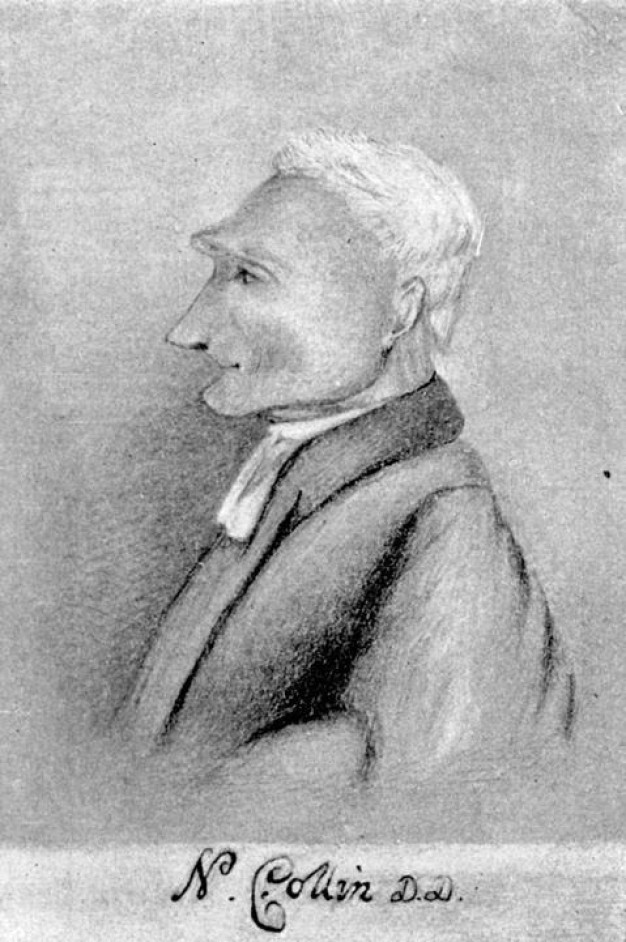
Rev. Nicholas Collin (1745–1831), portrait sketch.
Nicholas Collin arrived in New Jersey from Sweden in 1770 to serve the spiritual needs of Lutherans in the British colonies. Born Nils Collin in 1746 in Fundbo, Sweden, Collin grew up in a family of Lutheran clergymen. He graduated from the University of Uppsala in 1768 and was ordained as a minister in the Church of Sweden. Two years later, the Church sent Collin to North America, where he became a curate at Trinity Church in Swedesboro, New Jersey. Shortly thereafter, he became a rector, and also began to minister at St. George’s Episcopal Church in Churchtown, New Jersey.
But religious leadership was far from his only calling. At Uppsala, he had been a student of mathematics and probability. And when he arrived in the colonies, he had few duties, so he found “considerable time to amuse [himself] with [his] dear mathematics and philosophy.” Collin lived near Philadelphia, the beating heart of natural philosophy in America. He firmly believed investigations into nature made his work as a clergyman better. Those who did not concern themselves with natural philosophy simply missed an essential piece of God’s creation. So he kept weather records, made experimental graftings in his orchard, hunted down botanical and other specimens, and maintained a lively scientific correspondence with notable Swedish scholars, including naturalist Carl Peter Thunberg and philologist Pehr Fabian Aurivillius. While a student in Uppsala, Collin knew and admired botanist Carl Linnaeus, a professor at the University from 1741 until 1776. Collin later recalled: “I often heard the great Linnaeus wish that he could have explored the continent of North America.”
Anxiety washed over his parish with the outbreak of the Revolutionary War. Collin, opposed to all violence and bloodshed, did not support the Revolution. But he kept a detailed diary on the local politics and events of the war, including nearby battles, and how while many were originally enthusiastic, “as the fire came closer, many drew away.” Some people “concealed themselves in the woods, or within houses,” while others “were forced to carry arms, others offered opposition and refused to go.” To some, Collin’s neutrality looked like loyalism. In 1777, the New Jersey militia took Collin as a prisoner and marched him to an unnamed location. He feared he would be shot at any moment. Fortunately, Bodo Otto, a Senior Surgeon with the Continental Army who knew of Collin, secured his release. Still, Collin was forced to make a decision: flee and join the British, or pledge allegiance to the new country. He wanted to do neither. He was still a Swedish subject, in fact, so he negotiated a compromise that allowed for an abridged and amended oath, which enabled his stay in New Jersey while remaining “neutral.” “I could not give my oath of allegiance to any but my own government,” he wrote.
Neutrality or not, the war continued its disturbances. Collin grew dismayed with both Patriots and Redcoats: “they smashed mirrors, tables and china, etc., and plundered women and children of their most necessary clothing, cut up the bolsters and scattered the feathers to the winds, burned houses, whipped and imprisoned each other, and surprised people when they were deep asleep.” Local authorities took several members of his congregation prisoner for trading with the British, and in 1778 American troops took over one of his churches for a few weeks, filling it with “filth and vermin.” “I thank God Almighty,” Collin wrote as hostilities receded, “who gave me strength to go through this fiery ordeal with Christian steadfastness.”
When the war ended, Collin was eager to return to his cherished life of the mind. The United States had prevailed, and he would embrace this new country as a home for progressive inquiry. He became pastor of Gloria Dei Church in Philadelphia in 1786, joined the Society for Political Inquiries (hosted by Benjamin Franklin), and penned a series of newspaper articles supporting the new Constitution. And to his delight, the American Philosophical Society elected Collin a member on January 16, 1789. In 1795, Collin would win APS’s Magellanic Premium, the oldest scientific prize in the United States, for his “speedy elevator,” a device operated by a pier and a pulley system, designed to raise and lower heavy items with speed.
Just months after his election to membership in 1789, Collin stood before the APS and gave them a road map, as he saw it. He called it “An Essay on Those Inquiries in Natural Philosophy, Which at Present Are Most Beneficial to the United States of North America.” His adopted country was a new one, finding itself in the wake of violent revolution. Collin believed he knew how science could help.
He began: “Philosophers are citizens of the world; the fruits of their labours are freely distributed among all nations; what they sow is reaped by the antipodes, and blooms through future generations.” Collin was a Swede who had arrived in North America on the brink of war. He had remained neutral, as a man of the cloth, a Swedish subject, and as a Philosophical citizen of the world. But now, he continued in his APS address, “it is…[philosophers’] duty to cultivate with peculiar attention those parts of science, which are most beneficial to that country in which Providence has appointed their earthly stations.” “Patriotic affections” imbued his remarks, he insisted, and to begin local, with the questions of science readily accessible in one’s own country, would, in the end, contribute to the health, learning, and prosperity of all.
He separated his address into five inquiries: medicine, physico-mathematics, rural economy, natural history, and meteorology. The number of items Collin discusses is vast, too numerous to cover in detail here. But a central thread emerges across each section: opportunity comes with new birth. The newness of both country and land (for European settlers, that is), posing its own distinct set of challenges, provides fodder for science and potentially great contributions to the global economy of scientific knowledge.
Americans faced unique medical challenges. Nervous disorders, rheumatism, intermittent fevers, loss of teeth, and colds pained Americans given their physical and social climate, especially with the all too common “fall and rise of the thermometer by 20 [or] 30 degrees within less than four and twenty hours.” Collin was particularly disturbed by the early loss of teeth among Americans, which resulted from high sugar consumption, poor dental hygiene, and the practice of simply removing teeth to alleviate tooth pain. For women, malnutrition during pregnancy also contributed to tooth loss. Collin noted that young women often lost many teeth by age 20, remarking in 1770 that “I fear that I would be obliged to chew for an American [wife], if I took one on my neck.” Tooth loss, moreover, inhibited annunciation for a populace so prone to public speaking, reduced the pleasure of eating, and exposed “the mouth and throat to cold,” he claimed. For Collin, the abundance of “nervous disorders” had a distinct history in the United States, originating from two major causes: one “is that gloomy superstition disseminated by ignorant illiberal preachers; the bane of social joy, of real virtue, and of a manly spirit”; and the other is “the convulsion of public affairs for a considerable time past, which occasioned many and great domestic distresses: the natural events of the late war are universally known: numbers of virtuous citizens have also felt the dire effects of the succeeding anarchy; especially in the loss of property.” The stresses of war had undoubtedly taken their toll. But not to worry: “this phantom of darkness will be dispelled by the rays of science, and the bright charms of rising civilization.”
The sheer vastness of the land would pose its own challenges. Surveying would be vital, and the study and cultivation of numerous plants, especially “Indian corn,” would be essential to sustaining American food supplies. Pests such as the Hessian fly would also need to be monitored. The “vast domains” of the United States contained “stately forests,” a “national treasure, deserving the solicitous care of the patriotic philosopher and politician.” And the extreme weather variations of a large continent, with tornadoes during summer storms and blizzards that tore through the east coast, required a robust and expansive network of meteorological observation.
The federal government would begin work in all of these fields in the next century: the Coast Survey (founded during Jefferson’s presidency), the Geological Survey, Agricultural Experiment Stations, the Bureau of Entomology at the Department of Agriculture, the Weather Bureau, and conservation, to name a few. APS members Alexander Dallas Bache (the great grandson of Benjamin Franklin), Ferdinand Hassler, and Joseph Henry became essential to jumpstarting science within the American government. It would take vast sums of scientific labor. And Collin, too, hoped that new machinery, such as his speedy elevator, would relieve the stresses of grueling manual labor, even eliminate the desire for American slavery in the South—another project the federal government would take up in 70 years’ time.
“Let us therefore study nature,” Collin wrote, “and nature’s Ruler shall reward our labour.” Many shared Collin’s views. Men such as Jefferson and Benjamin Rush similarly fretted over “nervous disorders” in the U.S. and the need for better weather prediction. But it’s not necessarily the novelty that makes Collin’s words important. A new nation had a distinct set of challenges, and those at the APS had a firm sense of where to begin: with science.
Bibliography
- Bell, Whitfield J., ed., and Collin, Nicholas. “Nicholas Collin’s Appeal to American Scientists.” The William and Mary Quarterly 13 (1956): 519–550.
- Collin, Nicholas. “An Essay on Those Inquiries in Natural Philosophy, Which at Present Are Most Beneficial to the United States of North America.” Transactions of the American Philosophical Society 3 (1793): iii–xxvii.
- Collin, Nicholas. “Description of a Speedy Elevator.” Transactions of the American Philosophical Society 4 (1799): 519–525.
- Dupree, A. Hunter. Science in the Federal Government: A History of Politics and Activities to 1940. Cambridge: The Belknap Press of Harvard University Press, 1957.
- Urken, Arnold B. and McLean, Iain. “Nicholas Collin and the Dissemination of Condorcet in the United States.” Science in Context 20 (2007): 125–133.
- Waldron, Richard. “‘A True Servant of the Lord’: Nils Collin, the Church of Sweden, and the American Revolution in Gloucester County.” New Jersey History 126 (2011): 96–103.