



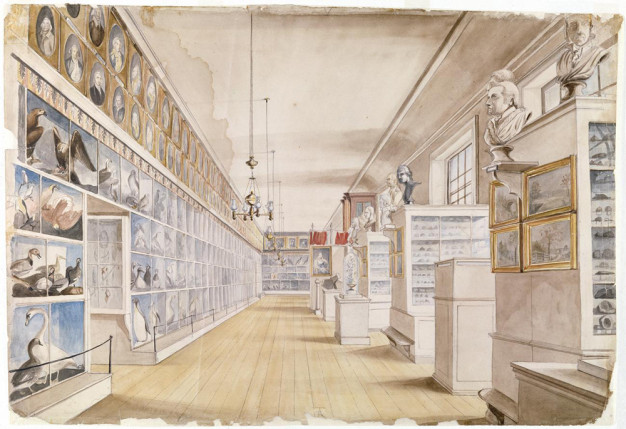
Charles Willson Peale’s preliminary sketch for his large self-portrait in his museum, 1822, Discover Lewis & Clark.
The boundary between art and science is much hazier than we often realize. Why, today, the two often sit diametrically opposed, or as a clean dyad—“College of Art and Sciences,” for example—has its own lengthy history, too long to recall here. But for Charles Willson Peale, the overlap was clear, if not perfectly self-evident. Nature, for Peale, was “a bewitching study,” whether he rendered it on canvas, or in the glass cases of a natural history museum.
The painter-turned-naturalist lived a life of twists and turns. His father, Charles Peale (1709–50), had been convicted of theft and embezzlement in England, so he was shipped off to the American colonies as a prisoner. He found work as a schoolmaster in Maryland and married Margaret Triggs (1709–91). The younger Peale was born on April 15, 1741, in Queen Anne’s County, Maryland. Peale apprenticed as a saddle maker, tried his hand at fixing clocks and metalworking, but eventually found his passion in painting. In the 1760s, he joined the Sons of Liberty, a clandestine, loosely organized group dedicated to resisting British rule, especially the Stamp Act (1765). With some assistance from friendly patrons, Peale then studied with the American-born painter Benjamin West in England for three years. When he returned, Peale made Annapolis, Maryland his home, where his family had moved in 1751. He found wealthy friends, and gradually the young painter made a name for himself. The Maryland capital was small but lively. Theaters, balls, and horse races in the port city enticed eminent visitors, including George Washington, whose portrait Peale would paint in 1772 during a 10-day visit to Mount Vernon.
In 1775, after the eruption of violence at Lexington and Concord, Peale saw Philadelphia as the place to be in the throes of Revolution. He quickly became a radical for independence and democracy, all the while painting portraits in his new Philadelphia studio. He enlisted in the city militia, joined the “Furious Whigs” (the most passionate faction of American revolutionaries), listened with pride to the public reading of the Declaration of Independence outside the Statehouse, and participated in the battles of Trenton and Princeton. He saw no action in Trenton, but found himself on the frontlines in Princeton. His first-hand experience of Washington’s leadership would lead to his 1779 painting, George Washington at the Battle of Princeton.
Peale was part artist, part propagandist. Portraits became his specialty, and he used this medium to paint the stern features and contemplative brows of Revolutionary heroes. He turned an outbuilding on his property at Third and Lombard Streets into a gallery of artistic prowess and patriotic zeal. By the end of the war, he had filled his gallery with both full-length and upper-body portraits. Peale gradually broadened his scope, first to works examining the experience of motion—in both landscapes and historical events—and then to a “Repository of Natural Curiosities.” The art of nature itself, as Peale saw it, deserved its rightful recognition. Soon, beneath the skylight of his gallery, the human portraits of the Revolution formed a hall of patriotic resolve, surrounded by the many specimens that shared the Earth with them, organized in the neat hierarchy of a blossoming natural history museum.
Over the course of the Early Modern period, art and science saw with a similar eye, so much so that historian Pamela H. Smith has suggested that “if we understand art in the early modern sense as an imitation of the processes of nature, then ‘art’ and ‘science’ overlap in very fundamental ways; indeed, they might even be regarded as the same thing: technoscience.” Both are image-making and knowledge-producing practices that, as Peter Galison and Caroline Jones note, share a parallel history, where the emergence of art as a humanist practice during the Renaissance overlaps with the early rumblings of a “scientific method.” In the 18th century, how one saw, represented, and came to know nature depended upon refined and perfected images made by expert hands, what Galison and Lorraine Daston call “truth-to-nature.” “Art and science converged in intertwined judgements of truth and beauty,” they write. Peale’s gallery not only put art and science side by side, but offered a celebration of the essential beauty of nature’s wonders. For many 18th-century natural philosophers, the natural world was the work of a “divine Maker…,” historian Laura Rigal writes, “an artisan extraordinaire, whose providential designs could be read in the leaves and stems or bones and muscles of his works.” The artist understood the natural world through representation, and the scientist excavated the art of creation.
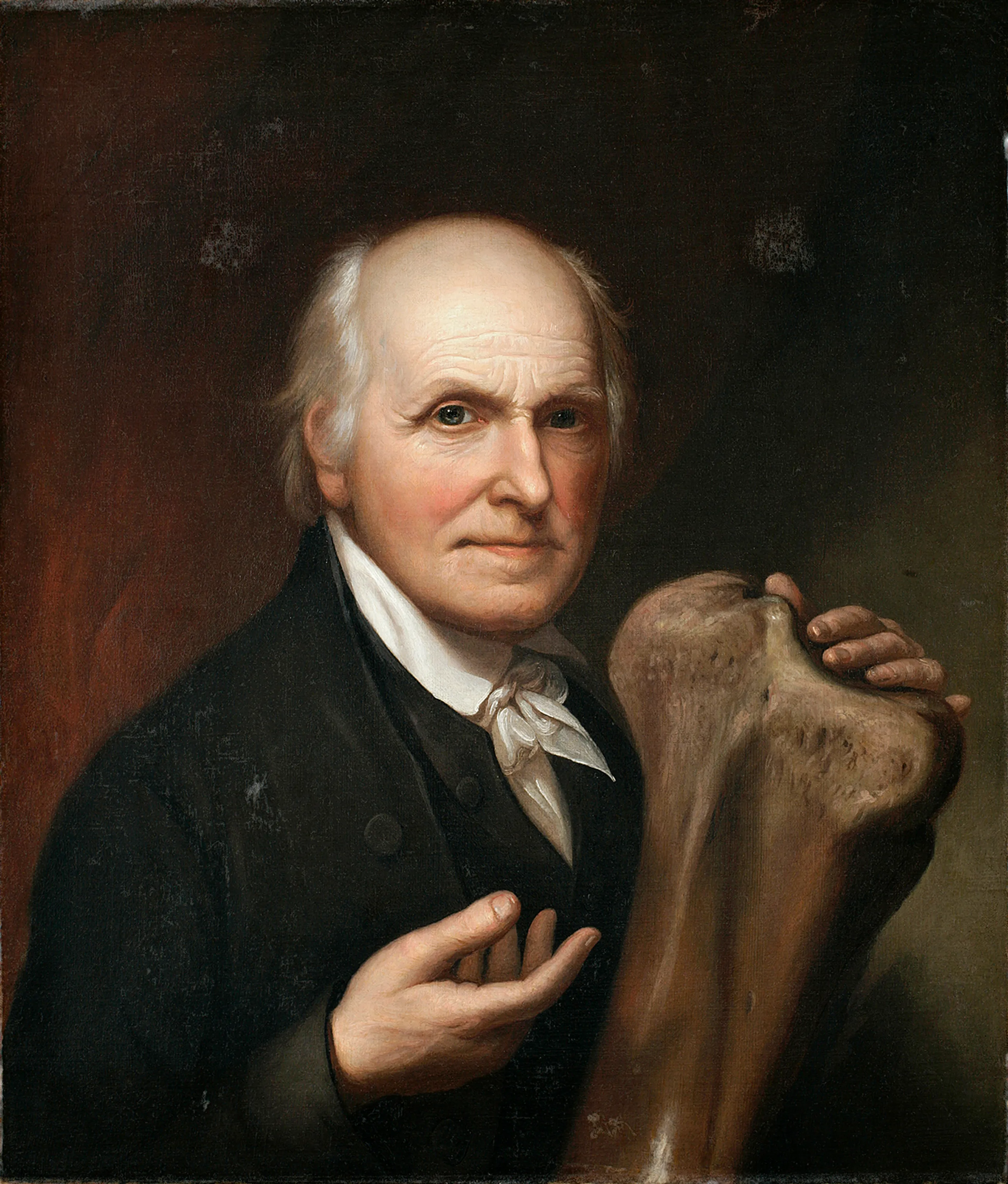
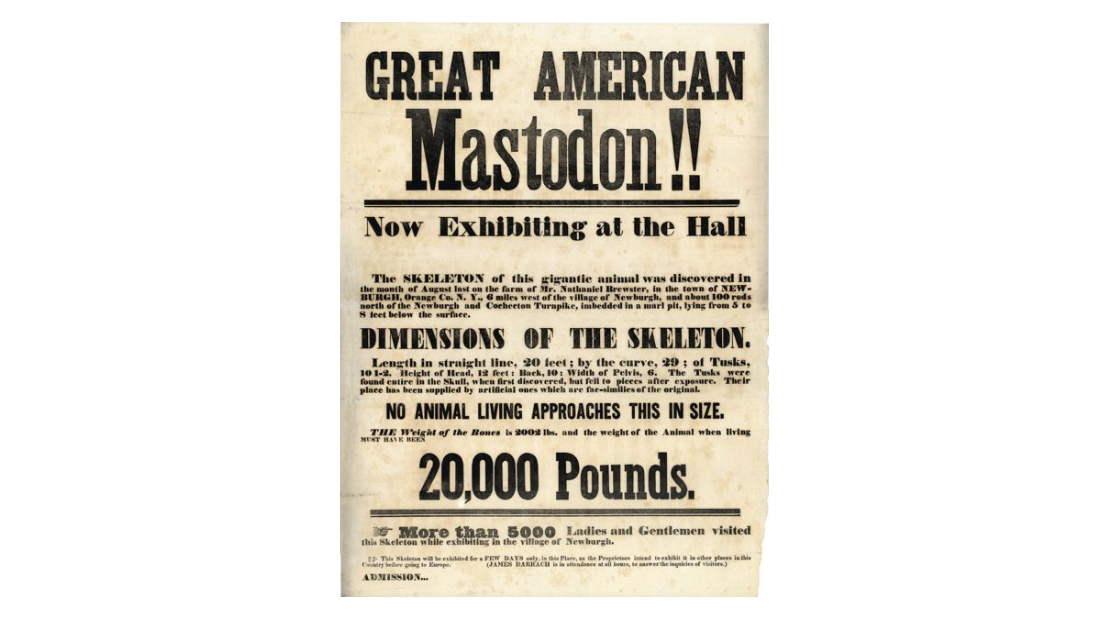
Peale wanted to give Philadelphia what he called an “Epitome of the World.” Peale’s Museum was born of the Revolution: a European model with democratic reach, an economic boon in the face of financial precarity. It displayed birds, mammals, insects, and more following Linnaean hierarchies. Yet it also exhibited more confounding curiosities. Friends donated specimens from their travels around the world—snakes, monkeys, antelopes—and the collection quickly outgrew his gallery on Lombard Street. In 1794, Peale rented space in the building recently erected for the American Philosophical Society adjacent to Independence Hall. On the backs of the wooden and glass cases that housed specimens, painted landscapes showcased different animal habitats. By the early 19th century, around 90 species of mammals, roughly 700 birds, and thousands of insects could be examined in the multiple rooms of the Philadelphia Museum. In 1801, the greatest curiosity of them all arrived: the mastodon. Discovered in 1798 on a farm in Newburgh, New York, the bones of a giant, elephant-like creature raised questions about extinction, North American life, and deep time. Peale excavated the bones and shipped them to Philadelphia for the pleasure of an awe-struck public. Later, he painted a tribute to his groundbreaking excavation, which he proudly hung in the Mammoth Room of the Museum, adjacent to one of the skeletons.
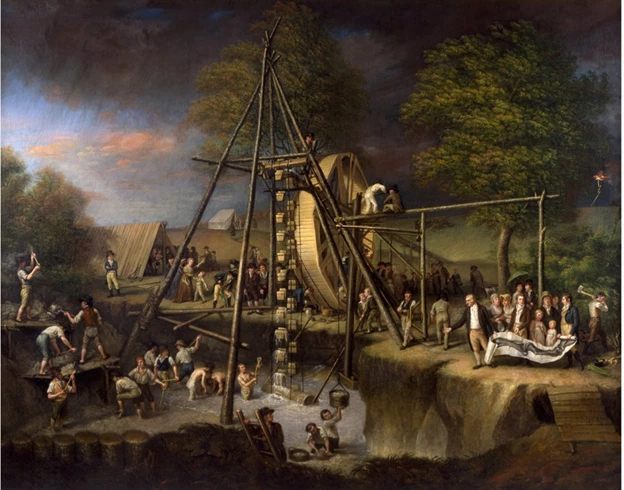
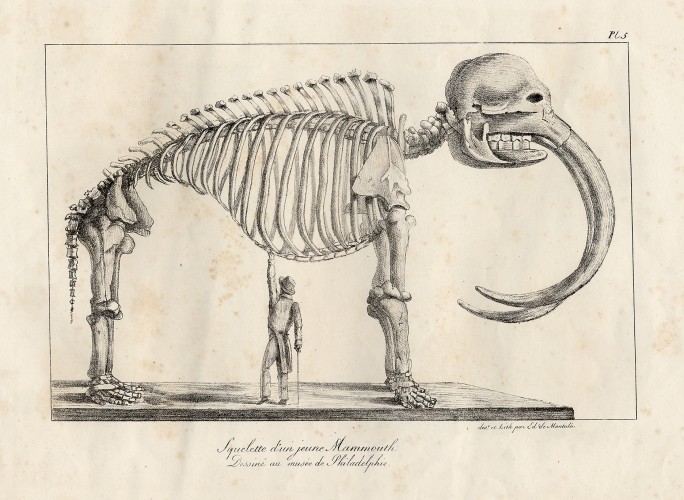
Peale painted the portrait of “New World” nature, embracing the old and the new—a new nation, a new science, but also an ancient past. He, along with Thomas Jefferson, challenged the slights of European naturalists, such as Georges-Louis Leclerc, Comte de Buffon, who asserted that the New World climate and environment produced smaller, weaker, and less healthy species. Lewis and Clark’s expedition out west (1804–06)—aided by Thomas Jefferson and others at the APS—gathered crucial evidence against Buffon’s theory. Jefferson gave Peale many fruits of this expedition, and Peale happily contributed once again to his decades-long mission of patriotic display. Buffon and others, they believed, would need to reckon with North America’s deep past and vibrant diversity. Deep time, as historian Caroline Winterer argues, was both discovered and invented in North America, a nationalist project that blended science, economic viability, and artistic depictions of new specimens and distant pasts on the North American continent. Indeed, Peale’s mastodon made for a convincing argument.
Peale kept his museum open into the evening, lit by candles and roused by a series of lectures. Those who worked during the day could spend their evening leisure time among nature’s curiosities, carefully gathered and curated by one of Philadelphia’s most celebrated painters. In 1802, the museum expanded into the State House, making museum attendance a much grander civic gesture than it had been in his Lombard Street studio. Technically, all were welcome to pay admission and peruse the museum’s collections. “If education is essential for obtaining happiness,” he argued, “—have not our daughters an equal right with our sons to our instruction? And if we consider what kind of education is most useful, we will find generally that which benefits our sons, may equally be serviceable to our daughters.” Women attended lectures and exhibits, they paid for the silhouette portrait concession at the museum, donated objects, and purchased annual tickets of admission. But the museum attendees, in truth, were primarily men. They were also almost exclusively white. Evidence of a few Native American attendees exists, but this was not the norm. In a public lecture, Peale referenced the museum’s stuffed orangutan, claiming that Black people stood closer to the ape than whites in the Linnaean hierarchy. The Philadelphia Museum was open to all, but only welcoming to some.
Several of Peale’s many children—including Raphaelle Peale (1774–1825), Rembrandt Peale (1778–1860), and Titian Peale (1799–1885)—followed in their father’s footsteps, attaining critical acclaim in portraiture, still life, and scientific illustration. Peale’s daughter, Sophonisba, had married the son of Nathan Sellers, a prominent man of industry and government in Philadelphia. The museum became a vast educational playground for his grandchildren. The young Escol Sellers was ecstatic when his uncles included him in an electrical show that used a wire, cork, and glass bottle. Nathan Sellers facetiously referred to Peale as a “show man,” but for Nathan’s and Charles’s grandchildren, as well as many other middle and upper-class children in Philadelphia, the museum became a unique site where science and art emulsified through display and performance.
In the 1790s, Peale had hoped to turn his museum into a national institution, but he was never able to secure federal support. Peale began to cede control of the museum after the move into the State House, and in 1810 he retired, giving control of the museum to his son, Rubens Peale. In 1814, Peale’s son Rembrandt opened a second Peale Museum in Baltimore. A third museum opened in New York in 1825, several years after the creation of the Philadelphia Museum Company. Peale’s ambition was imitated by others, including P.T. Barnum, who took the “wonders” and showmanship side of the Philadelphia Museum to new heights. Peale died in 1827, and by the 1840s, when Barnum opened his American Museum, competition led to dire straits. The Philadelphia Museum eventually ran out of money, exacerbated by the lingering effects of the Panic of 1837. Most of the natural history collection was sold to Barnum. The mastodon bones were shipped to Europe, eventually purchased for the Hessisches Landesmuseum Darmstadt in Germany, where visitors today can still make a trip to see Peale’s great mastodon.
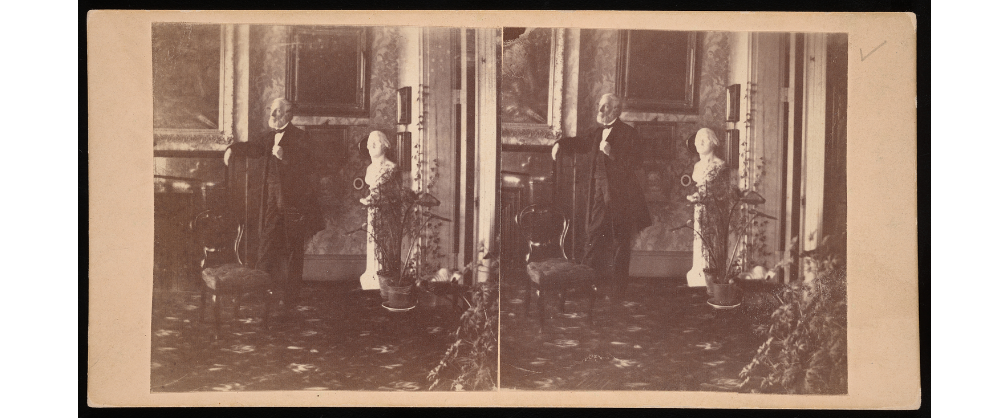
Even if not by Peale’s hands, the national museum dream indeed came true. James Smithson died in 1829, just two years after Peale. In an unexpected turn of events, the Englishman left his fortune to the U.S. government to found, “at Washington, under the name of the Smithsonian Institution, an Establishment for the increase & diffusion of knowledge among men.” In 1846, the same year Peale’s Museum had sold its collections, Congress did just that, led by the principles Peale had inculcated decades prior—democracy, civic education, and national purpose. Titian Peale, who was born in Philosophical Hall in Philadelphia, applied to the Smithsonian for a curatorial position, but only found disappointment. Instead, he accepted a job in the U.S. Patent Office, made a new life for himself in the capital on the Potomac, and explored the budding art and technology of photography. He took photos of his G Street home, Abraham Lincoln’s inauguration, and the nascent Washington landscape from atop the tower of the Smithsonian Institution, today the largest museum complex of art and science in the world.
References
Brigham, David R. Public Culture in the Early Republic: Peale’s Museum and Its Audience. Washington, D.C.: Smithsonian Institution Press, 1995.
Daston, Lorraine and Galison, Peter. Objectivity. New York: Zone Books, 2010.
Haifley, Julie Link. Titian Ramsay Peale, 1799–1885. Washington, D.C.: The Gelman Library, George Washington University, 1981.
Hart, Sidney and Ward, David C. “The Waning of an Enlightenment Ideal: Charles Willson Peale’s Philadelphia Museum, 1790–1820.” Journal of the Early Republic 8 (1988): 389–418.
Jones, Caroline A. and Galison, Peter, eds. Picturing Science, Producing Art. New York: Routledge, 1998.
Meyers, Amy R. W., ed. Knowing Nature: Art and Science in Philadelphia, 1740–1840. New Haven: Yale University Press, 2011.
Richardson, Edgar P., Hindle, Brooke, and Miller, Lillian B., eds. Charles Willson Peale and His World. New York: Harry N. Abrams, Inc., 1983.
Rigal, Laura. The American Manufactory: Art, Labor, and the World of Things in the Early Republic. Princeton: Princeton University Press, 1998.
Ross, Andrew B. “‘Gratified in the Sight’: Charles Willson Peale, the Philadelphia Museum, and the Object of Early American Happiness.” Early American Literature 54 (2019): 741–772.
Schofield, Robert E. “The Science Education of an Enlightened Entrepreneur: Charles Willson Peale and His Philadelphia Museum, 1784–1827.” American Studies 30 (1989): 21-40.
Smith, Pamela H. “Art, Science, and Visual Culture in Early Modern Europe.” Isis 97 (2006): 83–100.
“The Will of James Smithson.” https://www.sil.si.edu/Exhibitions/Smithson-to-Smithsonian/will.htm. Accessed December 15, 2025.
Vitiello, Dominic. Engineering Philadelphia: The Sellers Family and the Industrial Metropolis. Ithaca: Cornell University Press, 2013.
Winterer, Caroline. How the New World Became Old: The Deep Time Revolution in America. Princeton: Princeton University Press, 2024.