

The American Philosophical Society Announces Acquisition of the Lynn Margulis Papers


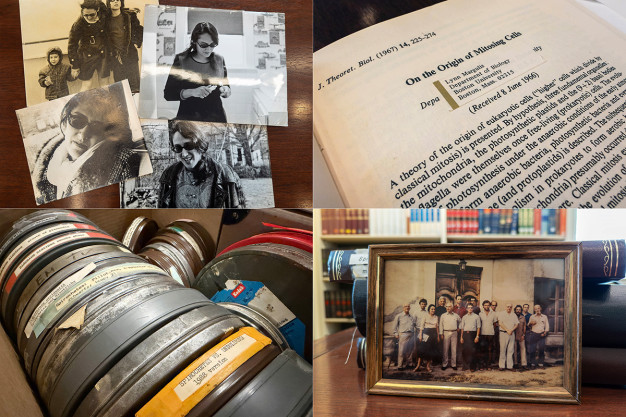
The American Philosophical Society (APS) is pleased to announce the acquisition of the papers of evolutionary biologist Lynn Margulis (1938–2011). Not fully recognized in her time, Margulis is now seen as the greatest challenger to Darwin since Darwin, and her work now resides alongside other scientific luminaries.
At over 300 linear feet, the collection is the largest acquisition made by the APS Library in 15 years and represents a significant moment for the APS’s Center for the History of Science (CHS). The collection chronicles the development of her once-radical ideas about evolution via symbiosis and cooperation rather than competition.
“Margulis’s thinking was singular and revolutionary,” said Adrianna Link, Curator of History of Science. “By housing her papers at the APS, we are both ensuring her scientific legacy and making it easier than ever for researchers to engage with her ideas—and to build on her work in the way we think honors her collaborative spirit.”
The Margulis Papers are a natural evolution of the Society’s holdings, which document over 300 years of scientific innovation in topics spanning from astronomy and zoology and include the works of individuals such as Benjamin Franklin, Lewis and Clark, and Charles Darwin. Among the collection is Margulis’s 1967 paper “On the origin of mitosing cells,” now considered a fundamental reconception of evolutionary biology, though it faced more than 15 rejections before its eventual publication. Since then, her research has influenced scientific thinking about everything from the inner-workings of the gut microbiome to the understanding of Earth as a self-regulating system to the search for life beyond our planet (an idea also explored by her first husband, astronomer Carl Sagan).
“Lynn Margulis saw what others missed. Her theory of symbiosis rewrote the story of evolution itself,” said David Gary, Associate Director of Collections. “We're honored to preserve the archive at the root of that insight, and we look forward to helping future generations of thinkers consider the world as a web of partnerships instead of continuous competition.”
Now safely housed at the APS archives, Margulis’s papers have journeyed far, even surviving a near-miss fire, to find their way to Philadelphia. One of the most compelling and understudied figures in the history of modern science, she left behind nearly 170 boxes of correspondence, photographs, research notes, writings, teaching materials, and audiovisual content—all of which is now available for study via the APS Library.
“My mom was beyond prolific,” said science writer and editor Jennifer Margulis, Margulis’s daughter and executrix of her estate, who is writing a book about her mother’s life and work. “Her letters and other papers show the astonishing breadth and depth of her knowledge of chemistry, biology, geology, atmospheric science, and systems thinking. This is a literal treasure trove of scientific information, and we couldn’t be more delighted that it will be housed at the American Philosophical Society.”
#
Press Contact
Grayson Morley
Communications Manager
[email protected]
215-701-4427