



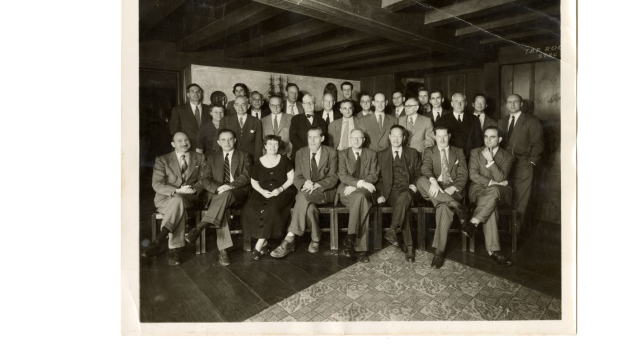
Photograph from the 10th Macy Conference on Cybernetics held in 1953. Freed is second from left in the second row.
Cybernetics, a precursor to contemporary artificial intelligence, was founded on the notion that human brains and machines work in similar ways. The Warren S. McCulloch Papers, held at the American Philosophical Society, record a key moment in the development of cybernetics: the Macy conferences, a series of 10 meetings held from 1946 to 1953. These conferences brought together scientists from across disciplines, including electrical engineering, psychology, psychiatry, physiology, neurology, mathematics, linguistics, and anthropology. The field of cybernetics emerged through the discussions held at these conferences and the work of its members.
I recently examined these archival materials as a graduate intern for the Center for Digital Scholarship at the APS working on a project about the history of AI. Although my own research interests lie in gender and sexuality in the history of science, I didn’t necessarily set out looking for a story about gender within this material. Instead, I began by doing network analysis, a method that charts relationships between individuals. By tracing networks of correspondence and collaboration, I hoped to visualize the interdisciplinary web of actors involved in cybernetics. As I read each document looking for names and figuring out the relationships, I came across many scientists who are well-known within the history of science or within their disciplines. Although most of the canonical figures in the history of cybernetics are men, there were a few notable women who participated in the Macy conferences, including anthropologist Margaret Mead and psychologist Molly R. Harrower. However, a lesser-known name caught my attention: Janet Freed.[1] As a secretary for the Macy Foundation, Freed is not often recognized as a key figure in the history of cybernetics. However, the slow and painstaking work of network analysis has the potential to bring marginal figures to the surface, and as her name popped up again and again, it became clear that Freed played a central role in the Macy conferences.
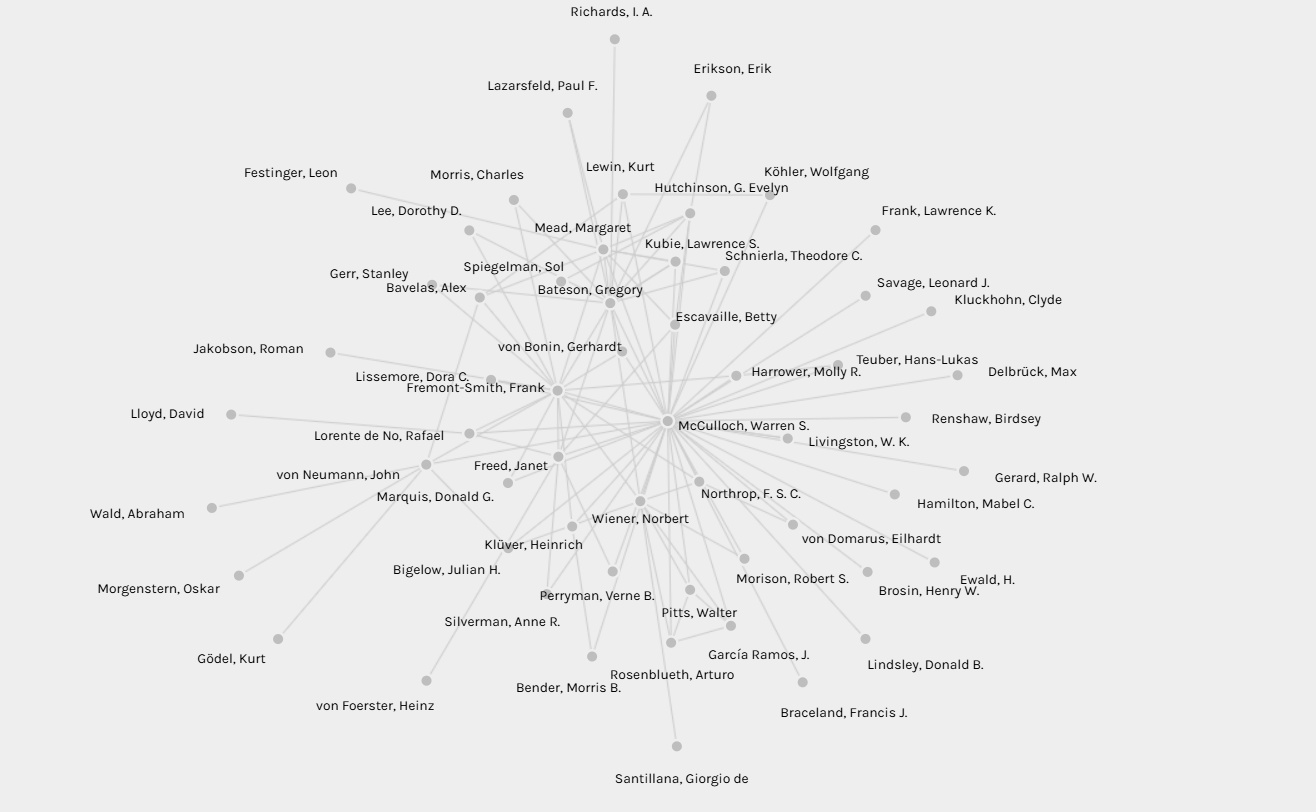
Recovering Freed’s labor and her contributions to cybernetics requires thorough archival research. If you search Freed’s name in the finding aid, you get no results. In the APS Digital Library, she appears in the metadata for only some of the folders with material relevant to her. For example, McCulloch’s correspondence with Frank Fremont-Smith, the medical director of the Macy Foundation, contains letters from Freed and several other women who worked for the Macy Foundation in clerical roles. However, only McCulloch and Fremont-Smith are currently included as subjects in the metadata, which makes these women much harder to locate in the archives. This omission within archival catalogs reflects a larger problem within the history of science: the work of secretaries (often women) is subsumed into the identity of the scientists they worked for (often men). This tendency obscures the crucial role of secretarial labor within the history of science, rendering many women’s contributions invisible in the process.
Freed contributed greatly to the Macy conferences and the establishment of cybernetics indeed. She was appointed to help Fremont-Smith with the Foundation’s conference program in 1946, the same year as the first Macy conference on cybernetics (which was then called the Conference on Feedback Mechanisms and Circular Causal Systems in Biology and the Social Sciences). As the Foundation formalized its conference program and decided to make conferences the core of its operations, Freed’s involvement in the conferences grew. She became the secretary to the conference program and later the assistant for the conference program. Her correspondence with McCulloch, who served as the chairman of the cybernetics conferences, and other conference participants reveals that she had a hand in all aspects of the conference logistics: scheduling, inviting guests, keeping track of who was planning to attend, circulating papers, overseeing procedures for recording and transcribing conferences, reimbursing conference expenses, and managing the process of editing the transactions of the conference. It may be tempting to draw a distinction between this secretarial labor and the scientific fruits of the Macy conferences. However, the development and formalization of cybernetics as a field, the key outcome of the Macy conferences, necessitated getting scientists from across disciplines together and creating the infrastructure to circulate research among them. Freed’s labor did just that. Thus, her work was integral to, not separate from, the scientific work of the Macy conferences.
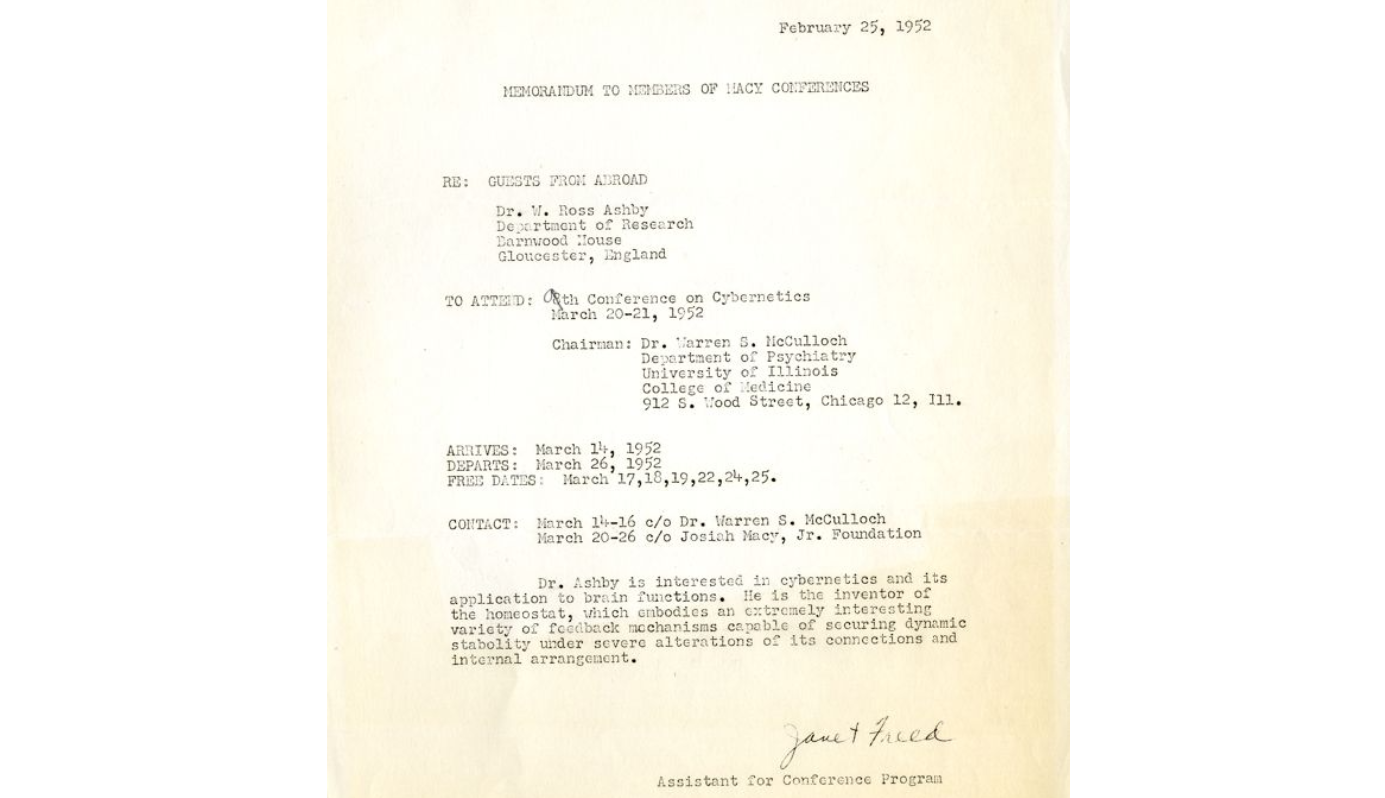
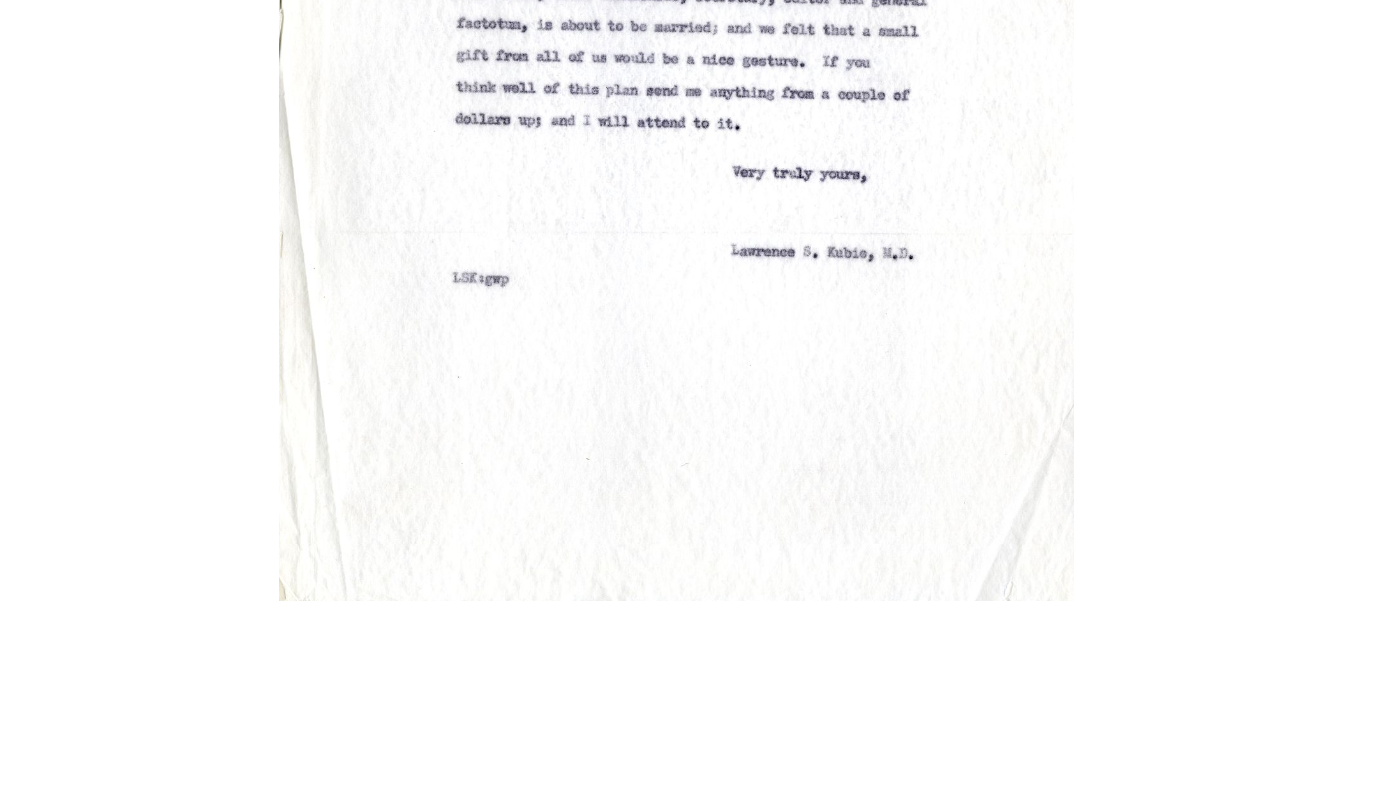
Conference participants remarked upon Freed’s integral involvement in the Macy conferences, often commenting on her skill. Heinz von Foerster, conference member and editor of the published transactions, referred to her as “a most remarkable lady stenographer” and marveled at her accuracy in transcribing the discussion at the sixth Macy conference, held in March 1949. Recording one of these conferences certainly could not have been an easy task. The meetings were lively, filled with interruptions and people talking over each other. Additionally, as one review of the published transactions pointed out, the discussion could be quite difficult to follow, as it required “comprehension of terms used by the psychologists on the one hand and physicists and electronic experts on the other.” Lawrence Kubie, a psychiatrist, psychoanalyst, and member of the cybernetics conference group, recognized her wide-ranging contributions, calling her “the amanuensis, secretary, editor, and general factotum” and the “guardian angel of so many Macy conferences.” At McCulloch’s suggestion, Kubie collected donations from members of the various conferences sponsored by the Macy Foundation as a wedding gift for Freed in 1953, a sign of their appreciation for and collegiality with her. The esteem conference members held for Freed seems to have been mutual; in her thank-you note to McCulloch for the wedding gift, she wrote, “I treasure my association with you all.”
Freed understood the ubiquitous yet under-acknowledged secretarial labor of science and subtly pushed back on the tendency to conflate the work of secretaries with that of their supervisors. On April 27, 1949, Fremont-Smith led a meeting with the chairmen and editors of the eight conference groups sponsored by the Macy Foundation. The meeting aimed to clarify and standardize procedures across the various conferences sponsored by the Foundation and gather advice for a booklet for the chairmen of five new conferences. The transcript of the meeting indicates that Freed had a major role in setting the agenda. In the meeting, Fremont-Smith noted that Freed called his attention to the responsibility and labor required of the chairmen. What follows, though, suggests that Freed was concerned not only with the labor of the chairmen but also their secretaries. Fremont-Smith cited “secretarial services,” like mimeographing, as an additional burden and expense chairmen assumed. He concluded, “If you will have to ask your secretary to work overtime there is no reason why there should not be appropriate compensation for that and we would like to ease the burden in so far as possible.” Later in the meeting, attendees had a lengthy discussion about the best way to include citations in the published transactions of the conferences. In a heated debate about what would be best for the authors, editors, and readers, Freed chimed in to say that checking the correctness of each reference should not fall on the editor, because then it would fall on his secretary, a time-consuming and costly endeavor. With her contributions to the meeting, Freed made clear that the work of the chairmen and editors—and the work of the Macy conferences altogether—was dependent on secretarial labor.
While her immediate audience was the scientists and doctors at that 1949 meeting (all of whom were men), Freed’s subtle insistence to recognize secretarial labor—women’s work—as the lifeblood of midcentury American science reverberates across the decades through the archives. We should heed her call.
[1] Janet Freed married in October 1953 and became Janet Lynch. However, since she changed her name after the final Macy conference on cybernetics, she appears as Janet Freed in almost all of the archival material. Therefore, I refer to her as Janet Freed throughout this blog post.