




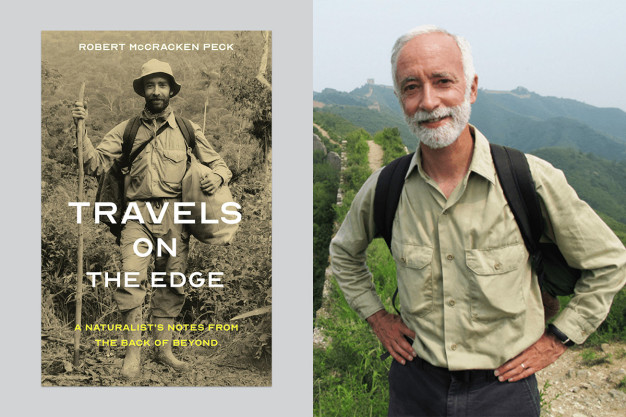
L–R: Travels on the Edge and its author, Robert McCracken Peck (APS 2022).
I was once invited to give a talk in London about some aquatic research that I had been conducting in Mongolia on behalf of the Academy of Natural Sciences of Philadelphia. My well-meaning host, more familiar with the world of finance than of natural science, introduced me as a “naturist.” My audience, already puzzled by the prospect of an aquatic lecture on a country with no marine coastline and better known for its Gobi Desert than its water resources, was well acquainted with the word used to describe me. They must have wondered why I had been conducting my research in the nude.
After thanking the assembled group for the opportunity to speak, I explained that I was not a naturist, but a naturalist, a term frequently used in the 19th century, but not so much today. It describes someone with a keen interest in and knowledge of the natural world. At a time when most scientists focus on specific areas of expertise—ornithology, mammalogy, botany, entomology, ichthyology, limnology, paleontology, etc.—there are few, if any, who still call themselves naturalists. Even fewer call themselves “amateurs,” as their predecessors once did, despite their love of the subjects they study. Before science became a profession, the title amateur-naturalist was considered the highest form of praise.
It is worth remembering that Charles Darwin, Alfred Russell Wallace, and Alexander von Humboldt, three of the best-known naturalists of the 19th century, were all amateurs. They had no formal training in the natural sciences, but they devoted their lives to the study of nature. Their insightful “amateur” observations helped to define the fields of nature study that would eventually grow more focused—and more professional (i.e., paid)—in the 20th century.
I have spent 50 years at the Academy of Natural Sciences of Philadelphia, an institution founded in 1812 by seven amateur-naturalists. Our founders believed that by sharing their libraries and collections and their love of different areas of natural history, they could accomplish more than by pursuing their passions in isolation. The enormous amount of work they did for the Academy—gathering, identifying, and caring for scientific specimens, creating public displays, and offering educational lectures—was entirely voluntary. It wasn’t until well into the 20th century that the Academy’s curators were actually given salaries. And yet, during its first century, the Academy became one of the country’s most important research institutions and assembled one of the world’s largest and most important collections of natural history objects (now totaling over 19 million specimens). None of this would have been possible without the hard work of amateurs.
As Fellow of the Academy, an intentionally vague title that allowed me to move among departments, I was frequently invited by the Academy’s scientists to join their research expeditions to some of the most remote parts of the world. I was expected to know enough about their respective areas of expertise to be helpful in the field, but also to know enough about other areas of study to fill the gaps in their expedition teams and make collections for unrepresented disciplines. I was, in short, an amateur-naturalist, in the old-fashioned sense of the term. In that role, I was fortunate to discover several new (previously undescribed) species of amphibians, insects, and fish. I would then explain the stories behind our research to the Academy’s members and to lay audiences across the country. As the “humanist” on staff, I provided a cultural context for each of the scientific expeditions our Academy undertook. I recount my experiences on these trips in my new book: Travels on the Edge, A Naturalist’s Notes From the Back of Beyond (APS Press, 2026).
I may have bathed without clothes in wild lakes and rivers while on our expeditions around the world, but I was never a naturist.