



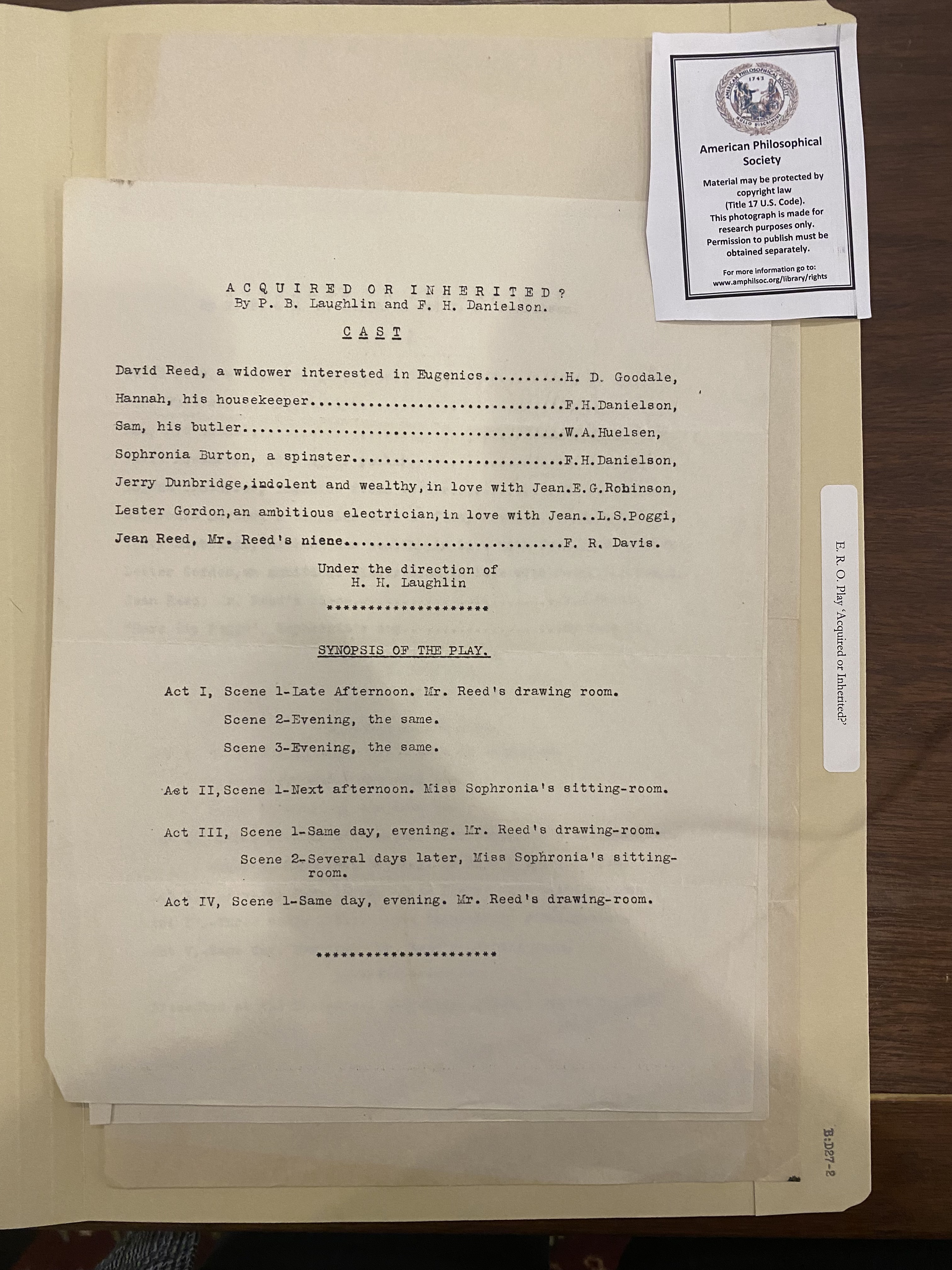
Header Image: Cast list for Acquired or Inherited, c. 1912. Charles Davenport Papers, B. D27, Series II: Cold Spring Harbor Series, APS.
Deep within the American Philosophical Society’s Charles Benedict Davenport Papers is a folder titled, “Play: Acquired or Inherited?” Open the folder and you will find four pieces of paper; three are cast lists for a production of the eponymous play, Acquired or Inherited?, two of which note productions at the Eugenics Record Office (ERO), where Davenport was its founding director until 1934. The final object in the folder is a small card, inviting the recipient to attend a performance by “The Record Office Dramatic Club” on February 3, 1912.
I first learned about Acquired or Inherited? from Tamsen Wolffs’ Mendel’s Theatre: Heredity, Eugenics, and Early Twentieth-Century American Drama. While working on my Ph.D. in Theatre and Performance Studies, I was captivated by how Wolff drew connecting threads between eugenicists’ study of how genetic inheritance shaped the physical body with early 20th-century playwrights’ exploration of tensions between hidden and visible truths. The fact that, as Acquired or Inherited? demonstrates, eugenicists were also interested in stage performances fueled my interest in how eugenicists used public presentations of their work to build scientific credibility.
Wolff is not the only scholar who has observed eugenicists’ and dramatists’ overlapping interests. Kirsten Shepherd’s Theatre and Evolution from Ibsen to Beckett examines how turn-of-the-century European playwrights drew on Galtonian ideas of human evolution. And in Nicole Hahn Rafter’s White Trash: The Eugenic Family Studies: 1877-1919, she compares eugenicists’ publications to theatrical melodramas where “the villain is very bad, the victim innocent, the solutions clear” (1). Across genres, eugenics rhetoric offered a vehicle to express anxieties about the future: who will produce the next generation? At the same time, eugenics-as-performance raises questions about how these public presentations of eugenic ideas further propagated racist, sexist, and ableist images of who was not “fit” to reproduce.
Acquired or Inherited? differs from contemporaneously written theatrical works that invoked eugenics or genealogical publications from eugenicists. For one, the play was performed at the ERO, a repository for hereditary data and the only research institution in the U.S. dedicated to studying eugenics. For the two cast lists that are dated, Acquired or Inherited? was performed during the summer training program, where students learned to conduct the field work necessary to collect family histories. Eugenicists-in-training attended lectures on human heredity and were taught how to conduct mental acuity tests. They also had regular field trips to nearby institutions like Ellis Island’s processing center for incoming immigrants and Kings State Park Hospitals, a local mental institution, to visually identify the traits they were learning about in the classroom and in the laboratory. And like a true summer camp, students sailed to local islands, gathered for clambakes, and produced a magazine invoking inside jokes among participants (2). For these productions of Acquired or Inherited?, the play was another stage for students to engage with eugenics alongside their peers.
When I initially arrived at the American Philosophical Society in 2021, I was excited to see what else I could learn about Acquired or Inherited? and was admittedly disappointed that all that was extant was an anemic folder. There was no script, no playbill, and no newspaper reviews—none of the documents that I, as a theatre historian, was hoping to find. I had only one week at the APS and assumed that I would find more information about the play as I visited other archives. But I didn’t. Now, with my dissertation finished and I am looking towards my forthcoming book project, I returned to the APS this year as a short-term fellow with no new information about this play, but with a much better understanding of what kinds of information can be extracted from these documents.
First cast list: unknown
The first cast list in the series does not note when or where Acquired or Inherited? was performed or what it was about. What it does say is the characters were David Reed, a widower interested in Eugenics, his niece, two suitors for his niece, Reed’s housekeeper, his butler, and a spinster named Sophronia. The cast list also notes that the play took place in Reed’s drawing room and Sophronia’s sitting room—indicating that there were set changes, but not terribly labor-intensive ones since the rooms were likely similar.
The cast list also reveals that Acquired or Inherited? was written by Pansy Laughlin, the wife of ERO superintendent Harry Laughlin, and Florence Danielson, an ERO field worker and a member of the first eugenics training class in 1910. The cast list also notes that Harry Laughlin directed this production, so this was clearly an in-house affair. This is further shown by the fact that the actors were cast from the ERO’s staff. Danielson, for instance, took on the role of the housekeeper. David’s niece, Jean, was played by ERO archivist Florence Reed Davis and Louis Poggi, a clerk, played one of her suitors, Lester Gordon. Walter Huelsen, a stenographer, took on the role of Sam, David’s butler, while Hubert Dana Goodale, a visiting researcher at the Station for Experimental Evolution (which shared a director and a campus with the ERO), played the lead role of David. Because Goodale was only visiting Cold Spring Harbor for a limited time, his involvement places the date of this production from between 1911 and 1912. Goodale was also included in the second cast list in the series, dated to August 1912. The cast was drawn solely from staff members at the ERO and so it is possible that this production was the one referenced in the invitation card on February 3, 1912.
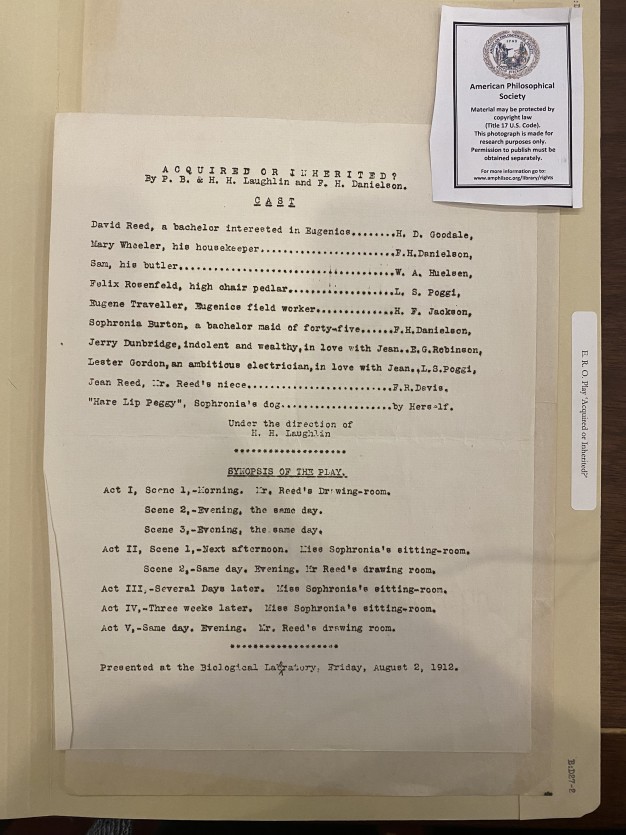
Second cast list: August 2, 1912
The second cast list in the folder gives us a definite performance date: August 2, 1912. The summer training program ran from early July to mid-August, placing the performance towards the end of the course. And since the first cast list, some significant changes had been made. Primarily, a whole new act has been added. Act IV now takes place three weeks after Act III, marking a much larger passage of time in the play. Harry Laughlin seems to be the reason for this change, because he now has a writing credit alongside his wife and Danielson.
Much of the cast remains the same, but there are a few more characters added to this production. For one, there’s a eugenics field worker by the name of Eugene Traveller (Eugene is played by H. F. Jackson who, like E. G. Robinson in this and the previous cast list, I could not find a record of). The name, “Eugene Traveller,” is clearly a reference to how eugenics field workers often traveled to conduct their research. For example, for much of 1912, Danielson was paid $85 a month to do field work in Jamaica. Other researchers were closer by, like Mary Sturges who was based at Head Harbor Island in Maine.
There is also a dog included in the cast list with the name “Hare Lip Peggy.” It is unclear what role the dog played in the production, but its name points to a visible sign of difference. A harelip, or cleft lip as it is more commonly referred to today, is a congenital separation in the mouth’s upper lip. Because cleft lip was a hereditary trait, it was a part of the ERO’s research agenda. At the time of this production of Acquired or Inherited?, William Blades was conducting a study on the inheritance of “hare-lip.” The name, and likely the performance, connected the character with the students’ study of hereditary science and their learning to catalogue physical difference.
Another instance where visible difference was likely a key part of the plot is in the new character, Felix Rosenfeld, a “high chair pedlar.” The overtly Jewish name paired with a well-known racialized archetype raises questions about how this character was performed. At this point in American history, vaudeville and variety sketch were the most popular form of theatre. These styles often drew on ethnic stereotypes. Like blackface minstrelsy, another mainstay on the vaudeville circuit, ethnic parody emphasized characters’ physical differences with performers using exaggerated accents, makeup, and props to play up the joke. The second cast list does not reveal how the actor playing Rosenfeld interpreted the character—maybe it was a nuanced portrayal of Jewish identity—but within the context of the ERO, it seems reasonable to speculate the actor would have drawn on other contemporary performances that mocked Jewish accents, religious rituals, and anatomy (3). Like “Hare Lip Peggy,” the character of Felix Rosenfeld joined the students’ study of racial(ized) traits to the performance.
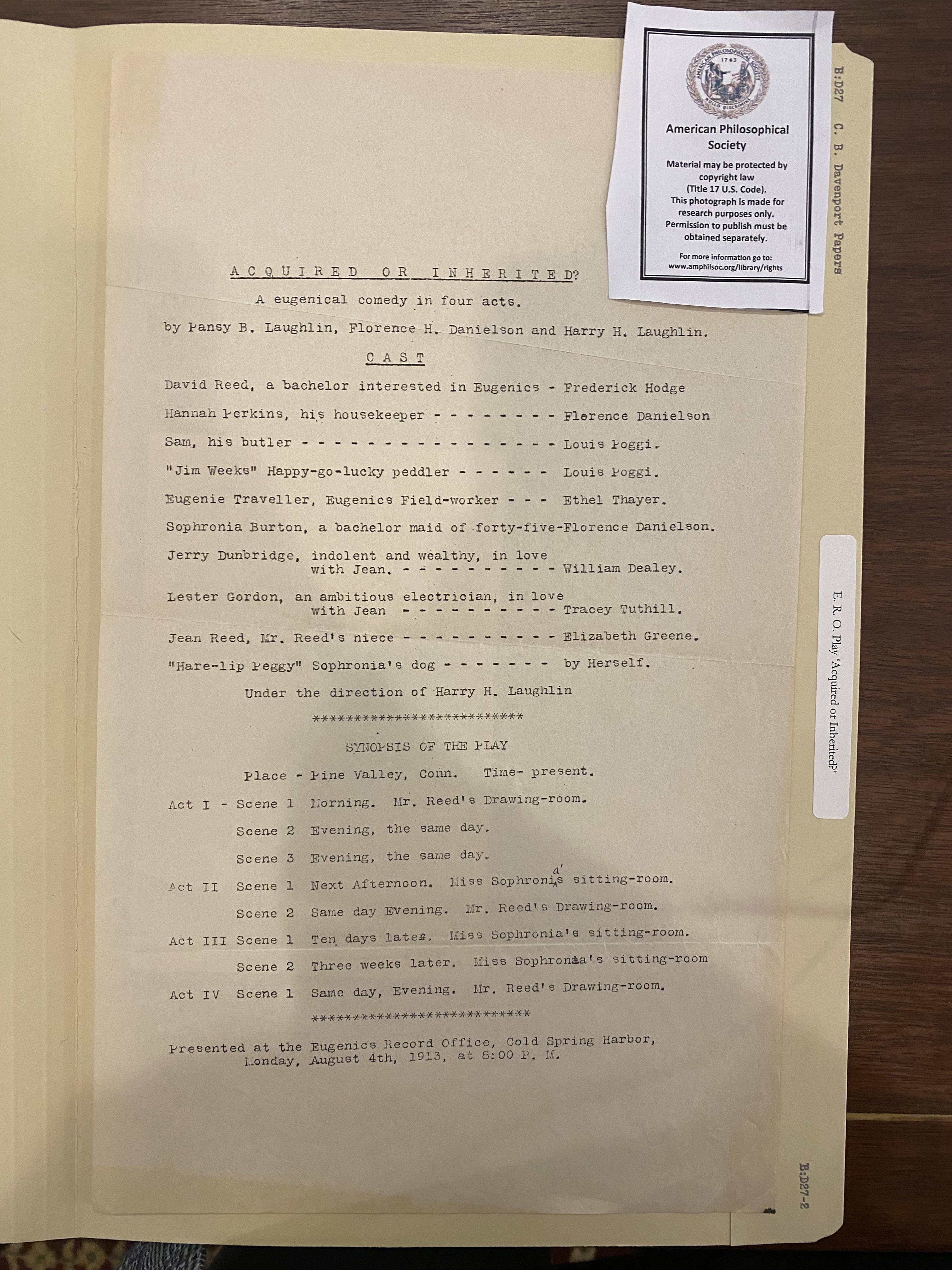
Third cast list: August 4, 1913
With the third cast list in the folder, there are few changes to the characters and synopsis. For this August 4, 1913 production, the world of the play is specified as taking place in Pine Valley, Connecticut. Felix Rosenfeld has been replaced with Jim Weeks, who is similarly described as a “Happy-go-lucky peddler.” Eugene Traveller has become Eugenie, played by Ethel Thayer, reflecting the growing number of women coming the ERO to learn eugenics. Thayer, like other new cast members such as Elizabeth Greene (playing Jean Reed), Frederick Hodge (playing David Reed), Tracey Tuthill (playing Lester Gordon), and William Dealy (playing Jerry Dunbridge), were all students in the 1913 ERO training class.
With students of the 1913 ERO training class included in the production, Acquired or Inherited? took on a new pedagogical aim. With students on stage, especially as Eugenie Traveller, they had to perform eugenic research for their spectator-peers. As they are being trained to go out into the field and interview families, physicians, and local genealogists, students on stage at the ERO are not just watching a simulacrum of their research but rehearsing what their performance of eugenic science will look like in future field work. In theatrical performance, students learned how to follow a script to conduct their research, preparing them to improvise interactions with subjects in the field.
Even without a full script, much can be gleaned from the skinny “Play: Acquired or Inherited?” folder. And yet, there are many questions left unanswered. What role did Eugene/Eugenie play in facilitating Jean’s marriage? How did the comedic figures shape the story’s narrative? What physical differences were made visible using props, costumes, make up, and gestures? And why did the ERO stop performing the play (or stop saving cast lists) after 1913? While this folder only gives a small glimpse into this fascinating moment of eugenics history, it shows how eugenicists were thinking about their work as something worth being celebrated on the stage.
References
- Nicole Hahn Rafter, White Trash: The Eugenic Family Studies: 1877-1919 (Northeastern University Press, 1988), 29.
- Cold Spring Harbor Song Book,” n.d. Waclaw T. Szybalski Collection. Cold Spring Harbor Laboratory Archives. In addition to the song book referenced, the students’ annual magazine “The Hooper Up” describes the boat trips and their love for clambakes. Charles Davenport’s daughter, Jane, was a regular contributor and illustrator. See “The Hooper Up,” The Brooklyn Institute of Arts and Sciences–Biological Laboratory Collection, Cold Spring Harbor Laboratory Archives.
- For more information about Jewish stereotypes during this time, see Harley Erdman, Staging the Jew: The Performance of an American Ethnicity, 1860-1920 (Rutgers University Press, 1997), 114-143. For a longer history of Jews on the American stage, see Heather Nathans, Hideous Characters and Beautiful Pagans Performing Jewish Identity on the Antebellum American Stage (University of Michigan Press, 2017).