




“By happy and spectacular coincidence the first great discovery in underwater archaeology yielded not only a fine collection of art treasures but also the most enigmatic, most complicated piece of scientific machinery known from antiquity. This singular artifact is now identified as an astronomical or calendrical calculating device involving a very sophisticated arrangement of more than thirty gear-wheels. It transcends all that we had previously known from textual and literary sources and may involve a completely new appraisal of the scientific technology of the Hellenistic period.”
Thus begins one of the most thrilling texts in the APS Press backlist, Derek De Solla Price’s 1974 monograph Gears from the Greeks: The Antikythera Mechanism. It is a history of the first major underwater archaeological excavation and a study of the most important and misunderstood objects salvaged from that site. It is, ultimately, a work which forces us to radically revise our understanding of engineering in the ancient world.
In spring of 1900, a wreck was discovered by a crew of sponge-divers plying their trade in the strait between the islands of Kythera and Crete, a major ancient shipping route. At a depth between 140 and 180 feet, one of the divers discovered a sunken ship loaded with bronze and marble statues. He dislodged a larger-than-life bronze arm from the compacted mass, swam to the surface, and delivered the news to his captain. The crew marked the spot and reported their find to the Greek government, which hired the divers to excavate as much of the wreck as they could, sending a navy ship loaded with engineers and archaeologists to assist and supervise.
The work was extremely dangerous, taking place at a depth that would be hazardous even for skilled divers today, and was even moreso 40 years before the invention of the aqualung. At least one diver died and two others were permanently disabled by the bends during the year-long project, as newspapers breathlessly covered the surfacing of lost treasures. These included a shockingly well-preserved bronze nude, numerous other artworks in bronze and marble, fragments of pottery and glass, and the fine-toothed gears of the Antikythera Mechanism.
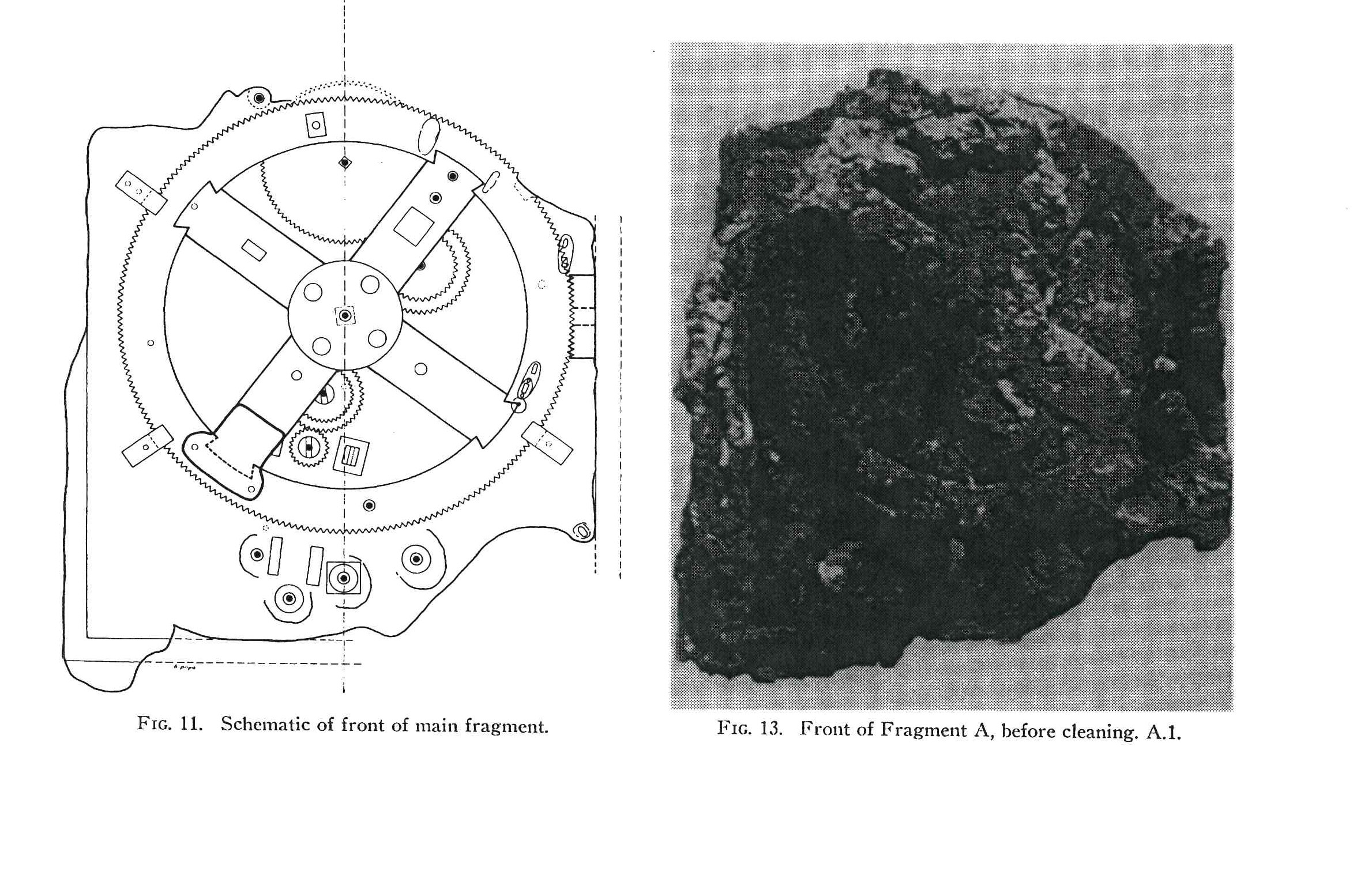
As the objects from the wreck were cleaned and restored at the Greek Archaeological Museum, controversy emerged around a set of about thirty gears and plates that seemed to have once been held in a wooden frame. The technology involved in these gears was so precise, so advanced, and so unprecedented that some experts tried to explain them away by claiming they came from a later wreck in the same place and had been misdated. Price vehemently rejects this conclusion:
“There were some only too ready to believe that the complexity of the device and its mechanical sophistication put it so far beyond the scope of Hellenistic technology that it could only have been designed and created by alien astronauts coming from outer space and visiting our civilization. Needless to say—or perhaps it is not—though I sympathize with the shock one may feel at revising upwards the estimation of Hellenistic technology, I cannot agree with any so radical interpretation. I feel that the whole story of Greek science makes a great deal more sense if we assume that the old view of their rising no higher than the simple Heronic devises was a drastic underestimation that can now be corrected.”
After studying grainy photographs of the gears for years, Price was able to visit Athens on a grant (his funders included the APS) to work with them in-person. There, he used gamma-radiographs and x-rays to produce incredibly precise images which could show him more than the naked human eye. He was finally able to reconstruct a model of the whole mechanism by first calculating the radius and pitch of each gear, then deducing from these calculations how they must have fit together in a single, complete device. He found that, when combined, they must have come together to form a piece of machinery more complex than anything in the known archaeological or written record from the period:
“Wheels from carriages and carts survive from deep antiquity, but there is absolutely nothing but the Antikythera fragments that looks anything like a fine gear wheel or small piece of mechanism. Indeed the evidence for scientific instruments and fine mechanical objects is so scant that it is often thought that the Greeks had none.”
But what is the device itself? Why was it built and what was it for? Price calls it “a calendar computer,” a mechanical device that could be used to predict the phases of the moon, the positions of the major stars and known planets, and even the dates of eclipses decades in advance. It is the oldest such calculating mechanism still extant, and according to Price’s (contested) interpretation at least, it even features an ingenious device called a “differential gear” that would not appear again in the West until 1575.
Price briefly entertains the notion that the Antikythera Mechanism may have been constructed in Syracuse by Archimedes himself, though he ultimately decides that it was more likely “an anonymous mechanician of Rhodes,” an ingenious craftsman whose name has been lost to time. Perhaps it is enough that his achievement has at last been recognized, though his contribution to the history of science is still only beginning to be understood.
If news of this backlist title interests you and you want to learn from recent scholarship on the Antikythera Mechanism, check out work by APS Member Alexander Jones (APS 1998), A Portable Cosmos: Revealing the Antikythera Mechanism, Scientific Wonder of the Ancient World (Oxford 2017), and his talk at the APS Meeting in November 2017 on "Like Opening a Pyramid and Finding an Atomic Bomb: Derek de Solla Price and the Antikythera Mechanism."