



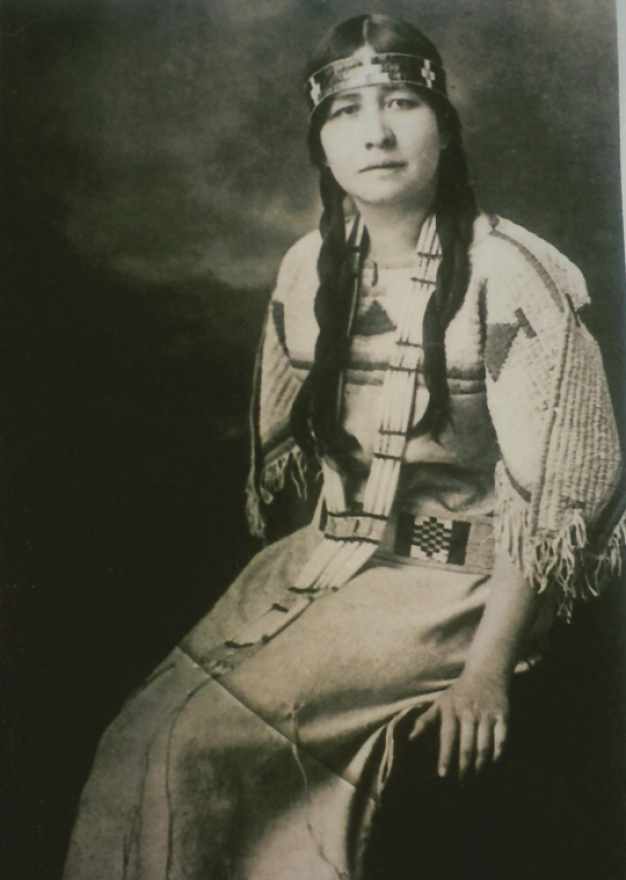
Header image: Ella Deloria, Courtesy of Dakota Indian Foundation, via Philip J. Deloria.
As the curatorial intern at the American Philosophical Society Museum, most of my work involved archival research for our upcoming exhibit in 2027. This exhibit will be centered around the Center for Native American Indigenous Research (CNAIR) collections at the APS.
As the exhibit is still in development, one of our early goals was to develop an understanding of the breadth of these collections, and how Indigenous communities and scholars were using CNAIR collections in the present. Another major goal was to look at our historical collections from a modern, critical perspective, considering not just what was in our collections but who was represented in the collections, and why. In order to build out context about these materials, I decided to try and focus on the individual stories of various scholars. This led me to the story of Ella Cara Deloria.
Ella Deloria was a Dakota-Sioux anthropologist born in 1889. Her story stood out to me because she was one of few Indigenous anthropologists represented in our collections from the early 20th century. While studying at Teachers’ College at Columbia, anthropologist Franz Boas hired her to work with his students in a linguistics course because of her ability to speak Dakota. Boas and Deloria worked together till Boas’ sudden death in 1942. Deloria and Boas had a complex relationship. On the one hand, in much of her correspondence Deloria mentions how useful Boas’ support had been in establishing her career. However, financial hardship was a constant specter in Deloria’s life. She relied heavily on financial support from Boas and academic institutions for her anthropological research work to care for an extensive family, but was often unfairly compensated for her labor.
Time and time again, Deloria was faced with impossible contradictions as a result of the interplay between her research and cultural background. Her experience as a member of the Dakota Sioux gave her a unique perspective while conducting her research, but also left her vulnerable to exploitation by non-Indigenous anthropologists.
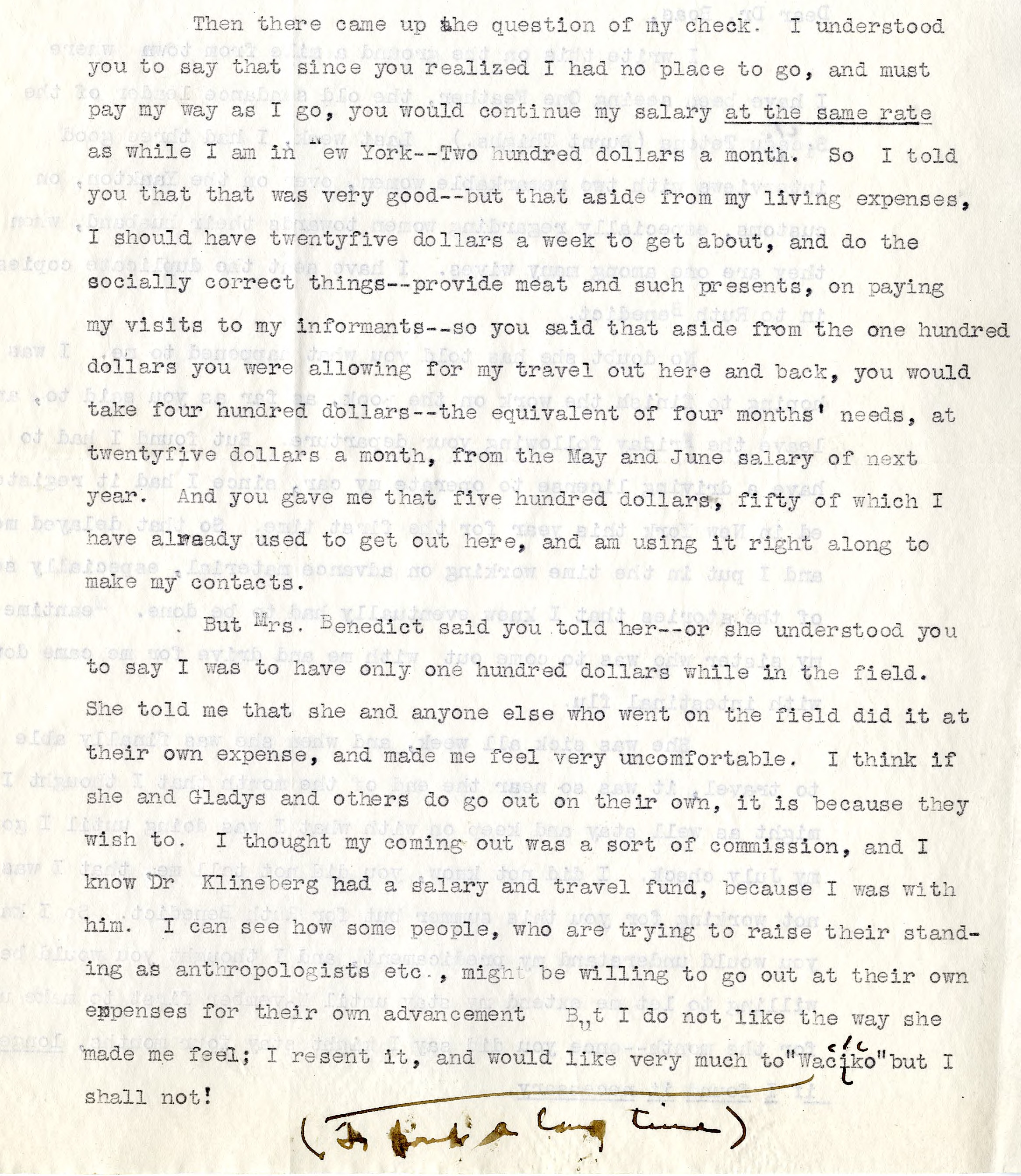
In a July 1932 letter to Boas, Deloria expresses her frustration with these contradictions. She describes a conflict with anthropologist Ruth Benedict regarding her pay, where Benedict wanted to pay her half her usual rate under Boas. The proposed amount of $100 a month was not nearly sufficient to cover the costs of field work, as Deloria found it important to always bring traditional gifts to those she worked with, to make them feel safe talking to her about their culture. This disagreement with Benedict also exemplified to Deloria the instability of her work as an anthropologist. While Boas supported her and tried to understand her needs, others would not.
The story of Ella Deloria was indicative of many larger patterns and forces affecting the field of anthropology. In her time, she was not afforded the same privileges as her non-Indigenous peers in the field and dealt with extraordinary adversity. However, in the present there have been many efforts across disciplines to shed light on such stories, including our upcoming exhibit at the APS.