



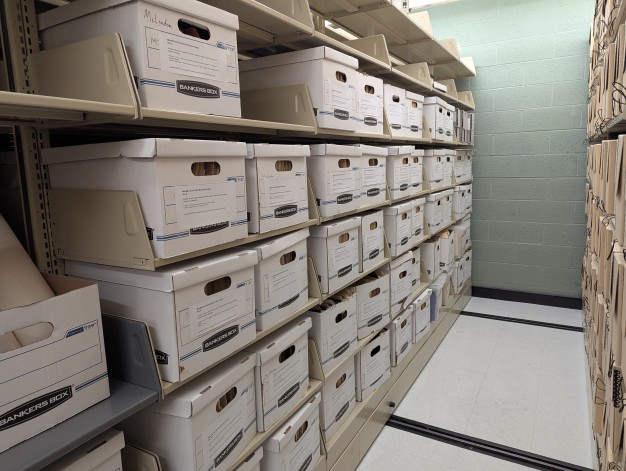
McLendon Collection housed in banker’s boxes.
CNAIR recently finished the initial survey of a major new collection donated by the family of Sally McLendon in November 2024. Although complete processing and description will take years, the collection is now open to intrepid researchers. Totalling an estimated 70 linear feet, and currently housed in 51 banker's boxes, this collection is large in both size and scope. (A new addition to the collection, totaling another 30 linear feet, arrived at the end of 2025 and will be surveyed soon.)
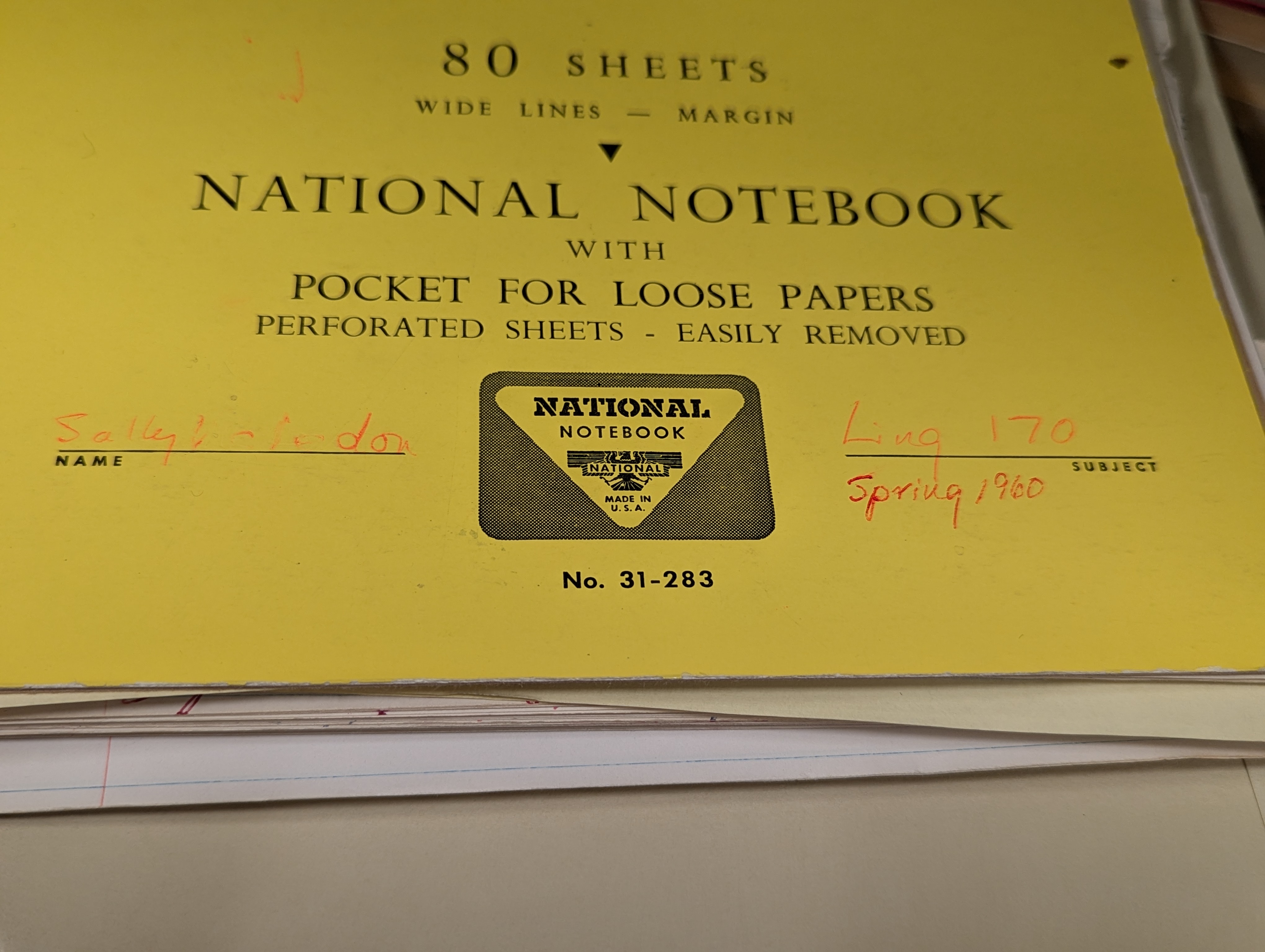
McLendon was a linguist and anthropologist who spent most of her career working with Pomo communities around Clear Lake in Northern California. She did extensive documentation of several Pomoan languages, especially Eastern Pomo, including audio recordings and written data. However, you will find almost no Pomo language materials in the collection at the APS. Instead, the materials we have accessioned include thousands of slides and photographs, mostly of Pomo baskets and the artists who created them; voluminous research about Pomo basketry conducted in preparation for several museum exhibits; correspondence between McLendon and her colleagues; photocopies and printed versions of works by other scholars; and notes and materials from courses and conferences McLendon attended throughout her career.
McLendon's Pomo language materials are housed 3,000 miles away, at UC Berkeley's California Language Archive (CLA), a specialized archive of language documentation materials affiliated with the Linguistics Department at UC Berkeley. In 2024, CLA Manager Zachary O'Hagan visited McLendon’s apartment, identified all of the language materials, and carried or shipped them to the CLA. McLendon began working with Pomo communities while she completed her Ph.D. in linguistics at UC Berkeley, so it's appropriate for her Pomo language materials to return to that campus. But more importantly, the CLA is only 130 miles from Upper Lake, California, where descendants of the speakers McLendon worked with still live. The recordings, field notes, and other language materials McLendon collected which are now housed at the CLA will be used by Pomo communities to strengthen their languages, and having access to those materials within driving distance is critical.
Of course, many of the materials from McLendon's work which are now housed at the APS, such as the basketry photos and research, are also of great interest and importance to Pomo communities. So why are they here at the APS, rather than at the CLA? In part, this splitting of the collection came about to accord with the dual interests of honoring McLendon’s wish to have her materials archived at the APS, where the papers of her teacher, Mary Haas, are also housed, along with the strong interest in having the Pomo language materials be geographically close to Pomo communities.
Another factor is that the CLA is a smaller archive and simply doesn't have space for 70+ banker's boxes of papers and photos. While this is a large collection even by APS standards, we are able to accommodate it. But space isn't the only consideration.
The CLA is a specialized archive of language documentation. It focuses on collecting, protecting, and making accessible the recordings, notes, and other materials created by researchers seeking to document a language that is underdescribed and possibly facing pressures that could lead to language loss. It is essentially an archive of a specialized kind of linguistic heritage. There are a number of these endangered language documentation archives around the world, including AILLA, PARADISEC, and ELAR.
The APS is a different kind of archive to this. Firstly, we have a much broader topical scope, with collections representing three major areas of inquiry — Early American History, History of Science, and Indigenous Languages and Cultures. Within these core collecting areas, the kinds of materials we accept from a depositor is fairly comprehensive. While our Indigenous collections often contain linguistic data created as part of language documentation, such as the Floyd Lounsbury Papers, William Bright Papers, and Franz Boas Papers, those materials are generally part of a larger collection that represents the complete scholarly or professional work of the individual who created them. We say we take 'the papers of' a person, not only the scholarly data they produced. In this way, these collections can also be used to research and understand the full range of that person’s professional life, and sometimes more than that. People researching topics of great significance to Indigenous communities other than linguistics regularly use these kinds of additional kinds of materials, and historians depend upon them to create fuller pictures of the whole life of the person and their thinking, as well as that of many of the people with whom they worked.
For these reasons — space, archival scope, and the needs of the Eastern Pomo community — the best solution for the papers of Sally McLendon was to split the collection between these two archives. We have a close relationship with the CLA, and frequently refer researchers working here to them, just as they direct people towards us. We are excited to share the care of these important materials with them.
If you are interested in doing research in the APS McLendon collection, please contact us at [email protected].