Anatomy in parts: Describing Anatomie pathologique du corps humain by Jean Cruveilhier




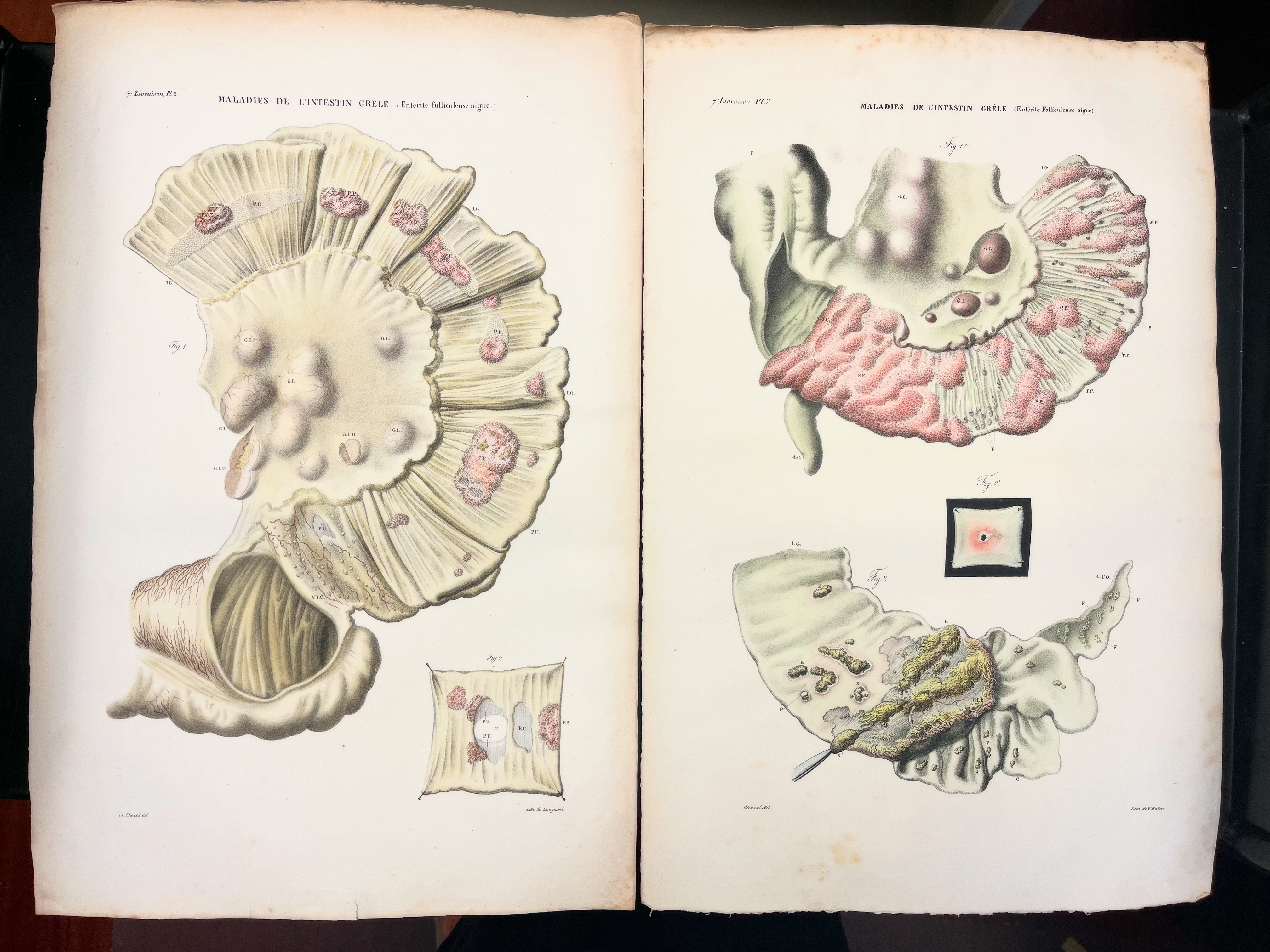
Every so often, a book that “has it all” appears on the cataloger’s cart. A recent example is Anatomie pathologique du corps humain… by Jean Cruveilhier, presented by James and Jenette Wheeler to the APS in 2022. The two-volume anatomical atlas of pathology contains 233 beautifully illustrated and colored lithographic plates by Antoine Chazal, a renowned painter and illustrator of the 19th century. Cruveilhier was an accomplished pathologist possessing a comprehensive knowledge of morbid anatomy. He was the first to describe the lesions which are associated with multiple sclerosis, one example among many contained within Anatomie pathologique.
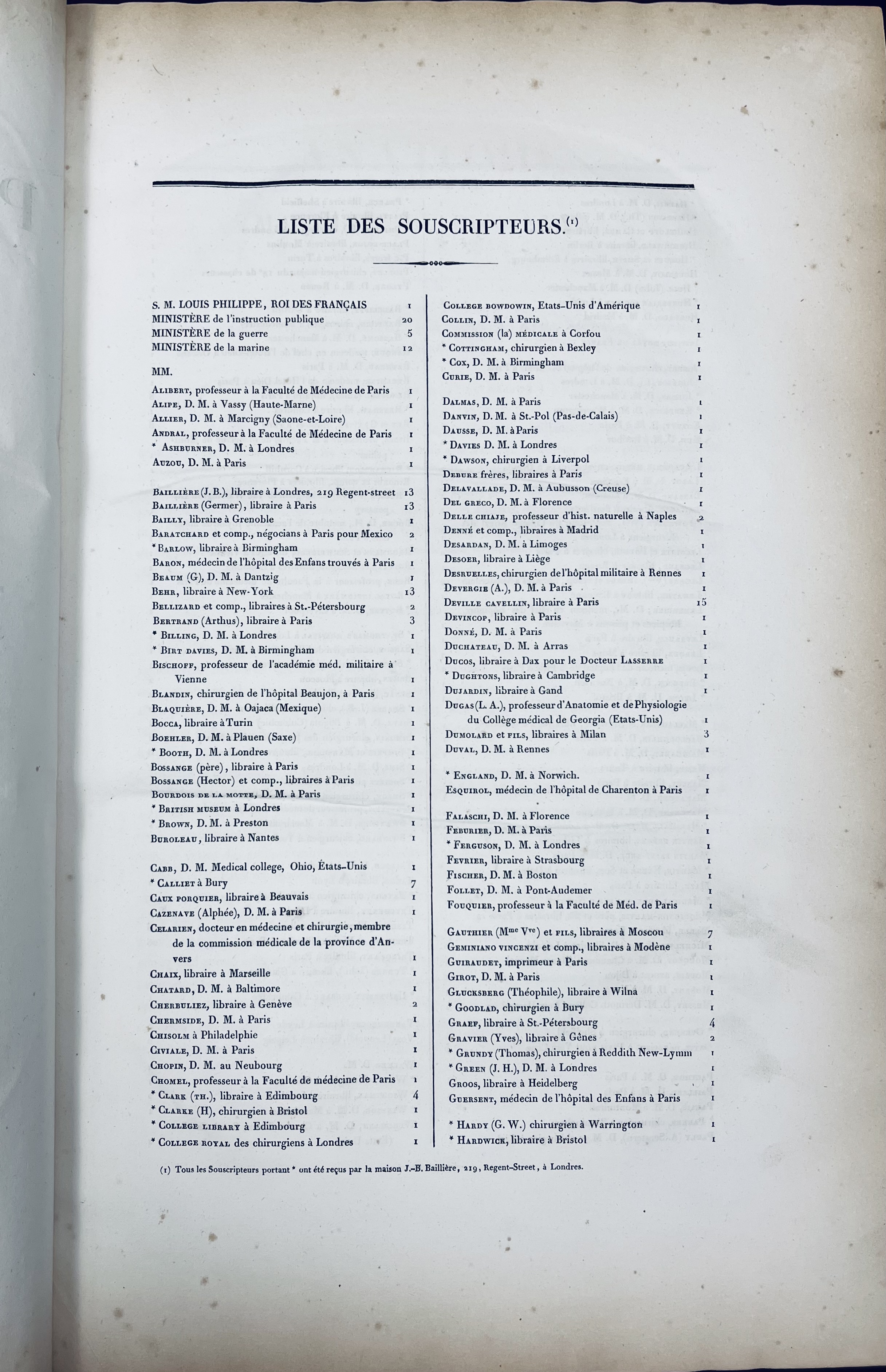
Anatomie pathologique was originally issued in 40 livraisons (i.e. issues or parts) from 1829 to 1842. Each livraison contains three to five descriptions of various pathologies with accompanying plates. The production of the work was supported by a group of private subscribers, both individuals and institutions. Subscribers collected each livraison and then arranged to have them bound into two volumes, 20 livraisons in each.
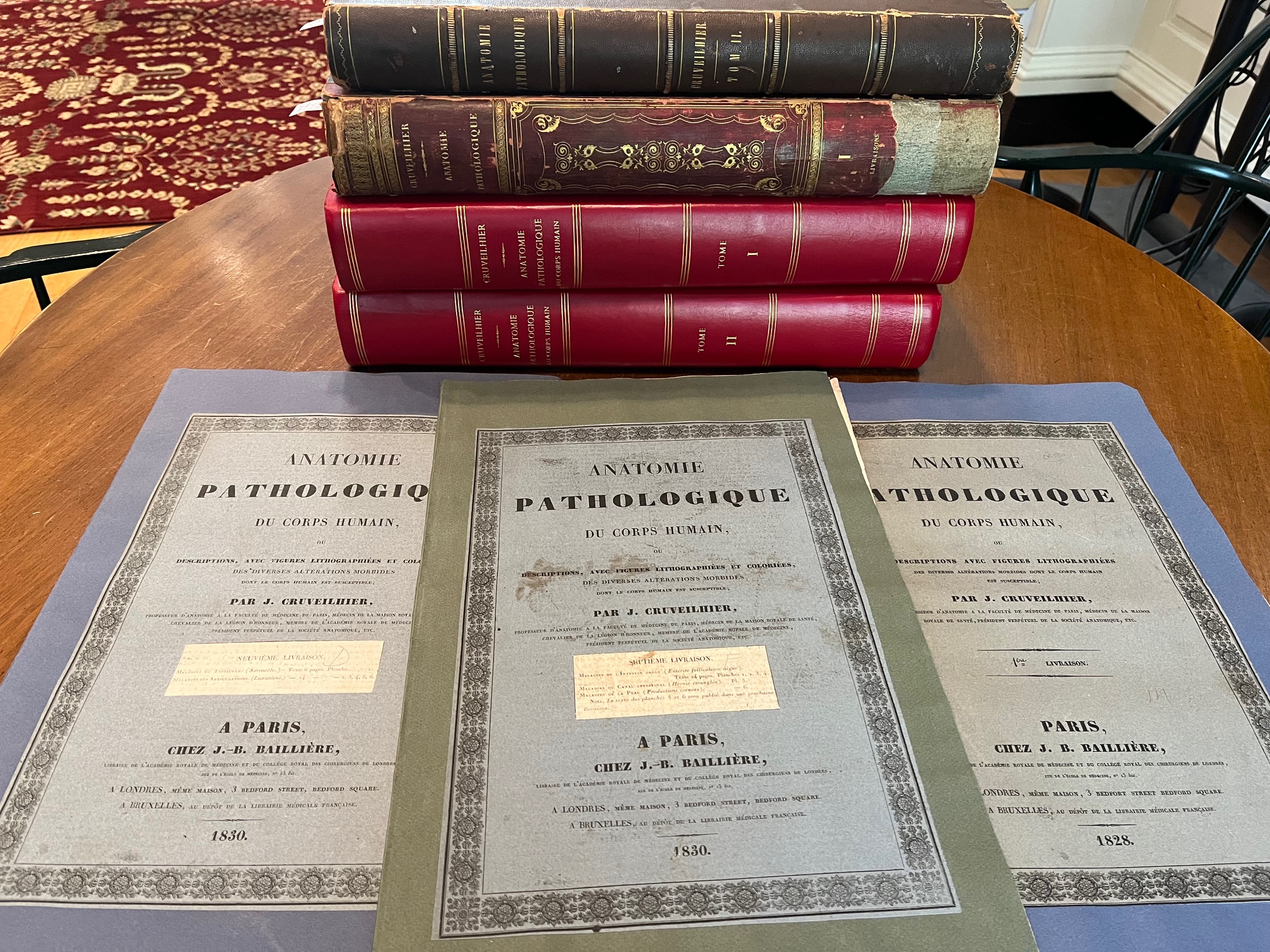
What appeared on my cart to catalog were two copies of the bound two-volume set, as well as three individual unbound livraisons along with a stray cover. Immediately this array of material caught the cataloger’s attention. To encounter bound volumes is routine; to see ‘parts’ is less so and for them to be presented together is rare in that it is essentially a demonstration of 19th century periodic book production and collecting. Note: The bindings of the volumes would have been done at the expense of the aforementioned subscribers, hence the array of different bindings. In the case of the loose livraisons, simply the original printed paper wrappers are present.
After surveying the work in whole and in parts, it was time to create the catalog records. I started with the loose livraisons, cataloging them separately as their own entities. This was important to do because not only did it lay the groundwork for describing the work as a whole, but also defined the livraison as the primary and original form of the work. For an example of this, here is the catalog record for the 7e livraison: https://opac.amphilsoc.org/cgi-bin/koha/opac-detail.pl?biblionumber=257877&query_desc=kw%2Cwrdl%3A%20257877
When it comes to cataloging anything in serial form, anomalies in production are common and must be noted to not only aid access, but also to accurately represent what is seen in physical form. In this particular case of 7ere livraison, while the plates are all present, the corresponding text to two of the plates is missing. This error is swiftly addressed on a label affixed to the front cover of livraison 7e. A note describing the anomaly is included in the catalog record:
"Nota: Le texte des planches 5 et 6 sera publié dans une prochaine livraison." [Note: The text to plates 5 and 6 will be published in a future issue.]
In creating the catalog record for the 7ere livraison, I included this note for clarity, keeping in mind the cataloger’s primary task is to describe what is physically seen in front of them with any irregularities or errors noted.

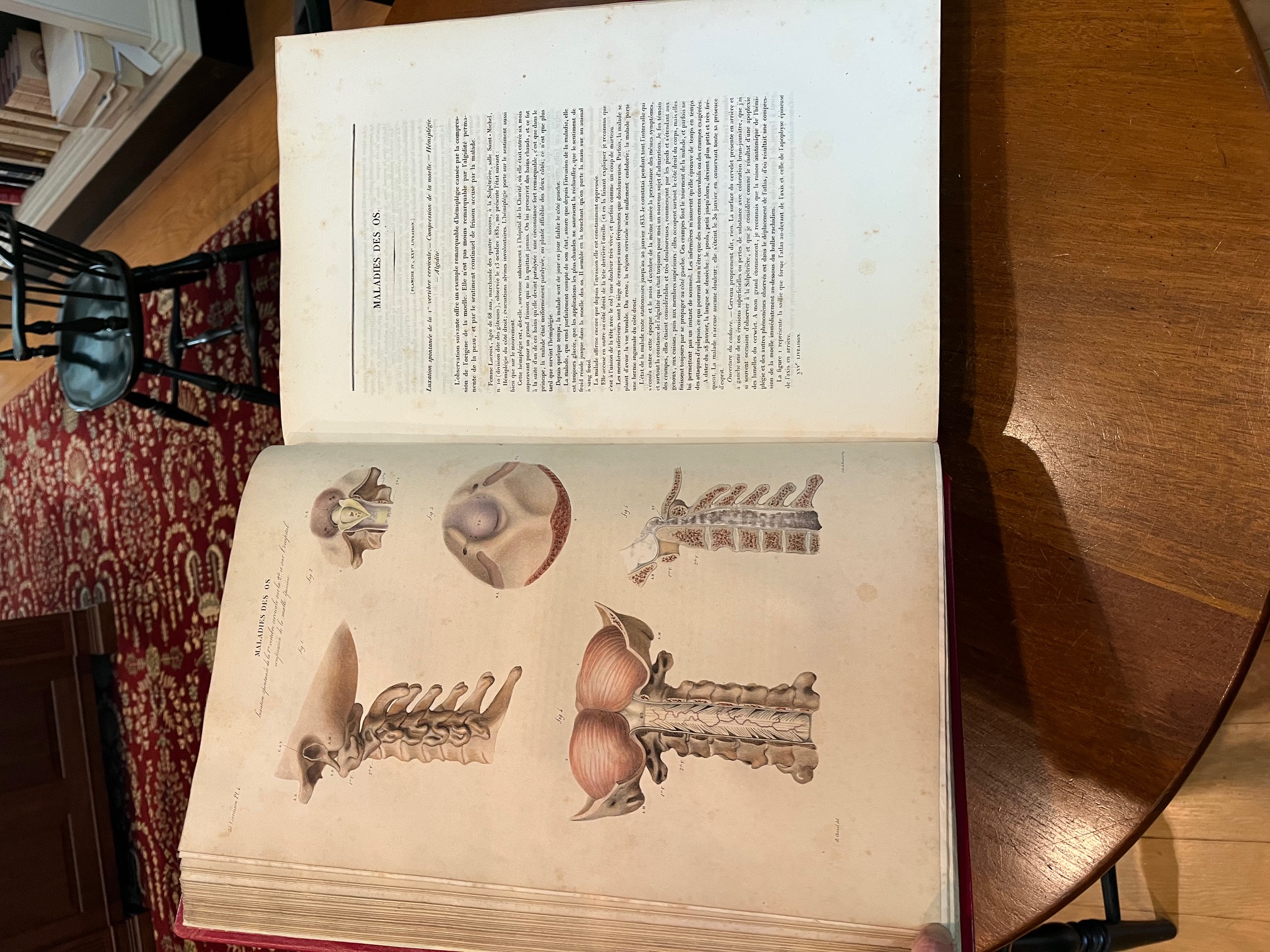
After cataloging the loose livraisons separately, the volumes were cataloged. The first thing to notice is the printed paper wrappers of the individual livraisons are not included in the binding. The lack of the covers in the bound 2 volume set sacrifices some aesthetics but also is an opportunity to correct any irregularity, such as the missing text to plates 5 and 6 of the 7ere livraison. These texts were now able to be bound in numerical order. The livraisons were not organized according to subject, but rather to the whims of whatever pathology Cruveilhier was researching or what illustrations were available at a given time, the only bibliographic structure being the numbered livraisons. Luckily an index was created and can be found at the end of volume 2. However, leafing through the livraisons while consulting the index, I noticed several recurring titles. For example a general title ‘Maladies de cerveau’ is found in several livraisons, each concerned with a different pathology, often mentioned in a subtitle.
The cataloger paused… How much work should be put into this record? Quite a bit, it was decided. Since these livraisons were published individually and subsequently bound into two volumes (each containing 20 livraisons) I thought it best to list the contents of each of the 40 livraisons in the catalog record for the 2 volume set. The catalog record for the whole work contained within 2 volumes can be seen here: https://opac.amphilsoc.org/cgi-bin/koha/opac-detail.pl?biblionumber=256340&query_desc=kw%2Cwrdl%3A%20256340

I thought that once Anatomie pathologique was cataloged and shelved, my work was completed. Wrong! Upon visiting the shelf where the volumes and individual livraison live, I discovered a third bound volume 1, not in the catalog. I could not find an accession number written in the volume, a standard clue to the provenance of the material in question. In addition to this mystery, a stack of loose pages and plates from another volume 1 was also discovered. The next step is to consult with colleagues and also the old card catalogs to hopefully identify where these duplicates came from.
Anatomie pathologique du corps humain has been one of my favorite titles to catalog because of its complexity coupled with thoroughness, much like the human body. In creating records for the work in both its original livraison and bound forms, the essence of cataloging work is brought forth—attention to detail and how these details make up the whole. While I focused on only one aspect of the work in this writing, the physical forms presented, there is much more to be discovered in its pages and covers regarding its production and subsequent provenance.