



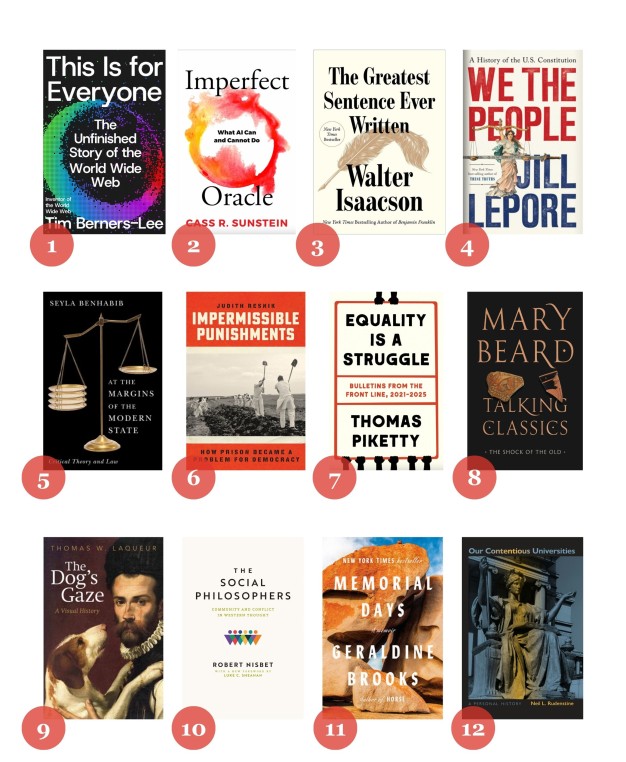
With the New Year well underway, January provides the perfect opportunity to refresh your TBR list (to be read) and add some new titles to enjoy this year. Fortunately, the APS Members have you covered with brand new books to keep you reading all year long. Whether you are looking forward to the Semiquincentennial (250th anniversary), want to learn the latest on artificial intelligence, or are looking for a more personal history, find your next read here.
Technology and AI
1. This Is for Everyone: The Unfinished Story of the World Wide Web by Tim Berners-Lee
September 2025, Farrar, Straus and Giroux
Inventor of the World Wide Web, Sir Tim Berners-Lee (APS 2004) explores the early days of the Web, its incredible capacity for creativity and collaboration, and the pitfalls inherent to the Internet. A lifelong advocate for the Internet’s potential to improve the human experience, Sir Berners-Lee addresses pitfalls posed by AI and how to shift away from use for power and profit and refocus on human flourishing.
2. Imperfect Oracle: What AI Can and Cannot Do by Cass R. Sunstein
October 2025, APS Press
Built on the premise that AI’s potential is limited by its inability to always make accurate predictions, Cass Sunstein’s (APS 2010) book examines the promise of artificial intelligence, particularly as a tool to offset human variables. Acknowledging that human bias and the “noise” of human judgments create unwanted variabilities, Professor Sunstein asserts that AI can help humans avoid mistakes, though the unpredictability of life poses inherent limitations.
America’s 250th Anniversary
3. The Greatest Sentence Ever Written by Walter Isaacson
November 2025, Simon & Schuster
Focused upon one of the best-known and most powerful phrases in the Declaration of Independence, Walter Isaacson (APS 2005) provides an in-depth exploration of a key foundational principle of the American Dream. These words continue to reflect the American spirit, even in polarizing times: “We hold these truths to be self-evident, that all men are created equal, that they are endowed by their Creator with certain unalienable Rights, that among these are Life, Liberty, and the pursuit of Happiness.”
4. We The People: A History of the U.S. Constitution by Jill Lepore
September 2025, Liveright
Offering the first unique approach to the history of the U.S. Constitution in many years, Jill Lepore (APS 2014) asserts that the Framers never intended the Constitution to remain stagnant, but to grow and be amended as the United States evolved. The country’s hesitancy in recent decades to ratify any new amendments has increased the likelihood of political violence; by continuing to refine the foundational laws, there is hope that America can right itself.
Law and Politics
5. At the Margins of the Modern State: Critical Theory and Law by Seyla Benhabib
June 2025, Wiley
Situated within growing conflicts around the world, including Gaza, Ukraine, Darfur, and the Congo, among others, Seyla Benhabib (APS 2024) addresses growing political skepticism of human rights and extremism around the world. She advocates for a more universalist approach to moral, legal, and political universalism that challenges Eurocentrist and Western subordination while rethinking international law, popular sovereignty, and climate change from a broader, global perspective.
6. Impermissible Punishments: How Prison Became a Problem for Democracy by Judith Resnik
October 2025, The University of Chicago Press
Set against the backdrop of three centuries of legal standards and shifting societal norms, Judith Resnik (APS 2002) highlights distinctions between “permissible” and “unpermissible” punishments, particularly in the wake of major social and political upheaval relating to the Second World War, the United Nations, and the Civil Rights movement. The modern conviction that the law should protect prisoners by providing for basic human rights, such as food and safe housing, places greater responsibility on governments to protect those they detain.
7. Equality is a Struggle: Bulletins from the Front Line, 2021-2025 by Thomas Piketty
September 2025, Yale University Press
Drawing from his columns in the French newspaper, La Monde, Thomas Piketty (APS 2015) recounts major world events over the last five years, including the global pandemic, wars in Ukraine and Gaza, and the rise of right-leaning politics in Europe and the United States. While maintaining optimism for global equality, particularly through ecological socialism, Piketty documents a period of rapid, global change and unrest.
Arts and Humanities
8. Talking Classics: The Shock of the Old by Mary Beard
Forthcoming, May 2026, The University of Chicago Press
In spite of the many differences between the ancient and modern worlds, humanity maintains an ongoing fascination with the Classical world of the Greeks and Romans. Advocating a balance between reverence for the past and manipulation of the Classics in support of modern ideologies, Mary Beard (APS 2012) explores the continued relevance of the Classical world to modern life.
9. The Dog’s Gaze: A Visual History by Thomas W. Laqueur
Forthcoming, May 2026, Penguin Press
Pulling from a long tradition of including man’s best friend in Western art, Thomas Laqueur (APS 2015) explores the prevailing social bond between mankind and dogs. Referencing images from Giotto, Goya, Rubens, and others, Dr. Laqueur examines the narrative implications of including dogs in art and what they can tell us about our own ways of seeing.
10. The Social Philosophers: Community and Conflict in Western Thought by Robert Nisbet
September 2025, APS Press
Within the downfall of the Greek and Roman societies, contends Robert Nisbet (APS 1973), were born the prevailing core ideologies of Western social philosophy: humanity’s ongoing search for community. Organized around six major categories of Western community, including military, religious, ecological, political, revolutionary, and plural, prominent ideas in Western thought can be attributed as philosophical responses to conflict, crises, and the persistent need for community.
Memoirs and Personal Histories
11. Memorial Days: A Memoir by Geraldine Brooks
February 2025, Viking
Following the sudden passing of her husband, Tony Horwitz, on Memorial Day 2019, Geraldine Brooks’ (APS 2024) memoir considers the immediate demands placed on the grieving, the many ways cultures grieve, and rituals that offer support in times of grief. Using her own experience and inability to immediately process her loss, Ms. Brooks offers a personal account of grief that is simultaneously universal.
12. Our Contentious Universities: A Personal History by Neil L. Rudenstine
March 2025, APS Press
Part history and part personal narrative, Neil Rudenstine (APS 1992) pulls from his time at Princeton and Harvard Universities, where he served as faculty, dean, provost, and president, to consider changes to higher education over the last several decades. Through his on-the-ground perspective, Dr. Rudenstine relates contemporary antagonism on college campuses to widespread unrest in the 1960s, noting that current causes for protest, such as climate change and gun violence, do not always have clear solutions, as did earlier causes for protest like the Vietnam War, which concluded when the war ended.