



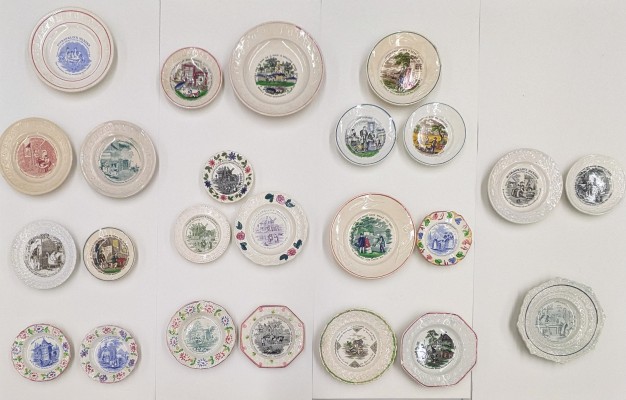
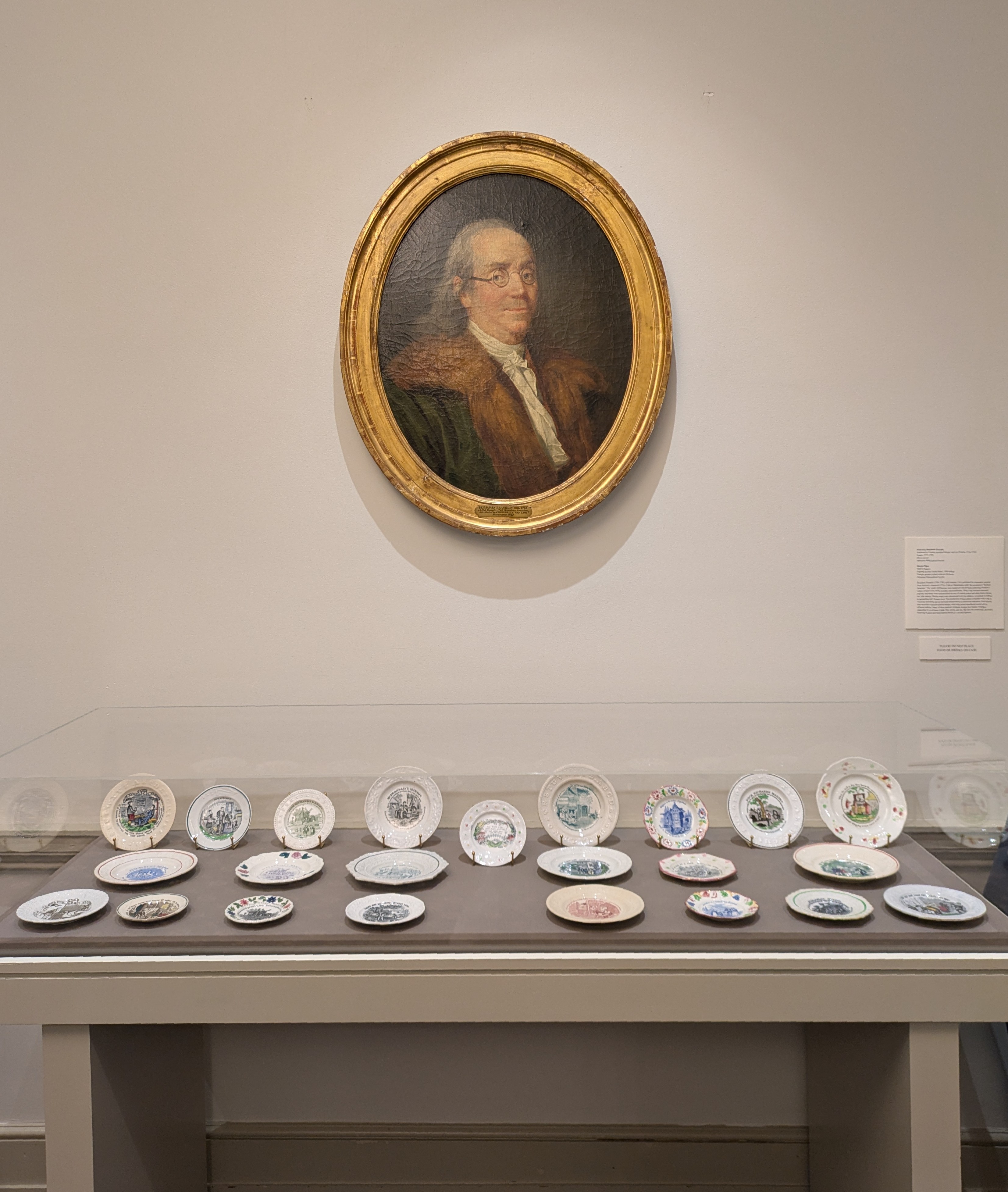
Above: 24 of the recently accessioned maxim plates in collections storage.
At the end of 2023, the APS Library & Museum received a donation of forty-seven 19th-century maxim plates featuring quotes from Benjamin Franklin’s Poor Richard’s Almanac. The Almanac, sold in Philadelphia from 1732–1758, shared Franklin’s thoughts and advice, from weather insights to poetry, and was immensely popular in colonial America, gaining notoriety in England and France as well. A key element of the almanac was its inclusion of maxims—concise rules of conduct— that elevated values of labor, thrift, and temperance. These maxims, some pithy, some grim, remained popular in the centuries since their publication. Throughout the 1800’s, ceramics manufacturers memorialized maxims on sets of plates, mugs, bowls, and other dishes.
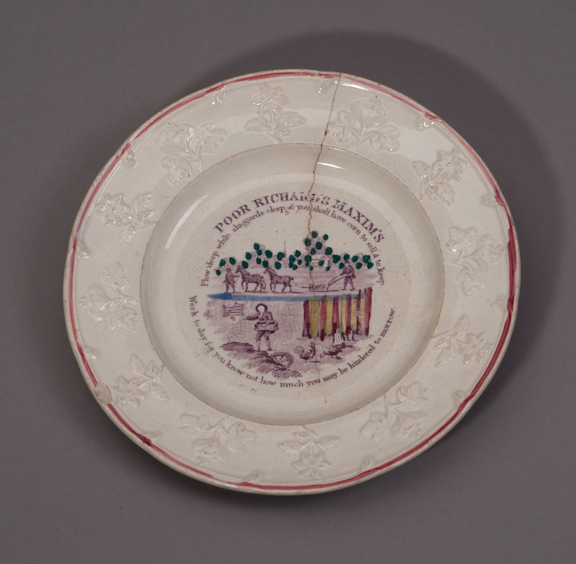
The APS’s collection prior to this donation included one such object, an ironstone plate with a scene of two men plowing fields with horses and another feeding chickens. The visual moment is encircled by the quote: “Plow deep while sluggards sleep & you shall have corn to sell & keep / Work to day for you know not how much you may be hindered tomorrow.”
The new collection of plates features 34 distinct maxims, rich imagery, and stylistic character. Children in the 19th century received these vibrant maxim wares as didactic tools, both a reminder to behave in upstanding and virtuous ways and a reward for doing so. But the plates themselves also reflect ideas of commemoration—how consumers in 19th-century America chose to remember the shared past. And they also reflect how those consumers chose which insights of that shared past were passed on to the children in their lives.
Once accessioned as gifts and brought to the museum’s collections storage, the plates were cleaned, labelled, and safely stored. I then began identifying groups of shared characteristics that could be used to organize these plates. There were some commonalities across them. The plates, all types of refined white earthenware, are quite diminutive with diameters ranging from 4.5–8.125”—a reflection of their small-in-stature users. Each maxim encircles a monochromatic transfer-printed design, with some prints duplicated across sets or reproduced by different makers. The transfer prints come in multiple colors, often black but also blue, green, red, and brown.
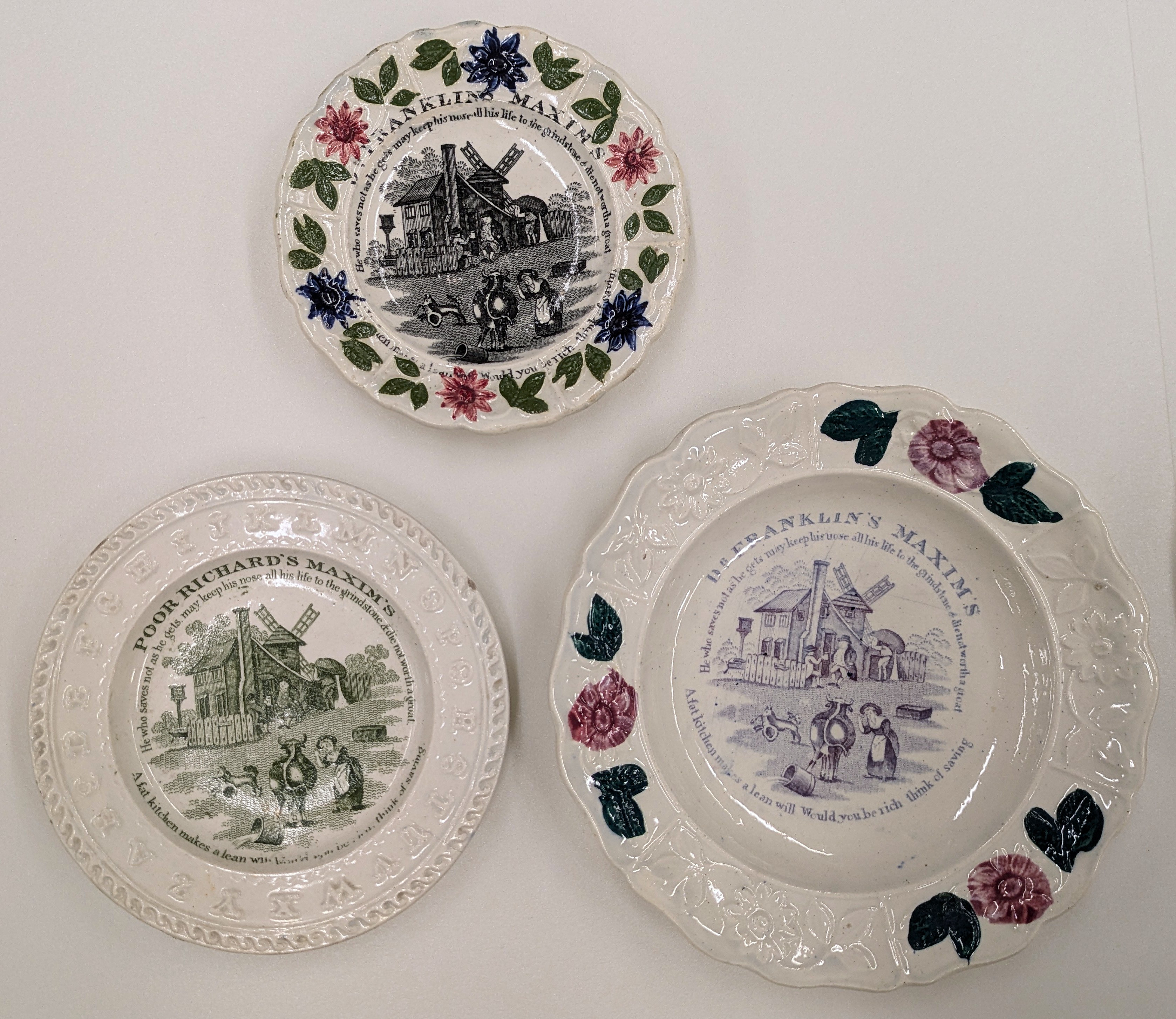
Some of these pastoral or domestic designs also feature hand-applied overglaze enameling in vivid hues of pink, blue, green, yellow, and red. The plate rims are all decorated, though some feature molded and hand-painted floral designs, while others include molded alphabets—a substyle called “alphabet wares”— or simply molded florals.
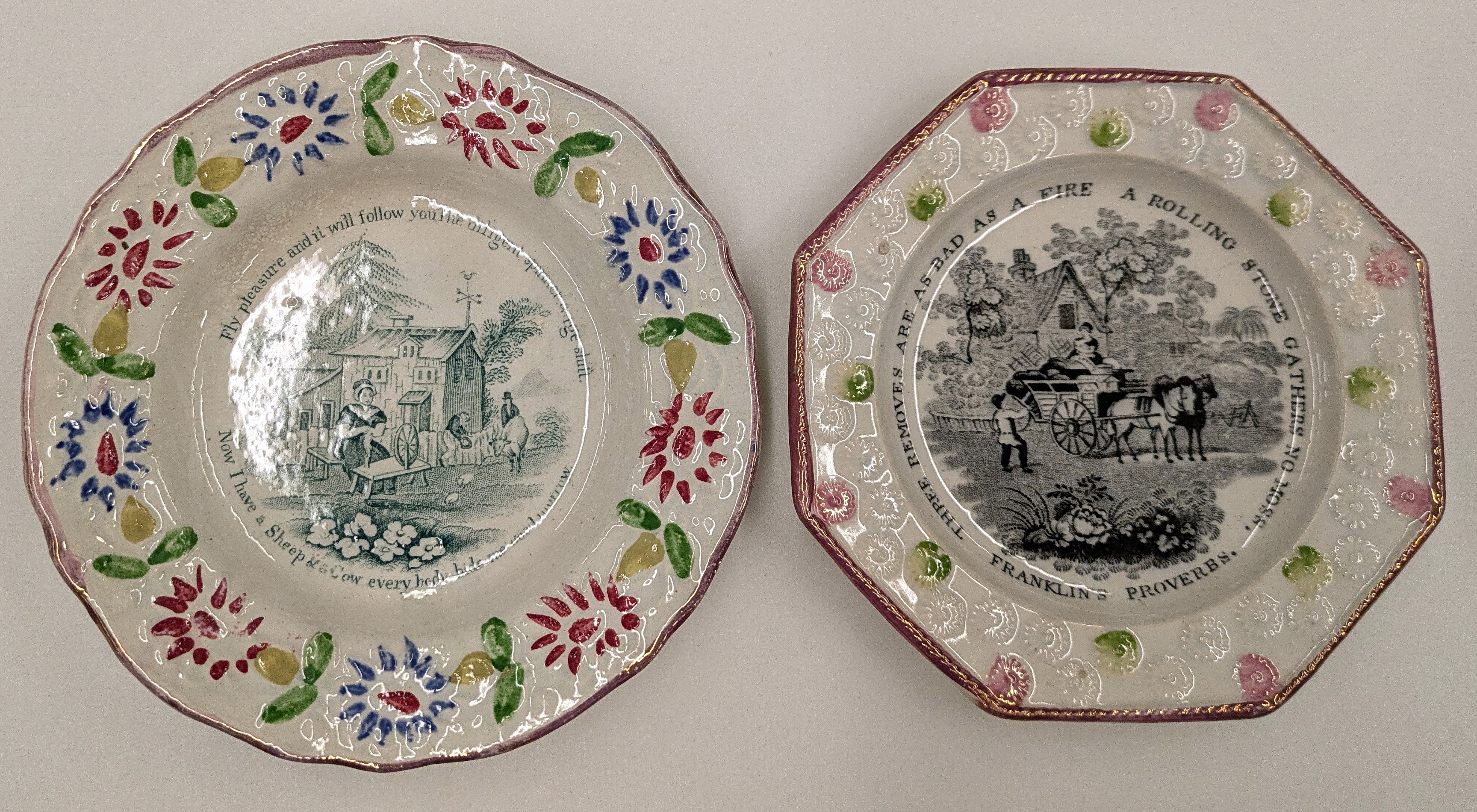
Details around printing style, rim design, molding, and enameling are not just relevant for a typology of artifacts. When crucial contextual information like maker’s marks are missing, as is frequently the case with such ceramics, these stylistic details can date and localize trends to fill in some of those gaps. For instance, monochromatic printing was standard from the late-18th century until the 1830’s and ornately decorated printed wares remained popular in general until the mid 19th century. Meanwhile, molded alphabet wares tended to date to the second half of the 19th-century and were often produced in England, while American-made printed alphabet wares were generally produced towards the end of the 19th century and do not feature at all in this recent acquisition.
Poor Richard’s Maxims were not originally marketed towards children. But with growing moralistic anxieties linked to the social reforms around labor and industry during the Victorian period, these maxims were aimed at an impressionable audience soon to enter the workforce. These plates were but one instance of how a nostalgia for the past was redirected into the moral schooling of new generations.
Sources
- https://www.seekersantiques.com/blog?p=18
- https://www.nps.gov/articles/proverb-plate.htm
- Noel Riley, 2006, “Gifts for Good Children: The History of Children's China 1790 - 1890”
- “Collectibles: Dishing Up History on Alphabet Pottery.” Los Angeles Times, 12 Nov. 1994. Retrieved from http://articles.latimes.com/1994-11-12/home/hm-61683_1_alphabet-pottery
- Wendy Moonan, 1998, “Antiques; Presents for Children, Good and Bad.” New York Times. Retrieved from http://www.nytimes.com/1998/07/17/arts/antiques-presents-for-children-good-and-bad.html
- Kathryn Hughes, 2014, “The middle classes: etiquette and upward mobility.” British Library. Retrieved from https://www.bl.uk/romantics-and-victorians/articles/the-middle-classes-etiquette-and-upward-mobility
- Teresita Majewski and Michael J. O’Brien, 1987, “The Use and Misuse of Nineteenth-Century English and American Ceramics in Archaeological Analysis.
- Mildred L. Chalala and Joseph P. Chalala, 1980, “A Collector's Guide to ABC Plates, Mugs, and Things.”