

“I Too Leave Little Wrecks Upon You”: Robert Cushman Murphy’s Fish-Shape Paumanok (1964)



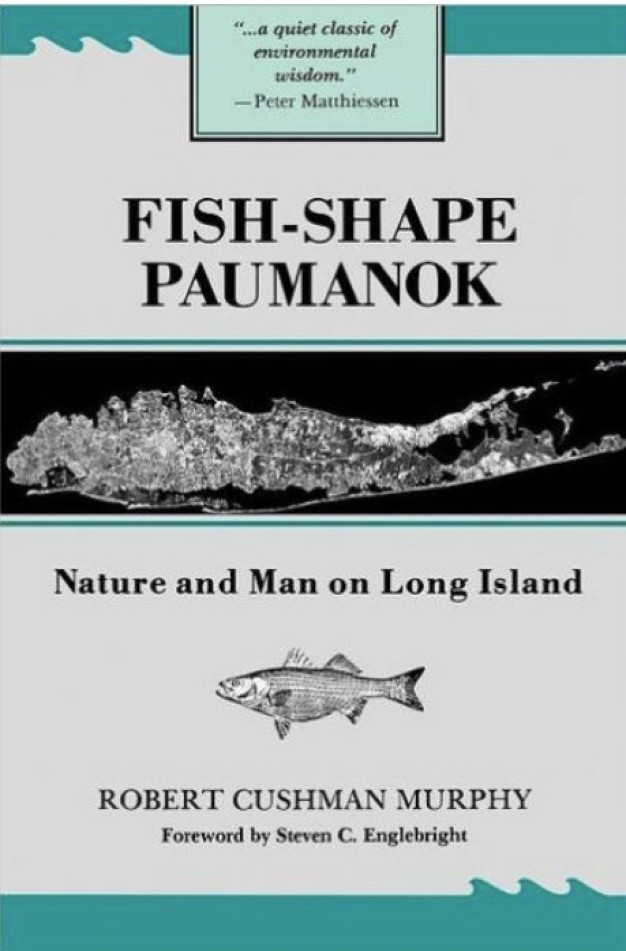
When Robert Cushman Murphy was elected to the APS in 1946, he was already one of the most famous and respected ornithologists in the world. His study of marine birds had brought him to Antarctica, Peru, New Zealand, the Bahamas, and numerous other locales. There, he collected thousands of specimens alongside his wife and collaborator, Grace E. Barstow Murphy. Many of these remain in the collections of the Museum of Natural History, where Robert would end his storied career as the Lamont Curator of Birds. His magnum opus, the two-volume Oceanic Birds of South America (1936), was perhaps the greatest ornithological achievement since Audubon. He was an early ally in Rachel Carson’s fight against DDT, and his own research was undoubtedly crucial to the development of her world-changing book Silent Spring (1962). By the time of his death in 1973, Murphy had published over 600 articles and many books, leaving an indelible mark on the fields of ornithology and ecology.
In 1962, a few years after his retirement, Murphy was invited to deliver the annual Penrose Memorial Lecture at the APS. He chose for his subject the ecological history of Long Island, New York, where he had lived since childhood. Murphy’s eighty-five long years on the island spanned two world wars, two presidential assassinations, Free Silver and the Hydrogen Bomb, the Great Depression and the Oil Crisis, Grover Cleveland and Richard Nixon, Prohibition and Free Love, not to mention suffrage and civil rights. Through it all, he watched his beloved home transform from natural wonder to suburban sprawl, as its ancient forests and wetlands were leveled and paved over for the sake of Levittowns and shopping malls. This book, a lucid summary of his key ideas about environmentalism and perhaps his greatest literary achievement, is about those transformations, and an attempt to place those all-too-human decades within the vaster scale of ecological and geological time.
Murphy chose for his title Fish-Shape Paumanok, the Algonquin name for Long Island. He borrowed the phrase from a poem by his fellow Islander, Walt Whitman, and begins the book with a series of quotations from some of the Good Gray Poet’s greatest hits: “Starting from Paumanok,” “A Song of Joys,” “Song of Myself,” “As I Ebb’d with the Ocean of Life.” Together, these excerpts articulate a vision of pastoral joys and natural harmony, a youth spent “rambl[ing] about the house and barn and over the fields once more,” breathing deeply “the briny and damp smell, the shore, the salt weeds exposed at low water.”
Murphy’s view of nature and of humanity’s place in it is unapologetically Whitmanic. His research was devoted to the collection of minute facts, while his theoretical work always sought an elegant account of the relation between those facts and the greater whole. One cannot know man without biology, nor biology without ecology, nor ecology without a sense of history that extends into the deepest geological past. Fish-Shape Paumanok is Murphy’s attempt to peer into that past, to locate his own biography within the sweep of a vast history in which humanity was playing a brief but potentially cataclysmic role.
Whitman’s remembered Long Island was already beginning to disappear in 1887, the year of Murphy’s birth, due to the centuries of over-fishing, deforestation, and poor land-management that had continued unabated since colonial times. These, combined with the ever-intensifying industrialization and pollution of the Gilded Age and the rapid suburban development of the post-war years, had rendered the Island all but unrecognizable from its pre-colonial days, during which it was one of the most diverse and dynamic ecosystems in North America. He catalogs this destruction in a prose that recalls the darker portions of Whitman’s own Specimen Days:
“It would be quite incorrect to leave the impression that all the natural resources of long Island were eliminated within any short period. Nature is too long-suffering and tough for that. The wild turkey went out early, along with the wolf and the beaver. The great auk, Labrador duck, heath hen, passenger pigeon, and Eskimo curlew one by one became extinct—as dead as the dodo—but not solely through the destructive propensities of Long Islanders. Ducks, geese, snipes, and plovers remained to be slaughtered for the markets of the metropolis, and they withstood the roll, more or less well, up to a definite point determined by modern firearms, rapid transportation, and an exploding populace.”
Murphy’s text is a classic in ecological writing, the work of a great scientist at the end of a storied career. He admits that “there is much that is ominous and awry” in the world, though he offers few solutions in these pages to the numerous and entangled problems identified, leaving these for the next generation. He remains optimistic about the capacities of humanity to reverse course, and he had reason for his optimism. Rachel Carson’s Silent Spring, released in the same year as Murphy delivered his lecture, would launch the modern environmentalist movement into the popular consciousness and lead to real policy change in the form of DDT restrictions and conservation efforts.
With its publication in 1964, Fish-Shape Paumanok would join a growing list of rigorous and urgent science books written in lyrical prose for a popular audience. To return to it now is to realize the extent to which we still live in Murphy’s world: vast, entangled, endangered, and wondrous.