

Backlist Spotlight: Ordinary Mysteries: The Common Journal of Nathaniel and Sophia Hawthorne, 1842-1843



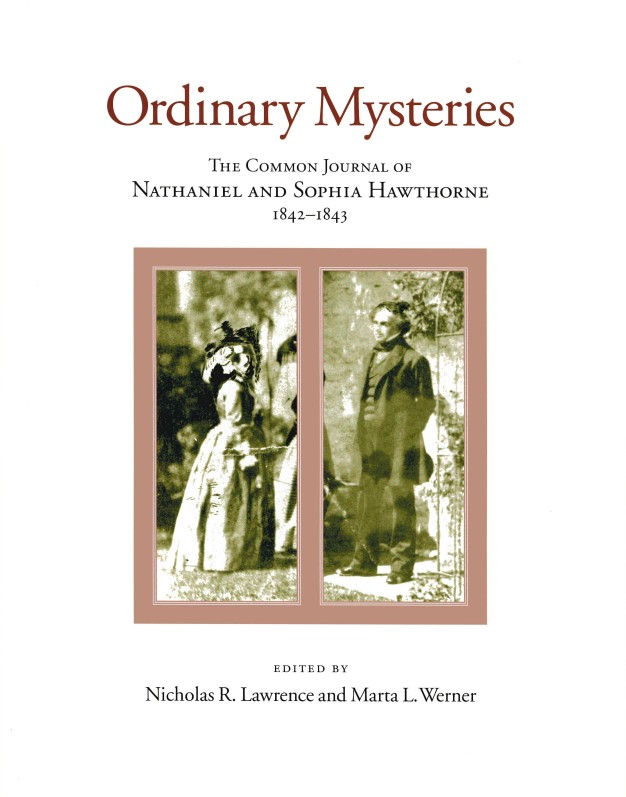
In the first year of their marriage, Nathaniel and Sophia Hawthorne rented the Old Manse, a historic clergy house outside of Concord, Massachusetts that had previously been the home of Ralph Waldo Emerson. They spent their days walking the grounds, caring for a garden prepared by Henry David Thoreau, and passing the evenings with their Transcendentalist friends. They also kept a common journal to document their daily life as newlyweds, where they recorded the changes in the weather as meticulously as the fluctuations of their own souls.
Journal-keeping is more than a means of self-documentation and self-examination, however; it is also—and perhaps most essentially—a technique of self-creation. When the Hawthornes sat down to write words meant for no readers but each other, they threw themselves into roles as dramatic as any of the characters in one of Nathaniel’s novels. Their entries read like a series of variations on the theme of a new Adam and Eve in an American Eden. As Lawrence and Werner suggest, the Hawthornes attempted to sustain in writing a world in which “the allegorical and the mundane occupy the same space, revealing themselves to be continuous with one another in the manner of a Mobius strip.”
Self-documentation, self-examination, self-creation, and now add a fourth: self-erasure. As Emerson used his famously voluminous diaries to shape the contours of his public persona as a “representative man,” dissolving his individuality in the solution of heroic ideals, Thoreau was busy disappearing into the pages of his own journals, using the pronoun “I” less and less as he trained his attention with ever-greater focus on the large and small things of the world outside, from the changes of the seasons to the writhing paths of worms after rain.
Nathaniel and Sophia seem to be after another kind of erasure, not an Emersonian abstraction nor a Thoreauvian act of self-forgetting, but rather an intense inward experience in which the merely contingent content of the self is stripped away and something more essential is laid bare without the uniqueness of the couple being lost. When Sophia speaks of “the unholiness of a union on any other ground than entire oneness of spirit,” she simultaneously celebrates the absolute singularity of their love—recalling the Platonic myth of lovers as two halves of one being split apart, which finally find one another again—and insists that “true” lovers touch some more universal truth through their love that, for a moment at least, seems to annihilate their particular historical identities.
Or, as Nathaniel writes, “Happiness has no succession of events; because it is a part of eternity; and we have been living in eternity, ever since we came to this old Manse. Like Enoch, we seem to have been translated to the other state of being, without having passed through death.” Love and writing, death and (re)birth, solitude and communion circle around one another throughout the Hawthornes’ text, and the private, collaborative status of the journal allows for them to play endlessly with these slippery concepts.
Add to this thematic constellation the fact that the journal is quite literally a document of erasure at several levels. The two carefully selected the entries they would write for each other’s eyes. Hawthorne would eventually extract and edit sections for his own public writing, most notably the auto-fictional preface to his collection Mosses from an Old Manse (1846), in which he makes no direct mention of Sophia. Sophia, when preparing Nathaniel’s papers for publication after his death, not only removed her own contributions to the work in Passages from the American Notebooks of Nathaniel Hawthorne (1868), but even went so far as to cut or blot out many of the passages she had written. In this way, she preserved some of the privacy the couples sought in their first year together and helped to construct the popular image of Nathaniel as a solitary, remote genius. Her surviving sections would not be published until 1996.
In this feature from the APS Press backlist, Ordinary Mysteries: The Common Journal of Nathaniel and Sophia Hawthorne, 1842-1843, editors Nicholas R. Lawrence and Marta L. Werner describe the experience of reading the journal in manuscript form thusly: “The result is a published text that both reveals and conceals layers of editing like a series of nested Chinese boxes; a private document that wears occasional veils of blank ink or empty space so as to produce, even now, a sense of hiddenness or mystery within an apparently mundane record of bourgeois daily life in mid-nineteenth century America.” The striking cover of Ordinary Mysteries gestures to this practice, featuring a photograph of Sophia with her face scraped out, presumably by her own hand years later. The image is uncanny and strange, though we can’t help but feel that we learn more about this woman from the marks she left on her own image than we could ever learn from the image itself.
Thanks to this edition, we are lucky to be able to finally read the manuscript in as complete a form as possible, with a facsimile of the handwritten pages on one side and a transcription of the Hawthornes’ almost illegibly lush script on the other. Editorial introductions prepare us to encounter a young, ambitious couple deeply embedded in their time, place, and class with the understanding necessary for sympathy, and with the sympathy necessary for understanding.