

Sociolinguistic constraints in Mayan bilingual communities


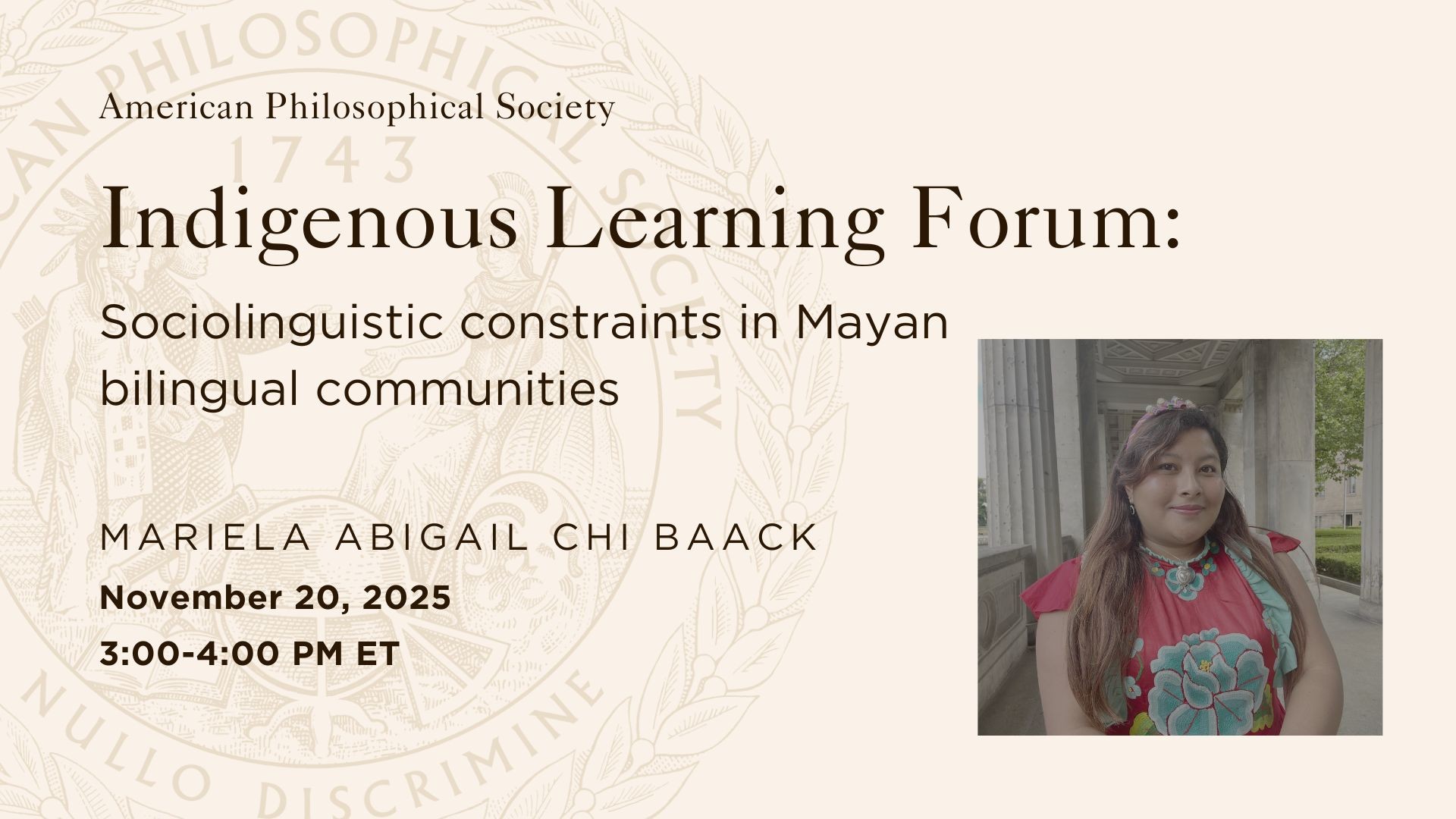
The third 2025-2026 Indigenous Learning Forum will take place November 20, 2025 at 3:00 p.m. ET on Zoom. This talk will be given in English with Spanish translation.
Se ofrecerá interpretación en español/inglés.
This event is open to all but registration is required.
Mariela Abigail Chi Baack is a PhD candidate at The Pennsylvania State University in the Department of Spanish, Italian, and Portuguese. She holds an MA from Penn State and a BA from the Universidad de Quintana Roo. A native of Quintana Roo, Mexico, her doctoral work centers on the Maya-Spanish bilingual communities of her home region. Her research interests focus on language contact, specifically the morphosyntactic and phonological features of Yucatec Spanish that have emerged from its sustained interaction with Yucatec Maya. She conducts her research using a community-based methodology and corpus linguistics to explore how these linguistic features intersect with sociolinguistic variables such as gender and age.
Sociolinguistic constraints in Mayan bilingual communities
This presentation examines how social factors shape linguistic variation in three Mayan bilingual communities in Quintana Roo: Tihosuco, Señor, and José María Morelos. In these communities, Yucatec Maya and Spanish coexist with varying degrees of bilingualism among the speakers. Despite the extensive use of Maya, Spanish dominates in education and formal settings. The diglossia in these communities reflects this imbalance, with Spanish often associated with higher prestige, education, and economic opportunities, especially for younger generations. However, Maya retains a significant presence as a marker of local identity and cultural heritage, particularly in informal contexts and within the family.
This work investigates how social factors such as age, gender, and bilingualism influence this variation in Yucatec Spanish, and to what extent language contact with Yucatec Maya shapes its phonological and morphosyntactic features. Focusing on two key linguistic phenomena, voiceless stop aspiration and subject pronoun expression, this research aims to shed light on the processes of convergence and other mechanisms of language contact that define these bilingual communities.