

"The Stories of Our Past inform the Stories of Our Future": Documenting, Collaborating and Constructing the Southern Dawnland Cultural Heritage Knowledgescape


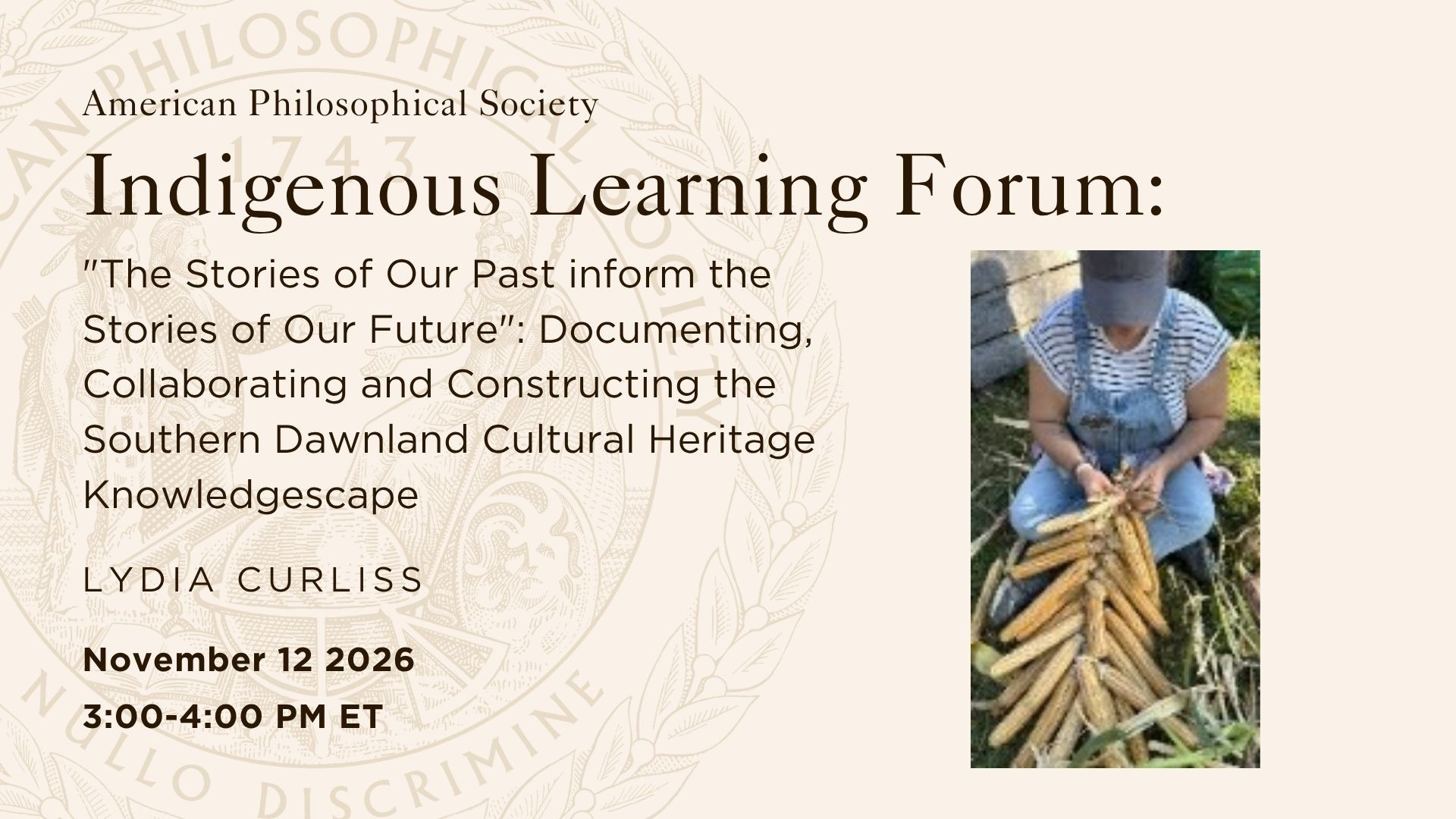
The third 2026–2027 Indigenous Learning Forum presentation will take place November 12, 2026, at 3:00 p.m. ET on Zoom. This talk will be given in English, with Spanish interpretation.
Se ofrecerá interpretación en español/inglés.
This event is open to all but registration is required.
Dr. Lydia Curliss (Nipmuc) completed her PhD at the University of Maryland, College of Information. Her dissertation, "The Stories of Our Past Inform the Stories of Our Future": Documenting southern new england Indigenous Knowledges In Cultural Heritage Memory Institutions, examines the relationships between southern new england Tribal Communities, their knowledges, and Cultural Heritage Memory institutions across time and space. Her work and research is grounded in ethical care of collections, community centered research practices, increasing accessibility for Tribal communities. She currently is The Mellon Foundation Native American Scholars Initiative Archives Training Fellow at the Center for Native American and Indigenous Research at the APS.
'"The Stories of Our Past inform the Stories of Our Future": Documenting, Collaborating and Constructing the Southern Dawnland Cultural Heritage Knowledgescape'
The Southern Dawnland encompasses the southern states of the region known as “new england” (for being the location of “new” english “colonies”) and includes massachusetts, rhode island, and connecticut. The Southern Dawnland has been theorized as a place through the kinship ties, cultural practices, and alliances that have continued over time and space. In contradiction to this, through the use of collections in Cultural Heritage Memory Institution (CHMIs), scholars and the public have continued to place our communities in the past rather than as contemporary Tribal Nations and communities.
This talk describes and reflects on my dissertation work, primarily the ways in which I embed Indigenous theory, method, and perspectives into this work. In working across and with 4 institutions, I found a complex set of relations that demonstrates the complicated nature of the Southern Dawnland Cultural Heritage Knowledgescape. Using an Indigenous analytical framework, I propose the idea of “river as analytic” to understand these relationships and center Indigenous perspectives across the work, grounded in my own relationship to the region and through my Tribal partners, The Tomaquag Museum and Aquinnah Cultural Center.