

Exchanging Knowledges in a Tribal-University Collaborative with Manoomin-Psíŋ (Wild Rice)


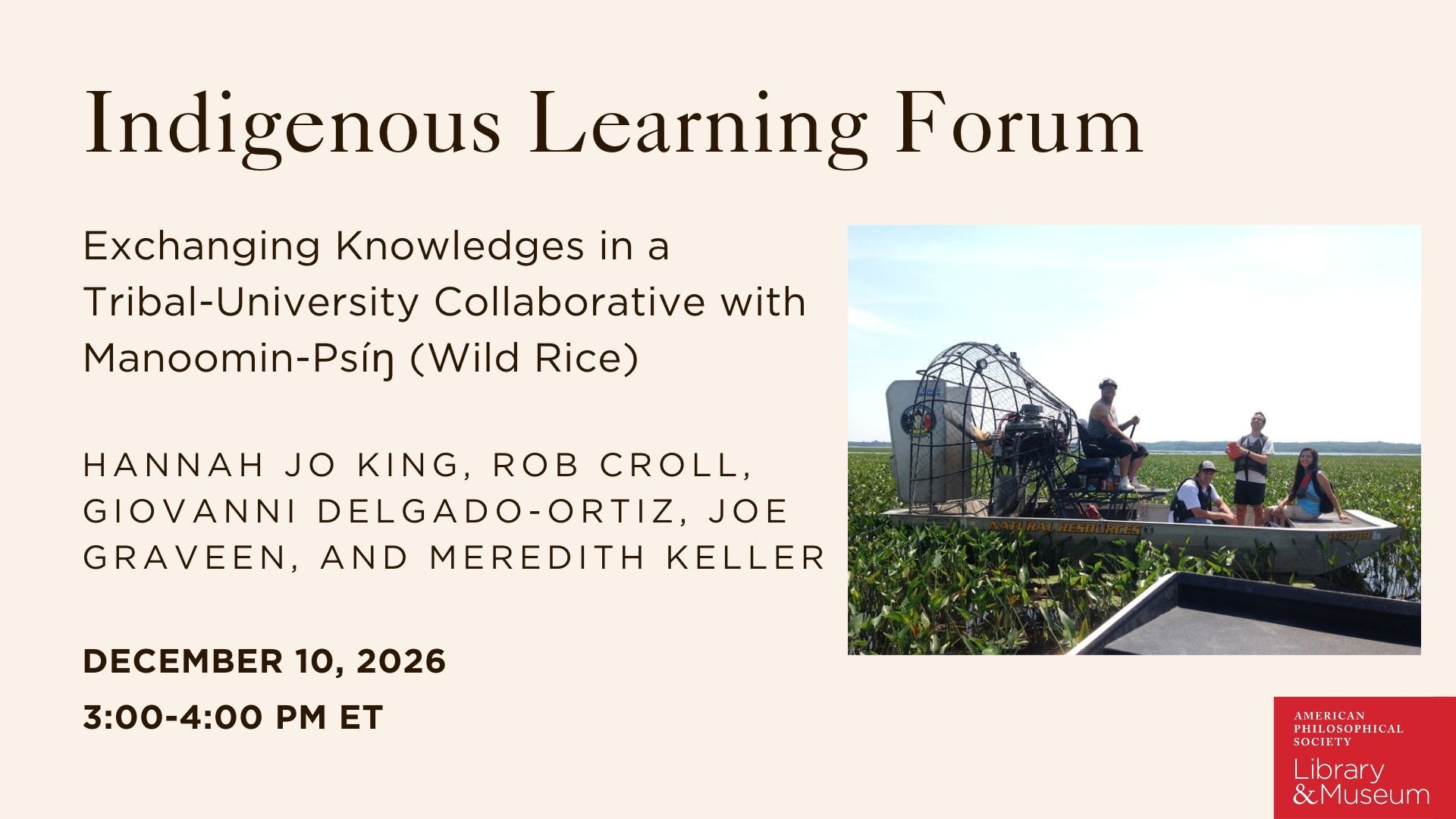
The fourth 2026–2027 Indigenous Learning Forum presentation will take place December 10, 2026, at 3:00 p.m. ET on Zoom. This talk will be given in English with Spanish translation.
Se ofrecerá interpretación en español/inglés.
This event is open to all but registration is required.
Manoomin (Ojibwemowin), Psíŋ (Dakodiapi), Wild Rice (English), or Zizania palustris (scientific), is a sacred relative, as well as a food, medicine, and gift from the Creator to Indigenous peoples of the Great Lakes. Kawe Gidaa-naanaagadawendaamin Manoomin (translating from Ojibwemowin as “First We Must Consider Wild Rice”) is a Tribal-university research collaborative that began in 2018 with the goal of protecting Manoomin-Psíŋ by prioritizing Tribal sovereignty and worldviews in our research and relationships. The partnership was formalized through written agreements and MOUs among five Upper Great Lakes Ojibwe nations, two Ojibwe inter-Tribal treaty organizations, and an interdisciplinary group of faculty, staff, and students at the University of Minnesota-Twin Cities (UMN). For this Indigenous Learning Forum, we share our stories and learnings around how to exchange knowledges between Ojibwe Tribal agencies, Anishinaabe community members, and Western institutions. Informed by a recent project evaluation, our panelists will speak to their experiences on repairing trust and taking accountability for past/present University harms against Natives peoples, exchanging knowledges by gathering in-person on Tribal lands and waters, and building multi-institutional collaboratives and relationships. The format for this session is a panel (moderated by PhD candidate and social scientist Hannah Jo King) followed by audience Q & A.
Rob Croll is a policy analyst in the Division of Intergovernmental Affairs at the Great Lakes Indian Fish & Wildlife Commission (GLIFWC) where he coordinates the Climate Change Program. He is a co-author of Dibaginjigaadeg Anshinaabe Ezhitwaad, Aanji-bimaadiziimagak o’ow aki, and Ganawenindiwag, and is a member of the Tribal Adaptation Menu (TAM) Team and the Midwest Climate Adaptation Science Center
Consortium Leadership Team.
Giovanni Delgado-Ortiz is a first year PhD student in the Natural Resources Science and Management program at the University of Minnesota. He is a community engaged researcher and his research focuses on understanding and supporting cultural ecosystem relationships in US policy processes. Giovanni has collaborated primarily with Tribal Nations in the Great Lakes region around the relatives water and Manoomin (wild rice). He recently completed his Masters in the same graduate program, where he assisted the Fond du Lac Environmental Program on a two-year wetland ecosystem services valuation study.
Joe Graveen (Lac du Flambeau Band of Lake Superior Ojibwe) is Program Manager of the Wild Rice Program with Lac du Flambeau Tribal Natural Resources Department. I was born and raised in/on Lac du Flambeau Indian Reservation. I have 4 Children—3 girls and 1 son, and 6 Grandchildren. I have always been an outdoors person, have always been an avid Hunter gather for all of my adult life. I enjoy fishing a lot, I also like to just sit by a camp fire and enjoy stories/the company. I enjoy working with others in building bridges, as good neighbors and to educate the public on Treaty Rights and Manoomin (Wild Rice).
Meredith Keller is the Program & Communications Manager for the Minneapolis-St. Paul Long-Term Ecological Research Program (MSP LTER) at the University of Minnesota. Since joining the University in 2023, she has also engaged in water governance research, led onsite fieldwork, and coordinated the 2023 Manoomin·Psíŋ Knowledge Symposium. She was previously a Chapter Scientist for the IPCC’s Sixth
Assessment Report and has led statewide environmental initiatives in Minnesota and Wisconsin. She holds a Master’s in Environmental Policy from the University of Cambridge.
Hannah Jo King is a Ph.D. candidate at the University of Minnesota-Twin Cities studying Natural Resources Science and Management with a focus in environmental justice, tribal resources management, and Black ecologies. They conduct food and water sovereignty research with tribal-university collaboratives, including the Kawe Gidaa-naanaagadawendaamin Manoomin project focused on protecting Manoomin/Psiŋ (Wild Rice) in the Great Lakes.