



427 Chestnut Street, Philadelphia, PA
Register here to attend.
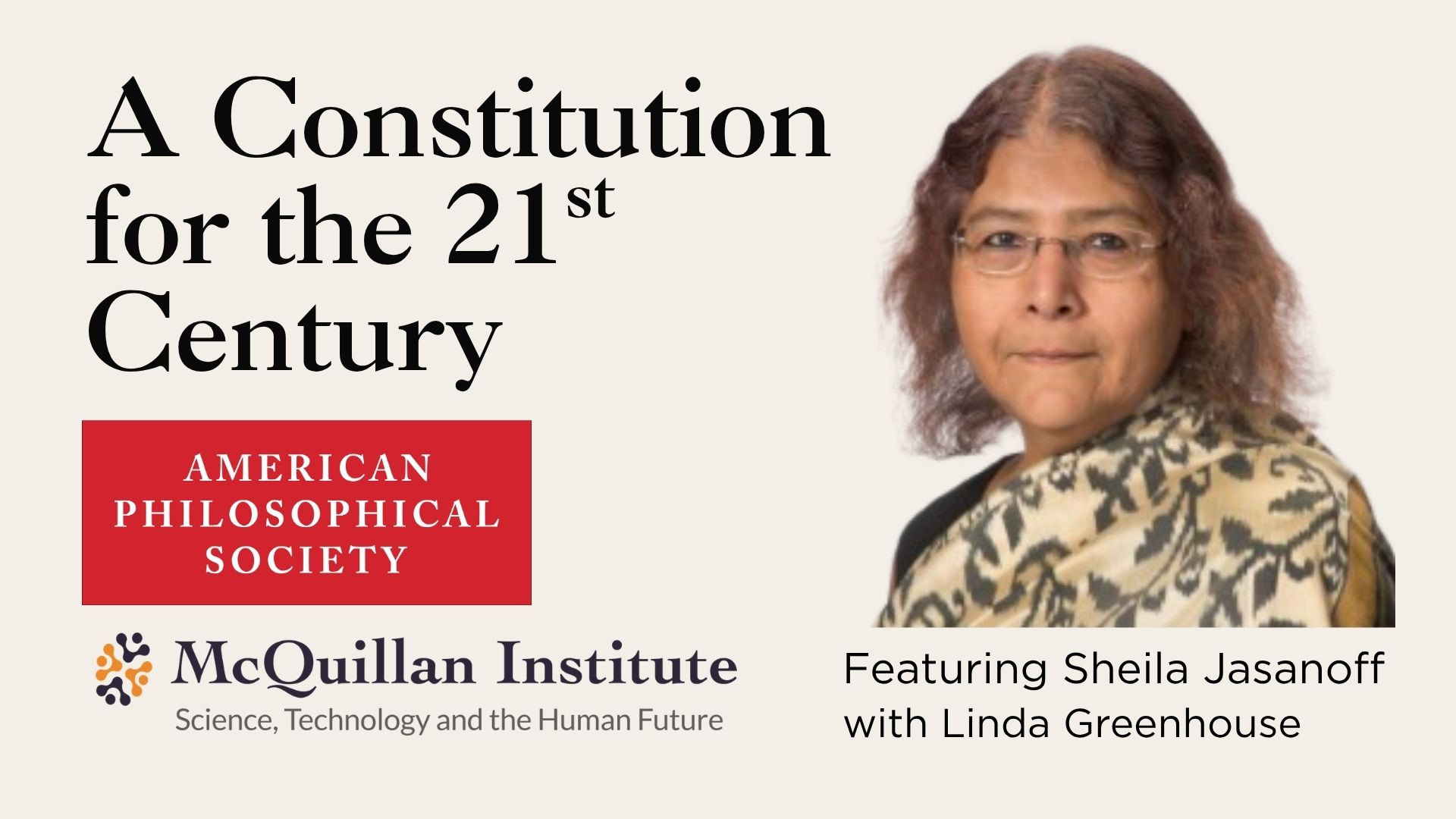
We are all today citizens of an emerging, borderless world in which technologies for managing data, genes, and climate can regulate our lives and reshape the meaning and purposes of being human, as well as being political actors. Recent striking retreats from the democratic principles that animated much of the 20th century are inextricably linked to developments in science and technology. Yet decisions about how these technologies should be deployed are taken largely outside the purview of democratic processes. The rights, duties, and entitlements of humans are often treated as subordinate to the goals of technological efficiency and economic growth. In short, science and technology have supplanted democracy in ordering our lives and, in so doing, have become ends in themselves.
Join the American Philosophical Society and the McQuillan Institute for Science, Technology, and the Human Future on Thursday, October 29, 2026 to welcome Sheila Jasanoff (APS 2021), Pforzheimer Professor of Science and Technology Studies at the Harvard Kennedy School, for a lecture on "A Constitution for the 21st Century." Fellow APS Member Linda Greenhouse (APS 2001) will offer a response.
Prior to the evening's lecture, there will be a half-day, interdisciplinary workshop that explores topics in science, technology, and democracy. The public is welcome to attend all sessions.
Panel Descriptions
Panel 1: American Citizenship and Public Reason since 1776
At the 250th anniversary of the United States, democratic governance confronts a central paradox. From its founding, the US government has struggled to define the proper relationship between “the people” and their elected representatives, through both federal and state constitutions. Political theory and practice are preoccupied with the legitimacy of those elected to make decisions in our name. We have, however, left largely implicit the constitutional status of the experts and institutions tasked with knowing for the people. From Jefferson’s faith in citizens’ enlightened rationality to the recent Supreme Court ruling against “expert agencies” in Loper Bright v. Raimondo, American politics questions how far experts, by virtue of specialized knowledge, have a right to govern in our name. This panel interrogates how ideas of what citizens should know and how they should be governed are linked in American politics. How are the few empowered to know for the many? What visions of citizen understanding are embedded in institutions and processes of public reasoning? And how, over time, has the American public held experts to account?
Panelists:
- Professor Bentley Allan, Johns Hopkins University
- Professor D. Graham Burnett, Princeton University
- Professor J. Benjamin Hurlbut, Arizona State University
- Professor Sophia Rosenfeld, University of Pennsylvania
Panel 2: The Ethics of Invention at the Frontiers of Life
The rights to “life, liberty, and the pursuit of happiness” enjoy a central position in our civic lexicon. More often than not, the interpretation of these words turns upon the meaning of the word liberty. Recent developments in the biosciences and technologies, however, have destabilized our understanding of the meaning and worth of human life. Biotechnologies are increasingly developing the power to control the dynamics of life, from reproduction to aging and dying, raising difficult questions of what counts as life and which interventions society sees as impermissible. Biotechnological developments often transcend the territorial boundaries of nation-states and concentrate power outside of democratic processes. This panel juxtaposes perspectives from the creative arts, law, bioethics, and cutting edge science to reflect on the challenges posed to the dignity of human life as knowledge and technology advance. What are the responsibilities of scientists, citizens, ethical experts, and the state in steering technologies with the potential to redefine what it means to be human? How can societies navigate between competing notions of progress and risk? And how can we imagine a politics that embraces the desire for new knowledge while also respecting the dignity of human life?
Panelists:
- Yoi Kawakubo, artist and filmmaker
- Professor Adriana Petryna, University of Pennsylvania
- Professor Kiran Musunuru, University of Pennsylvania
- Professor O. Carter Snead, University of Notre Dame
Provisional Program (Subject to Adjustments)
● 3:00 Panel 1 – American Citizenship and Public Reason since 1776
● 4:00 Coffee Break
● 4:15 Panel 2 – The Ethics of Invention at the Frontiers of Life
● 5:15 Reception
● 6:00 Welcome and Introduction
● 6:05 Public Lecture -- A Constitution for the 21st Century with Sheila Jasanoff
● 6:50 Closing and Adjourn with Linda Greenhouse

Bentley Allan is Associate Professor of Political Science at the Johns Hopkins School of Advanced International Studies (SAIS) and an affiliate of the Ralph O'Connor Sustainable Energy Institute at Johns Hopkins University. His research and policy engagement address the political economy of decarbonization, clean energy supply chains, industrial policy, climate geopolitics, the history and theory of international order, and the role of science in politics. Professor Allan is founder and co-director, with Tim Sahay, of the Net Zero Industrial Policy Lab (NZIPL). The lab joins the technical analysis of clean energy supply chains with the study of net-zero industrial policy to provide actionable advice to policymakers and decision-makers.

D. Graham Burnett is the Henry Charles Lea Professor of History and History of Science at Princeton University. The founder of the non-profit Institute for Sustained Attention, Burnett currently heads the Institute’s flagship project, the Strother School of Radical Attention. Recent related collaborative books include: Twelve Theses on Attention (Princeton, 2022); Scenes of Attention: Essays on Mind, Time, and the Senses (Columbia, 2023), and Attensity! (Crown, 2026), the latter a manifesto of the international “Friends of Attention” coalition. His next book, Till the Light Leaps: Essays on Playing Attention, is forthcoming from the University of Chicago Press in early 2027.
J. Benjamin Hurlbut, PhD is Professor in the School of Life Sciences at Arizona State University. He is trained in science and technology studies (STS) with a focus on the history of the modern biomedical and life sciences, and his research lies at the intersection of intersection of STS, bioethics and political theory. He studies the changing relationships between science, politics and law in the governance of biomedical research and innovation, examining the interplay of science and technology with democracy, religious and moral pluralism, and public reason.
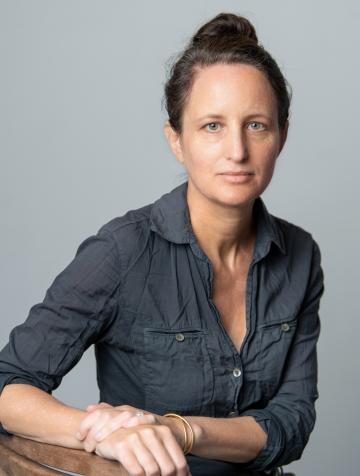
Sophia Rosenfeld is Walter H. Annenberg Professor of History and former chair of the Department of History at the University of Pennsylvania, where she teaches European and American intellectual and cultural history with a special emphasis on the Enlightenment, the trans-Atlantic Age of Revolutions, and the legacy of the eighteenth century for modern democracy. She is also currently (2026-28) directing Penn's Society of Fellows in Public Knowledge and the SAS Commons on the theme of Democracy and Knowledge.

Adriana Petryna is Professor in Anthropology and directs the MD-PhD program in Anthropology at the University of Pennsylvania. In her ethnographic studies in Eastern Europe and the United States, she probes the socio-political natures of science, how populations are enrolled in experimental knowledge-production, and what becomes of citizenship and ethics in that process. She is the author of the award-winning books, including Life Exposed: Biological Citizens after Chernobyl and When Experiments Travel: Clinical Trials and the Global Search for Human Subjects, and is co-editor of Global Pharmaceuticals: Ethics, Markets, Practices and When People Come First: Critical Studies in Global Health. Petryna’s concepts of biological citizenship, ethical variability, and experimentality have advanced the critical social scientific study of environmental disasters, biomedical research and equity, and global health. Her new book, Horizon Work: At the Edges of Knowledge in an Age of Runaway Climate Change, examines the climate crisis through the lens of “horizoning,” a mode of reckoning that considers unnatural disasters against horizons of expectation in which people and societies can still act. She focuses on experiments probing planetary points of no return as well as the stories of wildland firefighters, for whom trust in patterns becomes an occupational hazard. A Guggenheim Fellow, Petryna’s research has been supported by the National Science Foundation, the National Endowment for the Humanities, the Wenner-Gren Foundation, the Social Science Research Council, and the School for Advanced Research. She was a Member of the School of Social Science at the Institute for Advanced Study and a Faculty Fellow at Princeton University’s Center for Human Values. At Penn, Dr. Petryna also directs the undergraduate concentration in Medical Anthropology and Global Health.
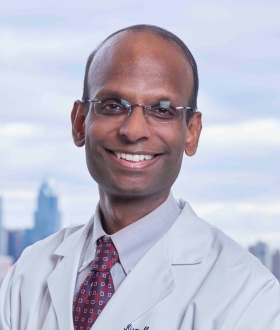
Kiran Musunuru, M.D., Ph.D., M.P.H., M.L., M.R.A., is the Barry J. Gertz Professor for Translational Medicine in the Perelman School of Medicine at the University of Pennsylvania. His research focuses on the development of novel gene editing therapies for the treatment of cardiovascular and metabolic diseases. He is a recipient of the Presidential Early Career Award for Scientists and Engineers from the White House, the Pennsylvania Governor's Keystone Award, the American Heart Association's Award of Meritorious Achievement and Joseph A. Vita Award, the American Philosophical Society's Judson Daland Prize for Outstanding Achievement in Clinical Investigation, the American Federation for Medical Research's Outstanding Investigator Award, Harvard University's Fannie Cox Prize for Excellence in Science Teaching, and the University of Pennsylvania's Jane M. Glick Graduate Student Teaching Award. He recently served as Editor-in-Chief of the scientific journal Circulation: Genomic and Precision Medicine and is the current Editor-in-Chief of The American Journal of Human Genetics. He is author of The CRISPR Generation: The Story of the World's First Gene-Edited Babies and Genome Editing: A Practical Guide to Research and Clinical Applications.
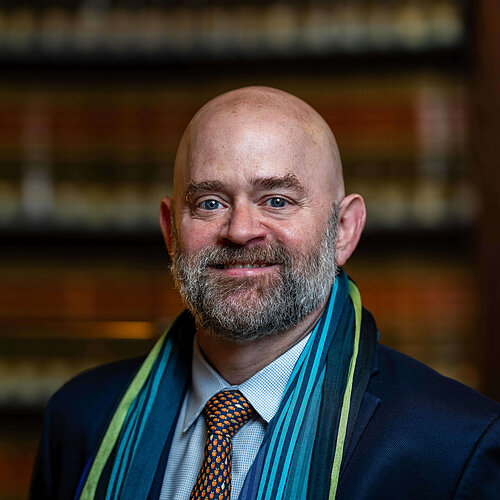
Professor O. Carter Snead is one of the world’s leading experts on public bioethics – the governance of science, medicine, and biotechnology in the name of ethical goods. His research explores issues relating to neuroethics, enhancement, human embryo research, assisted reproduction, abortion, and end-of-life decision-making. He is the author of What It Means to be Human: The Case for the Body in Public Bioethics (Harvard University Press, October 2020), which was named by the Wall Street Journal as one of the “Ten Best Books of 2020;” in his review for the same paper, Yuval Levin called it “among the most important works of moral philosophy produced so far in this century.” In May of 2022, it was listed in The New York Times as one of “Ten Books to Understand the Abortion Debate in the United States.”